Showing posts with label labor unions. Show all posts

Sunday, September 1, 2013

Protests and clashes continue in Mexico

Images of the clashes before the Congressional Palace in Mexico D.F.:


These clashes took place at the crossroads between Venustiano Carranza and Eje Central, as granaderos (riot police) managed to surround some 50 youths who attempted to reach Congress by any means necessary.

There were previous clashes at the crossroads between Juárez Av. and the Paseo de la Reforma, as the police attempted the march to continue but were overwhelmed by youths who pushed them aside at the cry of "not violence!"

A perpendicular march of teachers to the Presidential Palace also took place. Regarding this march, the Revolutionary Action lamented that the CTNE (teacher union) autocratically revoked an assembly decision by the teachers to invite students to join their march, reason why this organization ignored this particular demonstration. 

Source: Webguerrillero[es].

Update: more videos of the clashes now at Webguerrillero.

Monday, July 29, 2013

Tunisia: protests and riots after second murder of Left leader

Protests and riots took over Tunis and the mining towns of Sidi Bouzid and Meknassi after Mohamed Brahmi was murdered by Islamists. In February another communist, Chokri Belaid, was also murdered with the same weapon, it seems. 

These crimes aggravate the confrontation between the revolutionary opposition and the reactionary Islamists (Enhada) in power, which practice brutal neoliberalism. 

The protesters in Tunis demanded the resignation of the government and new elections but the Prime Minister Ali Larayedh rejected this possibility, although he announced presidential elections for the end of 2013.

The main labor union, the UGTT, called for a general strike and warned that these murders will lead the country to a bloodbath.

In Sidi Bouzid the demonstrators set fire barricades and also burned down the see of the ruling party, something that also happened in the nearby town of Meknassi. Police attacked them with tear gas. 

Source: Webguerrillero[es] (link 1, link 2).

Wednesday, July 10, 2013

Andalusia: union leader arrested

Diego Cañamero, leader of the militant Andalusian Workers Union (SAT) was arrested yesterday after he rejected to pay homage to bourgeois injustice by not going to court to declare on the workers struggle for the collectivization of Las Turquillas ranch, owned by the Spanish military. 

Plain clothes policemen arrested him at the Worker Center of El Coronil, where he and dozens of supporters were awaiting the announced arrest.

The demand of collectivization of farmlands in Andalusia is a popular struggle that comes from old, as most of the land belongs to aristocrats who were assigned it by the Medieval dictatorships. The workers want to collectivize the right of use of those lands (property means nothing) in order to tackle the massive chronic unemployment, which reaches 40% in many districts. 

In the words of Cañamero himself:

We do not want the property of the land, we want its use. 

...

It can't be that the lands public or private are kept aside from a people that does not know anymore what to do with unemployment. We want to demonstrate that, in the hands of cooperatives, the ranch will have another use, oriented to the creation of jobs and to extract productivity from the land and not just from EU subsidies.

Source: Borroka Garaia Da![es]

Friday, July 5, 2013

Egypt: an Anarchist vision of the 2013 revolutionary movement

Waging Nonviolence published recently an interview with Egyptian Anarchist Mohammed Hassan Aazab in the context of the massive revolutionary uprising of these last days. I reproduce here some excerpts:

(...)

Who called for the general strike? Are there particular unions involved?

No. The unions are totally ineffective.

So how is the strike organized?

Tamarod [the Rebel Movement] called for the general strike. Actually, it has not been organized in advance; it has been a spontaneous development. It will work by people believing in and supporting it.

Do you think people will follow through?

Port Said will start the general strike tomorrow. I have no idea to what extent people will follow through on it, beyond that. But it’s clear people are absolutely determined to force Morsi out.

(...)

How are anarchists organizing within this particular moment. I got the sense that some of you were involved with Tamarod, but are you playing a particular role?

No, anarchists didn’t sign onto the Tamarod declaration. Tamarod is not revolutionary at all. It was just obvious that the movement connected with millions of Egyptians, so we joined the protests. The protesters yesterday were against the idea of an Islamic dictator, but at the same time, most of them are okay with a civil or military dictator. Fuck any dictator. We’ll never forget. We’ll never forgive.

And you’ve got an anarchist tent in Tahrir, right now?
Yes. We’ve got four tents, actually.

(...)

How can people here best support you all?

By spreading the word that Obama and U.S. government are actively supporting the formation of religious states in the Middle East. The U.S. ambassador said that Egyptians should learn the meaning of democracy! Who the fuck is she to say that?


Full interview at Waging Nonviolence.

Wednesday, June 26, 2013

Turkey: union calls for new protests against police impunity

The decision of the Ankara authorities to set free the policeman who murdered Ethem Sarisuluk with an intentional gunshot has caused that the Confederation of Revolutionary Worker Unions (DISK) called for renewed protests since yesterday. 

I have no more information on this as of now. 

Source: Webguerrillero[es] (includes video of the murder of Sarisuluk).

Chile: workers and students strike together

Miners, teachers, dock and healthcare workers have gone on strike today in Chile, along with high school and university students. The demands are focused on free quality education for all, labor rights, dignified jobs and healthcare.

While the leading force in this strike is the Student Confederation (CONFECH), these have been getting closer and closer to labor organizations in the last several years in the course of struggles against privatizations imposed by the neo-Pinochetist President Piñera. This way the General Union of Dock Workers (UNTP), the Teachers' College, the Confederation of Copper Workers (CTC), the Unitary Workers Central (CUT) have joined student organizations in this strike, bringing class struggle in the Andean country one step ahead. 

Three marches will converge today at the center of Santiago de Chile, while the popular organizations are working in order to express the anger in multiple ways at each location. 

This strike is also a preparation for the General Strike of July 11th. 

Source LINyM[es].

Saturday, June 22, 2013

Italy: 100,000 march against unemployment in Rome

At least 100,000 Italians marched today through Rome in demand of jobs and tax equity. The march, called by the unions, was even backed, somewhat hypocritically by one of the two parties which support the coalition government, the Democratic Party. Of course this is nothing but posing for a photo but still the march clearly indicates that the anger in Italy against the Capitalist socio-economic chaos is growing at the same time as unemployment grows. 


Source: Webguerrillerohttp://periodicodigitalwebguerrillero.blogspot.com.es/2013/06/100-mil-trabajadores-italianos.html[es].

Thursday, June 20, 2013

Britain: the People's Assembly


what can the people’s assembly do for the people?

20 06 2013
 
This Saturday more than 3,000 people are expected to attend the People’s Assembly Against Austerity in London. John Keeley examines what it offers the people.

People's AssemblyLaunched in February 2013 with a letter to The Guardian signed by Tony Benn, President of the Coalition of Resistance (CoR), & many trade union leaders, it stated its aim as being to “bring together campaigns against cuts and privatisation with trade unionists in a movement for social justice”.

The CoR is largely a Counterfire (John Ress, Lindsey German, Chris Nineham) initiative. As such it conforms to the united-front tactic of enabling revolutionaries to engage & shape things working alongside non-revolutionary workers. By bringing together those who are essentially social democrats, wanting to defend the welfare state but not challenge capitalism, with trade unionists who have the power to lead strike action, & those who are already clear that capitalism is the problem, there is the possibility of reforms that benefit the working class leading to demands for more reforms & the eventual overthrow of capitalism.

Obviously, the success or otherwise of such a strategy largely depends upon the material conditions. As I’ve mentioned many times before, I believe that capitalism is in real trouble, & what we are now seeing is the politics catching up with the economics. In otherwords, the workers have been suffering, there’s little prospect this will end, indeed it’s more likely to increase, & hence consciousness is now changing & more & more people want to do something about it.

Finally, this is resulting in the left starting to work together, realising that petty arguments over the nature of the Russian Revolution are not vitally important, even that ‘democratic-centralism’ has been largely undemocratic & totally unappealing to today’s generation.

The word that is catching on more & more is ‘participation’. People want involvement. They want to be involved in decision-making. They are sick of the elites; whether professional politicians, bankers & other corporate fat-cats, even professional revolutionaries & trade union leaders who have constantly sold out their members. So we will have to see how much power the union leaders have & whether they are brave enough to lead the fight or become a hindrance.

The draft statement that the People’s Assembly is being asked to endorse talks about defending education, health & welfare provision. It aims to unite the anti-cuts movement & states its goal as being to “make the government abandon its austerity programme”. All limited but quite sensible. It then goes on to say it intends to “develop rapidly key policies and an alternative programme for a new anti-austerity government”. What does this mean? For many, no doubt, it will be to get the Labour party elected. The ‘One-Nation’ Labour party of Ed Miliband & Ed Balls who have no intention of reversing many of the cuts already made or proposed by the Tories in their vain attempt to convince the City, & big business in general, that they are no threat to capitalism – which they clearly are not. The Labour party are now very openly a pro-business party & therefore cannot be a party for the workers. This will be a battle to be fought by all involved in the People’s Assembly.

There are positives though. Through the building of local people’s assemblies based upon participatory decision-making, there’s a real chance that a movement based upon real people power can take on its own momentum. The union leaders & professional politicians may well find that the people do not follow them in the direction they want to go – social democracy, for many – but get a real taste of their power & ability to shape things. One of the first tests will be the proposed national day of civil disobedience on Guy Fawkes Day – 5th November. Will the more radical elements end up being disowned by the union leaders or will there be a ground-swell of support for a General Strike? As protests spread throughout the world & an economy on a knife’s-edge, where things go is quite hard to predict.

The People’s Assembly, just like Left Unity, it’s an initiative that allows revolutionaries to reach a larger number of people who are being increasingly radicalised by the current crisis. As such I think it’s a vehicle that should not be ignored. For too long now revolutionaries have held ideologically pure positions where, in their own minds at least, they are right & everyone else is wrong. Here’s an opportunity to engage with others, & although many will not agree, increasing numbers will. The world is going to change, don’t let it pass you by.

Monday, June 17, 2013

Turkey: Erdogan, against the ropes, threatens now to deploy the Army

Turkish PM T. Erdogan, cornered by the indomitable revolutionary stand of the People and facing today a General Strike, has threatened to bring out the Army (which was already present at some key points this weekend).

Unlike police, which is made up of mercenaries only, the Turkish Army is based on conscription, what makes it at least possible that one unit after another rebel against the government and the officialdom. Maybe I am daydreaming but that is exactly what happened in the Russian Revolution, completely dismantling the Tsarist state almost overnight. 

What seems clear is that if soldiers conscripted from a very angry People are forced to shoot against their fellows, they will face serious contradictions and nobody knows where that may end.


Update: mainstream opposition (CHP) leader Kemal Kiliçdaroglu has spoken in the same line, warning that Erdogan is bringing Turkey to a civil war. (→ Webguerrillero[es]).

Monday, June 10, 2013

Italy: major unions bow down and renounce to the right to strike and direct worker representation

This is the formal consolidation of fascist-like vertical unions, intended only to keep workers submitted to the tycoons' power. 

From Struggles in Italy:

June 1st saw the beginning of a new era in Italian labour policy, with a new agreement about union representation signed by the three union confederations and Confindustria (the national association of industrialists). The agreement came after a long build-up and a few months of informal meetings with industrialists, for instance, taking part in the May Day rally organized by CGIL, CISL and UIL in Bologna.

Despite the general consensus around it, this agreement seems to be a victory only for industrialists and union bureaucrats. It was welcomed by many, including Prime Minister Enrico Letta and Maurizio Landini, national Chair of FIOM (the union representing metalworkers). Ironically, those who would be most harmed by such an agreement are its most fervent supporters – this seems to be, apparently, the case of Landini.

The text of the agreement has not yet been made public; from what is known, it would underwrite the new power balance in labour relations, effectively weakening the right to strike. High-ups in the union confederations now have official recognition and a new and powerful tool in their ongoing struggle against workers’ grievances and against the most active unions – a struggle that so far has been characterized by political immobility and by acquiescence to industrialists’ diktats.

From now on, only those unions that signed this deal will be authorized to represent workers in bargaining. Agreements between unions and employers will need only to be approved by 50%+1 of all unions at the table, regardless of the size of their membership. Consequently, a few small unions (that is, a few among those that signed the deal) could form a majority and approve an agreement, thus deciding matters for all other workers.

Workers will still have some say through a referendum process. However, as the cases of Pomigliano and Turin clearly showed, these consultations often come with heavy pressure: the threat of losing one’s job is so strong that it can often determine the outcome of the vote. Unions, of course, exist precisely to free workers from such threats, through the strength of collective organization.

Once an agreement is signed, unions cannot change it. This rule is enforced through a sanctions mechanism. Workers still have the right to strike, as laid down in the Constitution of the Italian Republic. However, the unions that are supposed to guarantee this right can be fined or sanctioned for it.

Base unions and left-leaning FIOM officers have protested loudly. Among them are Giorgio Cremaschi and Sergio Bellavita, who strongly criticized their chair, Landini. As Bellavita declared: “All power is given to the leadership of union confederations – a leadership that keeps mistaking the protection of their own organization for the protection of workers’ rights.”

This deal is not valid for FIAT. Sergio Marchionne, FIAT’s CEO, withdrew FIAT from Confindustria in order to have “a free hand” with unions. This decision has already brought about the expulsion of FIOM from its plants, and the adoption of a very regressive contract.

Marchionne, with his anti-union behavior, has now opened up a way of operating that is being extended across the whole of Italy. What is worse, this is happening with the complicity of CGIL and FIOM, its metalworkers’ wing.

Wednesday, May 29, 2013

Basque Country: General Strike tomorrow

Unions' press conference
The major bloc of Basque labor unions, holding the vast majority of representativity and affiliation, and supported by a vast array of social movements (but only one significant political coalition: EH Bildu) has been calling for the last many weeks for a General Strike tomorrow May 30th in the Southern Basque Country with the declared goal of changing the social-economic model. 

The strike, which is the first of this year but follows many others in the last ones, intends to be yet another show of force by the Basque Worker People against the doctrine of austerity for the poor and growing profits and power for the oligarchy, which upholds the European Union and every single member state government, with only anecdotal exceptions. 

The enemy is tomorrow but also the rest of the year: the social and labor cuts, in money but also in rights. 

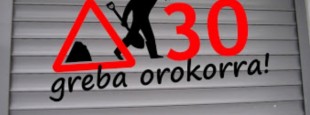
M30 GENERAL STRIKE
Dignified social and labor rights
for our own model in the Basque Country
The unions calling for tomorrow's General Strike are the two major ones: Basque Workers' Solidarity (ELA) and the Union of Patriotic Workers (LAB), as well as the smaller unions ESK, CGT-LKN and CNT-AIT, and also the important sectoral unions STEE-EILAS (education), HIRU (transport) and EHNE (farmers). Spanish-nationalist unions UGT and CC.OO. have again attempted to boycott the call by the Basque union majority but their call power is minimal and declining, very especially since they have signed "stability pacts" with the capitalists and their puppet governments that actually aim to destroy worker power in order to guarantee their own mercenary subsidies. 

EH Bildu will not take part tomorrow in the institutional activities, even if some plenaries have been mischievously called for the very day of the strike. In Navarre the majority of Parliament voted to cancel those institutional activities, however this did not happen in the Western Basque Country, showing contradictions in the proceedings of the centrist forces PSOE and PNV/Geroa Bai.

Most company committees (bodies elected by the workers to represent them) have adhered to the strike already.

Unions made a call to flood the streets tomorrow and not remain at home, shaking out fear in order to demand as strongly as possible a change in the anti-social policies of the oligarchic governments. The cliff between those who have very little and those who have a lot widens every day, they said. 

LAB's Secretary General, Ainhoa Etxaide explained that:

Big companies trading in IBEX keep having huge profits: € 25 billion last year and some € 35 billion this one. 94% of those companies have societies in tax heavens while 4% of the GDP is dedicated to pay for an illegitimate debt: almost € 40 billions.

She also said that if we stand up, if we fight back, there wouldn't be anymore talk of pension cuts...

(from Enbata)
ELA's Secretary General Txiki Muñoz claimed that today it is more democratic to take part in a general strike than in Parliament, considering the results of parliamentary debates.

The Basque General Strike is also strongly backed at international level. Among the supporting unions from outside the Basque Country are: CSC, COS and IAC from Catalonia, CIG and CUT from Galicia, CSI from Asturias, Intersindical Canaria from Canary Islands, CUT, PURNA and Intersindical de Aragón from Aragon, SAT from Andalusia, COBAS and CSC from Castile-Spain, STC from Corsica, NPA and Solidaires from France, USB from Italy, PAME from Greece, PEO from Cyprus, CTA from Argentina, CTB and CGTB from Brazil, Únete from Venezuela, CITU and AITUC from India, etc. The strike is also backed by World Union Federation (representing 82 million workers), the Platform of Stateless Nations' Unions and sectoral union world federations (public services, metal and mining, construction and wood, etc.)

As usual, I won't work in my blogs for the 24 hrs of the strike journey, excepted maybe to report here on the strike itself.

Partial source: Gara[es].

Major marches to be held tomorrow (Berria)


Note: those from Bilbao can find some information on a wild array of planned struggle activities (pickets, marches, etc.) at Bilboko Branka and Elkartzen Bilbo sites (in Basque and/or Spanish). See you around.


Sunday, May 26, 2013

Portugal: massive demo demands the resignation of the government


Thousands demonstrated in Lisbon rallied by the labor union CGTP and the Fuck the Troika movement crying "out with the government", "no to exploitation and impoverishment". 

Source: Webguerrillero[es].

Saturday, May 18, 2013

Italy: massive protest in Rome, worker partial success in Milan hospital struggle

Thousands demonstrated today in Rome against the austerity-for-the-poor bourgeois doctrine and the coalition government that wants to implement it. 


In Milan, after months of harsh struggle, workers finally reached a semi-satisfactory agreement with the direction of San Rafaele Hospital, by which all workers will remain under public jurisdiction and fired workers will be readmitted. In exchange workers accepted a salary cut of 9%. 

The worker struggle has been led by grassroots assemblies called by the anarchist USI-AIT and the grassroots USB unions. All major unions, with the partial exception of CGIL, were absent in this fight. CGIL signed a much worse agreement which was rejected by worker assemblies. 


Thursday, May 9, 2013

Basque Country: police evicts workers protesting in Basurto Hospital

Police forces entered today at the main hospital of Bilbao, Basurto Hospital, where some 50 workers were exerting a peaceful protest against budgetary cuts and healthcare privatization.

The action began this morning at 7:00 after 100,000 signatures had been gathered and sent to the Western Basque Health Service Osakidetza, whose politically appointed direction rejected to meet the representatives of the workers, backed by absolutely all the unions (SATSE, ESK, ELA, UGT, CCOO, LAB, SME and FFHE). As result the workers wen to Autonomous Parliament where they held meetings with all political forces excepted the ruling Basque JEL-ist* Party (EAJ-PNV, holding in extreme minority a highly unstable government with just 27 of the 75 seats), who refused to meet them. 

By 12:30 police forces in riot gear evicted them forcibly, taking them out one by one, as they performed nonviolent resistance. This happened in spite of the agreement between workers and hospital direction to remove a camping tent they have placed in the entry hall of the hospital. 


Source: Elkartzen[es].

___________

* JEL stands for Jainkoa ta Legi Zarra (God and the Old Law) and is how the Basque Nationalist Party defines itself in non-Indoeuropean language: JELtzale: JEList, possibly translatable as Fundamentalist-Traditionalist or something like that. It is the main party of the Western Basque middle and small bourgeoisie (big bourgeoisie rather look at Spanish parties) and under a pretense of nationalism or independentism it actually manages regionalist policies instead, almost invariably in agreement with Madrid.

Italy: workers force police to retreat in healthcare strike march in Milan

Yesterday health workers across Lombardia went on strike, with protests in the streets of Milan that resulted in scuffles with the police. 

The moments of tension came as police attempted to curtail the right to demonstration violently, impeding the marchers access to the regional government building. However workers and patients (recently evicted from a popular occupation at Milan's State University) drew their own batons and forced the police forces to withdraw, reaching their desired endpoint for the march. 

The trigger of the protests was the firing of 244 workers at San Rafaele Hospital, however the shadow of further cuts and redundancies looms over the public healthcare in all Italy.

Wednesday, May 8, 2013

Basque Country: capitalist syndicate headquarters occupied in Navarre

Some 30 labor unionists of the Patriotic Workers' Union (LAB) occupied this morning the see of the capitalist syndicate (Confederación de Empresarios de Navarra) in Iruñea-Pamplona. Their demands: continuity with content of the sectoral and provincial collective agreements because while the working people is suffering the oligarchy is making huge profits.

Follows video of the action (discourse in Spanish):


Source: Ateak Ireki[es].

Thursday, May 2, 2013

Andalusia: workers occupy state-owned farmland

Some 500 workers occupied yesterday the parcel known as Las Turquillas, owned by the Spanish Ministry of Defense. Police evicted them at night but the workers have decided to keep pressure at the gate of said farmland.

The direct action has been organized by the Union of Andalusian Workers (SAT) and the 'Critical Bloc' (coalition of many organizations against "austerity").

The same organizations mustered thousands of workers yesterday in Seville and Granada. In Jaén, some 400 union members attempted to occupy the ranch La Rueda but were blocked by police forces. In Lebrija some 100 workers also marched to the ranch Lebrojo.

Source: Kaos en la Red[es].