Showing posts with label Socialism. Show all posts

Sunday, September 8, 2013

Mexico: thousands march again against privatization of PEMEX

At least 30,000 people marched through D.F. in rejection of the project to privatize the state oil company PEMEX, one of the legacies of the Mexican Revolution, now a century old. 


Source: Webguerrillero[es].

Sunday, August 25, 2013

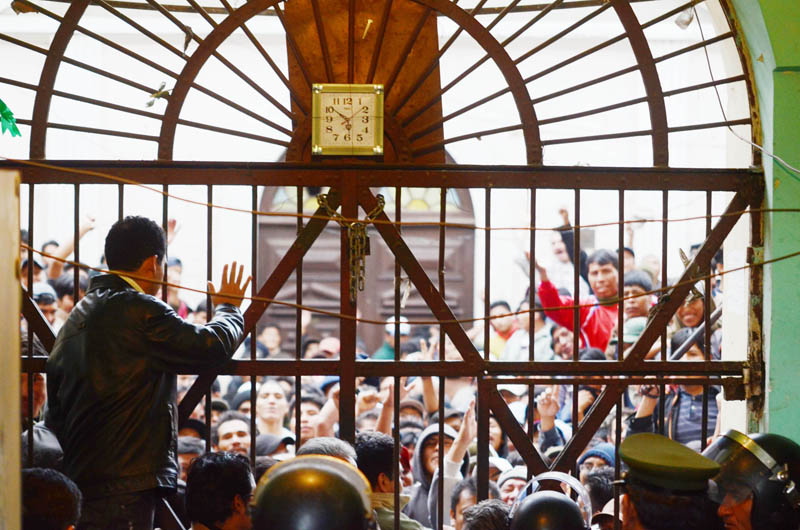
Bolivia: prisoners riot: "crime is not punished, poverty is"

In another example of the very limited progress achieved by the Bolivarian governments of Latin America, whose model is in essence developist socialdemocracy, Bolivian prisoners have risen up against a regime that punishes the poor and is getting worse by means of punishments that disperse the inmates the system wants to punish (not necessarily those deserving punishment). 


Bolivian prisons rise up


“When a prison riot starts, even those who accept the rules of society are roused by the noble temptation of freedom; when the ceilings of the prisons are pulled off by fire or rebels, we throw their hands off our shoulders and identify the enemy.”

Editor’s note: In their zeal, these words have no intention of victimizing the prisoners of the Bolivian State, but rather simply describing events that took place in the jails here. The echoes of our anarchist will reach those living confined in the State’s cold slave pens.

Mass riots in Bolivian jails began a year ago, calling for the resignation of Ramiro Llanos, the director of the penal system; demanding an end to delays of justice, “humane” treatment, and transportation to hearings. Foreign prisoners demanded to be sent to their countries of origin, and everyone demands an increase to the daily expenses that feed each individual [prediario]. Added to the protests is the unfulfilled agreement signed in February 2013 between the prisoners in San Pedro (La Paz) and the penal system, which brought a recess and a suspension of the riots, giving a period of three months for compliance with all of the agreed-upon points. Ramiro Llanos denied knowledge of this document, and to this day the prisoners’ demands have not been met.

The State plans to apply new rules on the penal system that fix harsher conditions for prisoners as well as visitors. They are ordering the systematic transfer of prisoners from San Pedro to other panopticon-style prisons far from the city of La Paz. They plan on not receiving new prisoners beginning on July 17th, and have announced the closure of this prison as a repressive measure against the constant protests that have arisen in the La Paz penitentiary. The riots are frequent, and the State intents to break them up through the transfer of prisoners to more distant jails. The transfer of the San Pedro inmates [that oftentimes live with their families on the inside] will cause more isolation due to the distance of the prisons where they are to be sent; this will mean that their families will have even more difficulty visiting them, since 80% of the prisoners and their families are poor.

Summary of the 2013 riots

On January 17th Llanos (director of the penal system) was taken hostage by the prisoners in San Pedro as a response to the constant threats to move them to other prisons if they mobilize or make demands. The repressive forces confronted the prisoners to rescue him. Llanos saved himself thanks to a few prisoner delegates, who prevented him from being strung up. Protests were unleashed as prisoners resisted the plan for 39 minors from the Calahuma Center for Youth Rehabilitation to be transferred to San Pedro in La Paz. After that day, Llanos no longer had the guts to reenter that combative prison. During the whole month, the prison was in a state of mutiny and riot, with all nine sections taking over all of the jail buildings. Flames were seen on the roofs and yards.

On this latest 10th of June, prisoners in the territory began new uprisings and protests, condemning the fact that only four of every hundred preliminary injunction hearings take place, while the rest are suspended. The principal slogan was a call for the resignation of Llanos. The State’s intention is to close the San Pedro prison, sending the convicts to the “Chonchoro” maximum security prison, and those less than 25 years of age to the Calahuma Center for Youth Rehabilitation, and the preventive prisoners to jails in Patacamaya and Sica Sica, hundreds of kilometers from the city of La Paz, as a reprisal and punishment for the fact that this prison has been in a state of emergency since 2012, demanding the director’s resignation.

Beginning on June 24th, simultaneous protests were initiated in the jails of El Abra in the city of Cochabamba and San Pedro in the city of Oruro. They demanded that their water and electrical services not be cut, as the State had not paid the bills.

On June 26th, the reaction in the Chonchocoro maximum security prison did not wait long after the announcement that prisoners from San Pedro would be transferred there.

On July 2nd, the Chonchocoro and Calahuma prisons protested and announced that they would be in a state of alert, facing the possible transfer of inmates from another prison, which would cause overcrowding in both facilities.
We hope for unity and solidarity among prisoners in Bolivian territory, and that they don’t let the State divide them by “sectional negotiations” (turning one group against the other), as it has frequently done to end riots.

Poverty is punished with prison 

“Crime is not punished, but poverty is.”(Words of an elder in the San Pedro prison)

In the prisons here, the majority of the population is poor. Nevertheless, the wealthier can live more comfortably, because cash rules. The poor have to survive miserable conditions, sickness, and destitution. For example, in the jail of San Pedro in La Paz the maintenance of cells, infrastructure, recreational space, the kitchen, cleaning materials, medications, and other goods are self-directed by the prisoners themselves. The State has knowledge of this context, but in its insensitivity and contempt toward the poor, it forces them to pay for their stint in prison with their own resources.

It is the poor who feel the harsh impact of prison society, both those in the hands of a judge who will determine whether or not they go to jail, and the preventive prisoners who must show that they have an established family, a home, personal guarantors, or an economic guarantee or job. All of these factors diminish one’s ability to move to house arrest. Thus, the question is: Are all prisoners in an economic position to benefit from this? The permanence of a poor majority in prisons is continually perpetuated, and for them the penal system is even harsher, with scarce opportunities to get out. The maximum period of preventive detention is 36 months. In Bolivian prisons, there are preventive detainees who have been in for more than three years without being sentenced (in some cases five or eight years). This cruel setting causes intentional overcrowding in prisons, and ensures that they are filled with the poor. The State is going to implement one more condition for release into house arrest: If a prisoner wants to get out, they must buy an anklet with a GPS chip at a cost of $4,000. This will only benefit those who have the ability to pay the cost. For those without means, there is only the hope that one day they will be able to get out. There are many older prisoners, and many with medical conditions, who request a move to house arrest; with the pardon law passed on December 24th, 2012, very few walked free. There is no adequate medical care or efficient method for medical leave, even in cases of emergency treatment. While bureaucratic paperwork slows everything down, the result of this inefficiency is that individuals’ health continues to deteriorate, and in many cases prisoners die from lack of medication or medical attention. Additionally, after being imprisoned it is difficult to find a job with a prior criminal record. This is all permitted by the State’s indifference.

In the maximum security prison of Chonchocoro, located in Viacha, there is no potable water; they have only one well to provide their water, which is still not potable.

Life in prisons in Bolivia is determined by one’s economic status. The majority have to work at whatever they can to survive and pay for their housing, bed, blanket, medication, and other goods. Among prisoners, food and clothing is bought and sold, and everything is a commodity. Prison makes visible the misery of an authoritarian society that chooses who to protect and who to leave in the dungeon.


The complicity of Press and Power

The role of yellow, sensationalist journalism is to adjust “information” to state versions, causing prisoners to be seen with disdain, and causing a broader “societal” rejection for them.

To this day, the penal establishment has diverted attention in other directions thanks to collaborationist coverage from the Press. As well, they have claimed that there was a supposed child rape in San Pedro, and that there is a drug lab inside the La Paz prison; these facts were made up by Llanos, but were refuted by the prisoners.

The State has succeeded in minimizing and smearing the prison riots through yellow journalists, as well as the frequent threats to send the prisoner representatives to other prisons, as they have them identified. The servile role of the disinformation media packages all of this to create an unfavorable situation for the prisoners. In San Pedro, they agreed voluntarily to the removal of children older than 11, and on July 8th they met again with state representatives and agreed to include all children older than 6 years of age.

Repudiation of rapists

In the Palma Sola jail, in the city of Santa Cruz de La Sierra, it came out that minors had been sexually abused. These deeds are detestable, and we repudiate them. Lamentably, this happens not only in Bolivian prisons where children live, but also in schools, churches, shelters, and orphanages, while these same spaces are also prisons by other names. Ramiro Llanos, director of the penal system, used these detestable acts to generalize about all prisoners, and take advantage of “public opinion.” Among the San Pedro prisoners, a collective agreement to prohibit the entrance of inmates who had committed rape emerged as another means of struggle. From the posters that remain on the walls and door of the prison, they do not simply call for Llanos to resign, but call for the prison population to reject rapists.

The State’s well known repressive strategy is the division, infiltration, intimidation, and punishment to make an example of individuals; thus the government is able to weaken, divide, and break up movements through negotiations per prison section. The increase in conditions of control and surveillance in the penal system are part of the maintenance of bourgeois society. It is thought that prison is the solution for “citizen security” or to reduce “delinquency.” Through this paradigm the State’s only real intention is to protect privileges and maintain the interests of the rich. This background undeniably shows us, for example, that some steal to eat, while others infringe on the law in order to avoid complicity with the impositions of this decadent society. Prisons in Bolivia, as in the world as a whole, reflect this society on a small scale; they are small cities wherein the imperfections of the system we live in are made visible: There are the privileged, the poor, those who serve as snitches for the police or administrators of “justice.” There are drugs and alcohol in prisons because the same administrators and police want these small worlds to rot with vice and sicknesses. Thus, as Power secures the privileges of the State/Capital, it shows its disdain for the poor and those who struggle against it.

Anarchist solidarity is extended to those who suffer punishment, those who do not bend to norms, those who survive in any way they can while the powerful exploit and destroy the earth. This is a humble call to struggle for a different world than the one that they have imposed on us.

Fight against the State with all your strength; the constant wait for a generalized mass revolt is a truly utopian desire that only perpetuates, strengthens, and assures the enemy’s continued existence. Move to the offensive, conspire, act; there is no reason to wait for the masses to rise, or for the appropriate conditions. While we are waiting, authority, repression, surveillance, and punishment are extended ever stronger against the poor and those who have decided to take the offensive. Attack loving that which you dream and feel inside, and hating society’s penury.

We do not forget our comrades who are locked up in the hateful enemy’s dungeons. Neither do we forget those who have decided to flee, showing their rejections of state persecution in a society that is falling apart and needs prisons to keep us scared and allow itself to continue. To our comrades: our sincerest greetings, laden with anarchist complicity.

Towards a community of free association and informal organization, without prisons, State, or Capital.

Fire to the prisons, fire to authority, solidarity with the prisoners in Bolivian territory!

Saturday, August 24, 2013

Marx as "Anarchist"

Or almost. Maybe more like modern Autonomists.

The Commune publishes today a very interesting article by David Adams questioning in depth the notion of Marxism, or more precisely Marx' own thought, as authoritarian and statist, being in fact quite different from the Leninist model (as well as from the Socialdemocratic or Bersteinian one).

A key excerpt on the dictatorship of Proletariat as being nothing but radical grassroots democracy:
A little-known text by Marx, his 1874 “Notes on Bakunin’s Book Statehood and Anarchy,” explains the concept of proletarian dictatorship more clearly than any other. In his book Bakunin ridicules Marx’s concept of the transitional state power of the proletarian dictatorship, and Marx critically responds in his “Notes.”  Bakunin writes, “If there is a state, then there is domination and consequent slavery. A state without slavery, open or camouflaged, is inconceivable-that is why we are enemies of the state. What does it mean, ‘the proletariat raised to a governing class?’”26 Marx responds, “It means that the proletariat, instead of fighting in individual instances against the economically privileged classes, has gained sufficient strength and organisation to use general means of coercion in its struggle against them; but it can only make use of such economic means as abolish its own character as wage labourer and hence as a class; when its victory is complete, its rule too is therefore at an end, since its class character will have disappeared.”27 The claim that through revolution the proletariat will be “raised to a governing class” thus has nothing to do with creating a dictatorship of a political sect, but is rather a claim that the proletariat will use “general means of coercion” to undercut the bourgeoisie’s power (by abolishing the private ownership of the means of production, disbanding the standing army, and so forth). It is the entire proletariat that is to exercise this power.  Bakunin asks, “Will all 40 million [German workers] be members of the government?”28 Marx responds, “Certainly! For the system starts with the self-government of the communities.”29

Can there be a more Anarchist statement? Or rather we may want to describe it as genuine Communism. 

Another excerpt: Leninism as Blanquism:

Blanqui, for example, advocated an educative dictatorship of a small group of revolutionaries. Marx’s use of the word “dictatorship” in the phrase “dictatorship of the proletariat,” however, is original and deliberately distinct from Blanqui’s usage. Engels emphasizes this point in a passage on Blanqui: “From the fact that Blanqui conceives of every revolution as the coup de main of a small revolutionary minority, what follows of itself is the necessity of dictatorship after it’s success-the dictatorship, please note, not of the entire revolutionary class, the proletariat, but of the small number of those who made the coup de main and who themselves are organized beforehand under the dictatorship of one person or a few. One can see that Blanqui is a revolutionary of the previous generation.”37 It is clear that the Leninist model of a particular sect or political party exercising political power is much closer to the Blanquist conception of “dictatorship” than to Marx’s (...)

Much of the divergence between Anarchists and Marx seems merely semantic: the use of the word "state" (polity):
For Marx, this form of power can be a “state” from the perspective of its political, coercive function of uprooting the foundations of the rule of capital. It cannot be a “state” in the sense of a “parasitic excrescence” usurping power from the mass of workers.50

Again much closer to Kropotkin or Durruti than to Lenin, never mind Stalin.
Marx saw the mandated and revocable delegates of the Commune as an example of working class state power in action.

Mandated and revocable delegates? Isn't that precisely what Anarchists propose?

So what do Marx and Engels mean by "state" and "class dictatorship"? In the words of Richard N. Hunt:
The full-time army as parasite disappeared, but the part-time National Guard remained as the coercive instrument of the workers’ state. Here in sharpest focus one can perceive Marx and Engels’ double usage: the parasite state is to be smashed immediately; the state as instrument of class coercion is to remain until the need for it fades away.

A people's militia under popular command, it seems.

The criticism of bourgeois "democracy" and state is persistent and merciless, and Engels charged against the USA as archetype of this separation between society and state by means of ritual and pointless elections:
Nowhere do “politicians” form a more separate and powerful section of the nation than precisely in North America. . . . It is precisely in America that we see best how there takes place this process of the state power making itself independent in relation to society, whose mere instrument it was originally intended to be. Here there exists no dynasty, no nobility, no standing army, beyond the few men keeping watch on the Indians, no bureaucracy with permanent posts or the right to pensions. And nevertheless we find here two great gangs of political speculators, who alternately take possession of the state power and exploit it by the most corrupt means and for the most corrupt ends-and the nation is powerless against these two great cartels of politicians, who are ostensibly its servants, but in reality dominate and plunder it.

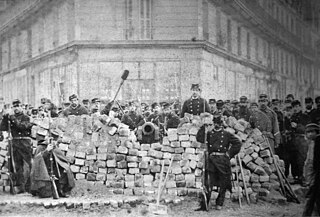
Naturally, although many have forgotten, the term Communism itself derives from commune (municipality or local government in French and other languages) and very specifically from the 1871 Paris Commune.

In this pioneering communist "state", not just the army became part of the people in full but the whole state did by suppressing the bureaucracy and getting managers to be paid common workers' salaries and be under the command of the People directly. Totally different to what happened in the Soviet Union.

Marx did not live to see the Russian Revolution but he witnessed the beginnings of the rise of what is now the Socialdemocracy, especially in France and Germany. It was then when he famously declared "I am not a Marxist myself". He was very critical of Lassalle and his socialdemocratic or proto-Keynesian ideas of building socialism from above by means of state loans and other nonsense. 

One of the key issues is democratic centralism, centralization or central planning. In this certainly Marx and Bakunin were very much at odds:
While Bakunin was a sworn enemy of all political and economic centralization, Marx had a very different perspective, but one that was in no way more “authoritarian”: “National centralization of the means of production will become the natural basis of a society composed of associations of free and equal producers, carrying on the social business on a common and rational plan.”70 Marx thought that both centralism (a common plan) and democratic control from below were necessary for building socialism.

Read the original article, "Karl Marx and the State", at The Commune.

Tuesday, June 25, 2013

Britain: The People's Assembly gathers


the people’s assembly: the fight-back begins?

24 06 2013
 
The gathering of over 4,000 people at the People’s Assembly Against Austerity in London on Saturday 22nd June was truly inspirational. To be together with so many who regard profit as a dirty word & who want a world based upon more humane values, such as equality, solidarity & dignity, it’s hard not to believe that there will be a fight-back. But as useful as it is to raise spirits, John Keeley attempts a more objective analysis of what the People’s Assembly potentially offers.


Will the People’s Assembly stop austerity? To do this it would need to bring down the Con-Dem coalition & reclaim the Labour Party as a party fighting for the class interest of the workers. The first part is relatively easy compared to the second. Indeed, the fact that Labour haven’t stood up for the workers is the main reason why the coalition has had a relatively easy time of it to date. Although there are still many good people in Labour, the leadership & the vast majority of MP’s care first & foremost about their careers. They want power & from their rationale this means not upsetting corporate interests. Hence on the same day as the People’s Assembly, Miliband gives a speech saying he won’t reverse the cuts. How much more evidence do you need of the pro-business nature of the Labour Party?

Labour is lost in history. Just as capitalism faces potential collapse & the case for socialism needs to be made more than ever, Labour are found missing. Labour only offer a vision of revitalised capitalism providing tax revenue for public-private initiatives financing public-private provided services. The promise of better healthcare & education funded by a buoyant capitalism that somehow produces ‘social entrepreneurs’ who have a social conscious, once of course they have made their millions. It’s the ideology of liberals who want to be remembered as ‘good individuals’. Blair, Brown, Miliband, they are all the same.

So can Labour be reclaimed? An optimistic scenario would have the People’s Assembly amassing support from a large section of the population & scoring victories over the coalition so that it falls & the new Labour government, in their gratitude to the unions, giving them a bit of say & launching a Keynesian fiscal stimulus – more investment, more jobs, more union members. A new boom then boosts the coffers in the Treasury enabling a confident, more self-assured Labour to renationalise the railways & the public utilities, as well as investing in the NHS & a fully state-controlled comprehensive education system. A return to the hope of 1945 & the parliamentary road to socialism.
Rather than optimistic, this is delusional. Only those who have no understanding of the nature of capitalism today can entertain such a possibility. Unfortunately, that’s the vast majority in the unions & the Labour Party. The problem is the confusion between the vast wealth created by capitalism & the fact that capitalism only produces for a profit. On top of that is the nature of debt & how it artificially supports profit rates. These are not easy subjects. This is why it is essential for those of us who have studied capitalism & the nature of its crises to engage with the leaders of the People’s Assembly to show them that social democracy – capitalism with a strong welfare state – is not a realistic possibility.

There is no Keynesian solution. Capitalism cannot be reformed. For there to be true democracy where the people are both legislature & executive, requires not just the common, social ownership of the means of production, but a whole new approach to politics. It requires embracing participatory forms of organising – something that is happening increasingly. Political parties & parliament are not democracy. New institutions, such as local Peoples’ Assemblies, are required to enable equality in decision-making. An alternative to austerity necessitates an alternative system. A new mode of production & a new form of politics. Can the People’s Assembly rise to this historical challenge?


For a more skeptic and a bit cynic criticism of the PA from the Left, see Random Pottins: 'Why I skipped Assembly'.

Thursday, June 20, 2013

Britain: the People's Assembly


what can the people’s assembly do for the people?

20 06 2013
 
This Saturday more than 3,000 people are expected to attend the People’s Assembly Against Austerity in London. John Keeley examines what it offers the people.

People's AssemblyLaunched in February 2013 with a letter to The Guardian signed by Tony Benn, President of the Coalition of Resistance (CoR), & many trade union leaders, it stated its aim as being to “bring together campaigns against cuts and privatisation with trade unionists in a movement for social justice”.

The CoR is largely a Counterfire (John Ress, Lindsey German, Chris Nineham) initiative. As such it conforms to the united-front tactic of enabling revolutionaries to engage & shape things working alongside non-revolutionary workers. By bringing together those who are essentially social democrats, wanting to defend the welfare state but not challenge capitalism, with trade unionists who have the power to lead strike action, & those who are already clear that capitalism is the problem, there is the possibility of reforms that benefit the working class leading to demands for more reforms & the eventual overthrow of capitalism.

Obviously, the success or otherwise of such a strategy largely depends upon the material conditions. As I’ve mentioned many times before, I believe that capitalism is in real trouble, & what we are now seeing is the politics catching up with the economics. In otherwords, the workers have been suffering, there’s little prospect this will end, indeed it’s more likely to increase, & hence consciousness is now changing & more & more people want to do something about it.

Finally, this is resulting in the left starting to work together, realising that petty arguments over the nature of the Russian Revolution are not vitally important, even that ‘democratic-centralism’ has been largely undemocratic & totally unappealing to today’s generation.

The word that is catching on more & more is ‘participation’. People want involvement. They want to be involved in decision-making. They are sick of the elites; whether professional politicians, bankers & other corporate fat-cats, even professional revolutionaries & trade union leaders who have constantly sold out their members. So we will have to see how much power the union leaders have & whether they are brave enough to lead the fight or become a hindrance.

The draft statement that the People’s Assembly is being asked to endorse talks about defending education, health & welfare provision. It aims to unite the anti-cuts movement & states its goal as being to “make the government abandon its austerity programme”. All limited but quite sensible. It then goes on to say it intends to “develop rapidly key policies and an alternative programme for a new anti-austerity government”. What does this mean? For many, no doubt, it will be to get the Labour party elected. The ‘One-Nation’ Labour party of Ed Miliband & Ed Balls who have no intention of reversing many of the cuts already made or proposed by the Tories in their vain attempt to convince the City, & big business in general, that they are no threat to capitalism – which they clearly are not. The Labour party are now very openly a pro-business party & therefore cannot be a party for the workers. This will be a battle to be fought by all involved in the People’s Assembly.

There are positives though. Through the building of local people’s assemblies based upon participatory decision-making, there’s a real chance that a movement based upon real people power can take on its own momentum. The union leaders & professional politicians may well find that the people do not follow them in the direction they want to go – social democracy, for many – but get a real taste of their power & ability to shape things. One of the first tests will be the proposed national day of civil disobedience on Guy Fawkes Day – 5th November. Will the more radical elements end up being disowned by the union leaders or will there be a ground-swell of support for a General Strike? As protests spread throughout the world & an economy on a knife’s-edge, where things go is quite hard to predict.

The People’s Assembly, just like Left Unity, it’s an initiative that allows revolutionaries to reach a larger number of people who are being increasingly radicalised by the current crisis. As such I think it’s a vehicle that should not be ignored. For too long now revolutionaries have held ideologically pure positions where, in their own minds at least, they are right & everyone else is wrong. Here’s an opportunity to engage with others, & although many will not agree, increasing numbers will. The world is going to change, don’t let it pass you by.

Sunday, June 9, 2013

Latvia: Left bloc gets 59% in municipal elections

The Saskaņas Centrs, a coalition of left-wing parties, has won 59% of popular vote in the elections held in this Eastern European country. The coalition, whose name means "Harmony Center" is formed by the Social-Democratic Party 'Harmony' and the Socialist Party of Latvia (heir of the Communist Party, which was declared illegal in 1994).

Saskanas leaders in May 1st activities


The coalition belongs to the all-EU political bloc European United Left-Nordic Green Left, which includes the major communist-leaning coalitions and parties, such as Greek SYRIZA, Cypriot AKEL, German Die Linke, French Left Front, Spanish United Left or Irish Sinn Féin, among others.

While the EU and IMF insist that Latvia is an example of the "success" of the draconian policies of "austerity for the poor, huge profits for the rich" that they sponsor and dictate all around, the reality is that Latvia has been ravaged by such policies as this funny video explains:


And naturally Latvians know better and have therefore voted for real change in these elections. 

The election implies that Latvia, which should hold national elections before the end of 2014, will most likely not enter the Eurozone, as the European Commission and the current state's government planned to do. 

It is also a setback for the United States and its imperial extension: NATO. The 'cablegate' (to which we must thank Wikileaks and Bradley Manning) showed that the US diplomats were already on their toes before 2011 because of the increased popular support that this coalition has in Latvia, which is not just left-leaning but also sympathetic to the plea of Russian descendants (excluded from automatic nationality rights but representing a third of the country's population) and clearly opposed to EU's impositions and determined to exit NATO.

Main source: Webguerrillero[es].

Monday, May 27, 2013

State support for the economy works

Ah, the irony: ultraliberal (=ultracapitalist) and decadent Europe (EU) debates whether or not impose duties on Chinese cheap solar panels. Why? Because it is suspected that the overwhelming Chinese production necessarily required of state support. 

Sure, probably very true. If so, why not to begin or retake at least some much needed state support for the economy here in Europe?

That is what is not being debated at all. The current desperate situation of European economy and society is only because of ultraliberalization and destroying by design the state involvement in the economy. 

Without state intervention we are bound to become others' colonies.