Showing posts with label Communism. Show all posts

Saturday, September 14, 2013

Greece: large anti-fascist demo

"Thousands" according to The Guardian took to the streets in Athens to protest the brutal attack by Nazis against KKE activists earlier this week.

There are growing fears that the Nazi party, with full support of the weak bourgeois government and the European (EU) and Imperial (NATO) authorities, are trying to stir up a civil war type of conflict, conflict in which they have the upper hand because they have already taken effective control of the police and are influential in the Army's officialdom (not among the soldiers however, who are recruits). 

Much as in Italy in the 1920s, the only way out of this situation is active popular self-defense, because the government is not willing nor probably able anymore to control the Nazis, which are going out of control and may well stage a coup of some sort unless the Working Class is ready to fight them.

An electoral exit to the Greek impasse may well be out of reach because, even if there are elections and the Radical Left wins, how are they going to keep control of a state apparatus so deeply penetrated by Nazi terrorists? There is urgent need, and not just in Greece but also elsewhere in Europe, to get ready to fight against fascism by all means necessary. 

Friday, September 13, 2013

Greece: Nazi thugs attack communists in Athens

Is Big Capital orchestrating a descent into "civil war" or fascist terror in Southern Europe? The answer is probably yes. This kind of terrorist attacks are becoming more and more common, not just in Greece but also in Spain, France, etc. 

Golden Dawn thugs attack KKE members in the neighbourhood of Perama; 8 seriously injured

On the night of September 12th, a group of approximately 30 Golden Dawn thugs approached members of the KKE (the stalinist-communist party) in the neighbourhood of Perama [Piraeus, Athens]. Perama hosts the ship construction zone and has been a traditional KKE stronghold. Eight KKE members were seriously injured and hospitalised. So far, no GD members have been arrested. The KKE is calling for a gathering tonight at Perama’s Iroon square, at 6 pm.

It's time to act against fascism. No pasarán!


PS- Other cases of Nazi terror related news in Europe just in today's morning feed:
  • Germany: police dismantled a Nazi terrorist cell in Freiburg (Baden-Würtenberg) who were preparing a bomb to attack left-wing and antifascist comrades in some gathering → SA[es].
  • Nazi graffiti against the see of the Catalan Republican Left (ERC) in Eixample (Barcelona) → SA[es].
  • Elect representatives ask the Spanish government why does it tolerate Nazi corpuscles like AN, with a large terrorist curriculum and zero representativity. Days ago it was also asked about their continued apology of Franco's fascist regime. → SA[es].
  • Police intimidates those who concentrated in Madrid in solidarity with the victims (largely elect representatives) of the Nazi attack in the Diada → SA[es].

Update: Or also (evening feed) this scary propaganda act at Termopylae by Golden Dawn, which is way too close to our worst memories of Hitler → I can't relax in Greece.

    Sunday, September 1, 2013

    Greece: direct action against repressive governor

    A group of people self described as "Solidarians" attacked on Saturday the luxury resort of the Governor of Epirus in retaliation for the eviction of squats, damaging elements of the property and the cars of his posh guests. 

    In their own words:
    Yesterday night, 30/8, we visited uninvited the private resort that the family of Epirus regional governor, Alekos Kachrimanis, maintains at the city of Ioannina. There occurred a feast for the celebration of his name day. We couldn’t have missed the chance to be there to wish happy name day to him warmly! The specific guy, along with other local rulers and the administrator of the Chatzikosta general hospital, Fotis Vavvas, had participated last April at a conference on the topic of finding a definite solution for putting an end to the months-long occupation of premises at the former Chatzikosta hospital. We hold the aforementioned gentleman co-responsible for the eviction of Antiviosi squat, and we remind him that buildings like this one are spaces that have already been reclaimed, and constitute cores of social resistance and struggle. Really, that’s the reason why they are being targeted by the repression of state power and all of its sidekicks.

    For all these reasons, we got ourselves at the yard of the resort yesterday, where the banquet was underway, with a purpose to cause disruption and put an end to it, and as an act of solidarity with Antiviosi squat. We painted “Antiviosi squat will stay” at the wall of the yard, while we shouted slogans such as: “10, 100, 1000 squats against a world of organized sepsis”, and “Antiviosi squat will stay; the flame we lit cannot be put out by anyone.” Also, we smashed the windows and mirrors of two super luxury cars that belonged to guests of the regional governor.

    IDEAS CAN NEITHER BE EVICTED, NOR SILENCED SOLIDARITY WITH THE SQUATS
     
    solidarians

    Source: Contra Info.

    Saturday, August 24, 2013

    Marx as "Anarchist"

    Or almost. Maybe more like modern Autonomists.

    The Commune publishes today a very interesting article by David Adams questioning in depth the notion of Marxism, or more precisely Marx' own thought, as authoritarian and statist, being in fact quite different from the Leninist model (as well as from the Socialdemocratic or Bersteinian one).

    A key excerpt on the dictatorship of Proletariat as being nothing but radical grassroots democracy:
    A little-known text by Marx, his 1874 “Notes on Bakunin’s Book Statehood and Anarchy,” explains the concept of proletarian dictatorship more clearly than any other. In his book Bakunin ridicules Marx’s concept of the transitional state power of the proletarian dictatorship, and Marx critically responds in his “Notes.”  Bakunin writes, “If there is a state, then there is domination and consequent slavery. A state without slavery, open or camouflaged, is inconceivable-that is why we are enemies of the state. What does it mean, ‘the proletariat raised to a governing class?’”26 Marx responds, “It means that the proletariat, instead of fighting in individual instances against the economically privileged classes, has gained sufficient strength and organisation to use general means of coercion in its struggle against them; but it can only make use of such economic means as abolish its own character as wage labourer and hence as a class; when its victory is complete, its rule too is therefore at an end, since its class character will have disappeared.”27 The claim that through revolution the proletariat will be “raised to a governing class” thus has nothing to do with creating a dictatorship of a political sect, but is rather a claim that the proletariat will use “general means of coercion” to undercut the bourgeoisie’s power (by abolishing the private ownership of the means of production, disbanding the standing army, and so forth). It is the entire proletariat that is to exercise this power.  Bakunin asks, “Will all 40 million [German workers] be members of the government?”28 Marx responds, “Certainly! For the system starts with the self-government of the communities.”29

    Can there be a more Anarchist statement? Or rather we may want to describe it as genuine Communism. 

    Another excerpt: Leninism as Blanquism:

    Blanqui, for example, advocated an educative dictatorship of a small group of revolutionaries. Marx’s use of the word “dictatorship” in the phrase “dictatorship of the proletariat,” however, is original and deliberately distinct from Blanqui’s usage. Engels emphasizes this point in a passage on Blanqui: “From the fact that Blanqui conceives of every revolution as the coup de main of a small revolutionary minority, what follows of itself is the necessity of dictatorship after it’s success-the dictatorship, please note, not of the entire revolutionary class, the proletariat, but of the small number of those who made the coup de main and who themselves are organized beforehand under the dictatorship of one person or a few. One can see that Blanqui is a revolutionary of the previous generation.”37 It is clear that the Leninist model of a particular sect or political party exercising political power is much closer to the Blanquist conception of “dictatorship” than to Marx’s (...)

    Much of the divergence between Anarchists and Marx seems merely semantic: the use of the word "state" (polity):
    For Marx, this form of power can be a “state” from the perspective of its political, coercive function of uprooting the foundations of the rule of capital. It cannot be a “state” in the sense of a “parasitic excrescence” usurping power from the mass of workers.50

    Again much closer to Kropotkin or Durruti than to Lenin, never mind Stalin.
    Marx saw the mandated and revocable delegates of the Commune as an example of working class state power in action.

    Mandated and revocable delegates? Isn't that precisely what Anarchists propose?

    So what do Marx and Engels mean by "state" and "class dictatorship"? In the words of Richard N. Hunt:
    The full-time army as parasite disappeared, but the part-time National Guard remained as the coercive instrument of the workers’ state. Here in sharpest focus one can perceive Marx and Engels’ double usage: the parasite state is to be smashed immediately; the state as instrument of class coercion is to remain until the need for it fades away.

    A people's militia under popular command, it seems.

    The criticism of bourgeois "democracy" and state is persistent and merciless, and Engels charged against the USA as archetype of this separation between society and state by means of ritual and pointless elections:
    Nowhere do “politicians” form a more separate and powerful section of the nation than precisely in North America. . . . It is precisely in America that we see best how there takes place this process of the state power making itself independent in relation to society, whose mere instrument it was originally intended to be. Here there exists no dynasty, no nobility, no standing army, beyond the few men keeping watch on the Indians, no bureaucracy with permanent posts or the right to pensions. And nevertheless we find here two great gangs of political speculators, who alternately take possession of the state power and exploit it by the most corrupt means and for the most corrupt ends-and the nation is powerless against these two great cartels of politicians, who are ostensibly its servants, but in reality dominate and plunder it.

    Naturally, although many have forgotten, the term Communism itself derives from commune (municipality or local government in French and other languages) and very specifically from the 1871 Paris Commune.

    In this pioneering communist "state", not just the army became part of the people in full but the whole state did by suppressing the bureaucracy and getting managers to be paid common workers' salaries and be under the command of the People directly. Totally different to what happened in the Soviet Union.

    Marx did not live to see the Russian Revolution but he witnessed the beginnings of the rise of what is now the Socialdemocracy, especially in France and Germany. It was then when he famously declared "I am not a Marxist myself". He was very critical of Lassalle and his socialdemocratic or proto-Keynesian ideas of building socialism from above by means of state loans and other nonsense. 

    One of the key issues is democratic centralism, centralization or central planning. In this certainly Marx and Bakunin were very much at odds:
    While Bakunin was a sworn enemy of all political and economic centralization, Marx had a very different perspective, but one that was in no way more “authoritarian”: “National centralization of the means of production will become the natural basis of a society composed of associations of free and equal producers, carrying on the social business on a common and rational plan.”70 Marx thought that both centralism (a common plan) and democratic control from below were necessary for building socialism.

    Read the original article, "Karl Marx and the State", at The Commune.

    Sunday, August 4, 2013

    Japan's first astronaut on Fukushima catastrophe

    Japan Times has an extensive interview with Toyohiro Akihama, the first ever Japanese astronaut, who was also the first journalist in space. Some time after his adventure, he moved to the countryside to experience the agricultural life, with the bad luck of ending up just 60 km from the destroyed Fukushima Daiichi nuclear power plant.


    The whole interview is of interest but he has something to say in particular about the Fukushima nuclear catastrophe and how Japan mismanages it:

    In the world of engineering, you can’t have “absolute safety” — that’s why the “nuclear village” engineers can’t be trusted. How can they say nuclear power plants are absolutely safe? That’s not possible. Experts who call something safe when it can’t possibly be safe are living in a world of religion, not science.

    (...)

    I had reported on the fifth anniversary of the 1986 Chernobyl disaster (in present-day Ukraine) and the Three Mile Island accident (in Pennsylvania in 1979), so I knew all too well what the governments of the U.S. and Russia had done. 

    I had read books on how the Japanese government has dealt with nuclear accidents in the past. When there’s an emergency, what the authorities try to do is to maintain “law and order.” What is order? It’s protecting the system presiding at the time. (...) What does maintaining order mean to them? To maintain the order of the existing “nuclear village.”

    (...)

    What gave me the best pointer was the fact that President Barack Obama ordered all Americans to evacuate from within a 50-mile (80 km) radius (of the Fukushima No. 1 nuclear power plant). There was no better message than that. The government was bound to lie.

    (...)

    In Kyoto (where he now lives) we had a welcoming outcome (in July 21′s Upper House elections), with a member of the (antinuclear) Japanese Communist Party winning a seat. I don’t particularly like the JCP and I’m not a communist — if anything, I’d be more black than red (laugh). But when I read the statements by all the candidates running for the Upper House from Kyoto, nobody except for the JCP candidate said they were clearly opposed to the restart of nuclear reactors.

    So the antinuclear voice was clearly expressed in the election. But the mass media failed to inform the voters. They treated the nuclear-power issue almost like a good luck charm. And Tepco only announced after the election that radioactive water from the Fukushima plant had seeped into the groundwater and flowed into the sea — but they should’ve known that already! Isn’t this media control? So my biggest theme at the moment is to stop the restart of nuclear reactors in Japan.

    Monday, July 29, 2013

    Tunisia: protests and riots after second murder of Left leader

    Protests and riots took over Tunis and the mining towns of Sidi Bouzid and Meknassi after Mohamed Brahmi was murdered by Islamists. In February another communist, Chokri Belaid, was also murdered with the same weapon, it seems. 

    These crimes aggravate the confrontation between the revolutionary opposition and the reactionary Islamists (Enhada) in power, which practice brutal neoliberalism. 

    The protesters in Tunis demanded the resignation of the government and new elections but the Prime Minister Ali Larayedh rejected this possibility, although he announced presidential elections for the end of 2013.

    The main labor union, the UGTT, called for a general strike and warned that these murders will lead the country to a bloodbath.

    In Sidi Bouzid the demonstrators set fire barricades and also burned down the see of the ruling party, something that also happened in the nearby town of Meknassi. Police attacked them with tear gas. 

    Source: Webguerrillero[es] (link 1, link 2).

    Thursday, July 11, 2013

    Nation and Revolution: a Kurdish breakthrough analysis: Democratic Confederalism


    The "nation-state" as enemy of nations and peoples in general and possible formulas to overcome the limitations of bourgeois political organization. 

    CC by James Gordon

    Wednesday, July 10, 2013

    Andalusia: union leader arrested

    Diego Cañamero, leader of the militant Andalusian Workers Union (SAT) was arrested yesterday after he rejected to pay homage to bourgeois injustice by not going to court to declare on the workers struggle for the collectivization of Las Turquillas ranch, owned by the Spanish military. 

    Plain clothes policemen arrested him at the Worker Center of El Coronil, where he and dozens of supporters were awaiting the announced arrest.

    The demand of collectivization of farmlands in Andalusia is a popular struggle that comes from old, as most of the land belongs to aristocrats who were assigned it by the Medieval dictatorships. The workers want to collectivize the right of use of those lands (property means nothing) in order to tackle the massive chronic unemployment, which reaches 40% in many districts. 

    In the words of Cañamero himself:

    We do not want the property of the land, we want its use. 

    ...

    It can't be that the lands public or private are kept aside from a people that does not know anymore what to do with unemployment. We want to demonstrate that, in the hands of cooperatives, the ranch will have another use, oriented to the creation of jobs and to extract productivity from the land and not just from EU subsidies.

    Source: Borroka Garaia Da![es]

    Tuesday, June 25, 2013

    Britain: The People's Assembly gathers


    the people’s assembly: the fight-back begins?

    24 06 2013
     
    The gathering of over 4,000 people at the People’s Assembly Against Austerity in London on Saturday 22nd June was truly inspirational. To be together with so many who regard profit as a dirty word & who want a world based upon more humane values, such as equality, solidarity & dignity, it’s hard not to believe that there will be a fight-back. But as useful as it is to raise spirits, John Keeley attempts a more objective analysis of what the People’s Assembly potentially offers.


    Will the People’s Assembly stop austerity? To do this it would need to bring down the Con-Dem coalition & reclaim the Labour Party as a party fighting for the class interest of the workers. The first part is relatively easy compared to the second. Indeed, the fact that Labour haven’t stood up for the workers is the main reason why the coalition has had a relatively easy time of it to date. Although there are still many good people in Labour, the leadership & the vast majority of MP’s care first & foremost about their careers. They want power & from their rationale this means not upsetting corporate interests. Hence on the same day as the People’s Assembly, Miliband gives a speech saying he won’t reverse the cuts. How much more evidence do you need of the pro-business nature of the Labour Party?

    Labour is lost in history. Just as capitalism faces potential collapse & the case for socialism needs to be made more than ever, Labour are found missing. Labour only offer a vision of revitalised capitalism providing tax revenue for public-private initiatives financing public-private provided services. The promise of better healthcare & education funded by a buoyant capitalism that somehow produces ‘social entrepreneurs’ who have a social conscious, once of course they have made their millions. It’s the ideology of liberals who want to be remembered as ‘good individuals’. Blair, Brown, Miliband, they are all the same.

    So can Labour be reclaimed? An optimistic scenario would have the People’s Assembly amassing support from a large section of the population & scoring victories over the coalition so that it falls & the new Labour government, in their gratitude to the unions, giving them a bit of say & launching a Keynesian fiscal stimulus – more investment, more jobs, more union members. A new boom then boosts the coffers in the Treasury enabling a confident, more self-assured Labour to renationalise the railways & the public utilities, as well as investing in the NHS & a fully state-controlled comprehensive education system. A return to the hope of 1945 & the parliamentary road to socialism.
    Rather than optimistic, this is delusional. Only those who have no understanding of the nature of capitalism today can entertain such a possibility. Unfortunately, that’s the vast majority in the unions & the Labour Party. The problem is the confusion between the vast wealth created by capitalism & the fact that capitalism only produces for a profit. On top of that is the nature of debt & how it artificially supports profit rates. These are not easy subjects. This is why it is essential for those of us who have studied capitalism & the nature of its crises to engage with the leaders of the People’s Assembly to show them that social democracy – capitalism with a strong welfare state – is not a realistic possibility.

    There is no Keynesian solution. Capitalism cannot be reformed. For there to be true democracy where the people are both legislature & executive, requires not just the common, social ownership of the means of production, but a whole new approach to politics. It requires embracing participatory forms of organising – something that is happening increasingly. Political parties & parliament are not democracy. New institutions, such as local Peoples’ Assemblies, are required to enable equality in decision-making. An alternative to austerity necessitates an alternative system. A new mode of production & a new form of politics. Can the People’s Assembly rise to this historical challenge?


    For a more skeptic and a bit cynic criticism of the PA from the Left, see Random Pottins: 'Why I skipped Assembly'.

    Sunday, June 23, 2013

    Japan: Communist Party becomes second force in Tokyo - abstention reached 57%

    The most notable feature of metropolitan elections in Tokyo was the outstanding level of abstention, reaching 56.5%, 11 percentile points above the last elections. 

    The conservative Liberal Democratic Party - New Komei Party coalition (in power at state level) won 82 seats, followed by the Communist Party, with 17 seats (previously it had 8). The former second party, the Democratic Party, shrank to a mere 15 seats, with 13 seats going to minor forces.

    The winning coalition therefore gathers quite less than 30% of the popular support: a clear legitimacy issue, even considering the weakness of the opposition. 

    With 13 million inhabitants, Tokyo holds more than 10% of the Japanese population. 

    Source: EXSKF.

    Saturday, June 22, 2013

    Spanish actor Willy Toledo moves to Cuba and speaks out again

    Guillermo "Willy" Toledo has won several prizes but he is best known maybe for his compromise with popular struggles in Spain and abroad alike, as well as his blunt honesty. Recently he announced he is moving to Cuba because he feels the need to be in direct contact with the lively dynamics of Latin America. Digital Newspaper Webguerrillero reproduces today an interview[es] with him, of which I translate some small fragments:

    They have always told me: "if you like Cuba so much, why don't you move there". Well, I am already in Cuba... I imagine now the chief editors and the lackeys of their masters in the newspapers' redactions squeezing their brains to see how they could discredit me and all they could muster was that one: to publish a photo of a mansion with butlers, chaffeur and swimming pool... and all the fantasized privileges that the Cuban state gives those who defend it... well, it is radical and absolutely false. 

    ...

    I am aware that I have been vetoed [in Spain, because of his compromise with Cuba] for various jobs in TV and cinema. What dimension does this have? I can't say because, excepting all these cases that I know for sure, I will never get to know if they said: "don't give this job to Willy Toledo". I am persuaded that this happens, exactly the same that there are dozens or even hundreds of political prisoners in my country just for expressing their opinions, just for being activists of the Left, of the Revolutionary Left especially, be it in the Basque Country, in Madrid, in Andalusia, in Catalonia wherever... Recently some Catalan Anarchists were arrested just for expressing their opinions in Facebook; that is the democratic state we live in. I am, I have always been very conscious of the consequences that being active in the Left, or the "extreme left" as they say, may carry.

    ... I keep an eye in Spain and when they need me I will be back there. When everything explodes, because it will explode, there will be a social uprising and there will be a true frontal opposition in the streets against the criminal government ruling in the Spanish state, I will be the first one to join. 

    ... would not I be a well-known actor I would probably be in jail right now, in prison in Spain; that is the sensation I have, they have tried it a couple of times but I think they calculated that having me in prison is not in their interest... by the moment, because there are many young men and women in jail who never had the media repercussion that there was the two times I was arrested.

    Note: he was arrested once at a protest in the Spanish Congress in solidarity against the Moroccan massacre of the Peace and Dignity Camp of Gdeim Izik, West Sahara. Then he was also arrested when participating in a General Strike picket, suffering, as many others, false accusations. 

    In the case of the General Strike many comrades who were arrested that very same night were kept prisoners for months in the jails of the Spanish state where - according to the European Union, the United Nations, Amnesty International, Human Rights Watch and local anti-torture groups - still today, in the year 2013, prisoners are brutally tortured in police stations and prisons, something that never happened in Cuba. 

    Thursday, June 20, 2013

    Britain: the People's Assembly


    what can the people’s assembly do for the people?

    20 06 2013
     
    This Saturday more than 3,000 people are expected to attend the People’s Assembly Against Austerity in London. John Keeley examines what it offers the people.

    People's AssemblyLaunched in February 2013 with a letter to The Guardian signed by Tony Benn, President of the Coalition of Resistance (CoR), & many trade union leaders, it stated its aim as being to “bring together campaigns against cuts and privatisation with trade unionists in a movement for social justice”.

    The CoR is largely a Counterfire (John Ress, Lindsey German, Chris Nineham) initiative. As such it conforms to the united-front tactic of enabling revolutionaries to engage & shape things working alongside non-revolutionary workers. By bringing together those who are essentially social democrats, wanting to defend the welfare state but not challenge capitalism, with trade unionists who have the power to lead strike action, & those who are already clear that capitalism is the problem, there is the possibility of reforms that benefit the working class leading to demands for more reforms & the eventual overthrow of capitalism.

    Obviously, the success or otherwise of such a strategy largely depends upon the material conditions. As I’ve mentioned many times before, I believe that capitalism is in real trouble, & what we are now seeing is the politics catching up with the economics. In otherwords, the workers have been suffering, there’s little prospect this will end, indeed it’s more likely to increase, & hence consciousness is now changing & more & more people want to do something about it.

    Finally, this is resulting in the left starting to work together, realising that petty arguments over the nature of the Russian Revolution are not vitally important, even that ‘democratic-centralism’ has been largely undemocratic & totally unappealing to today’s generation.

    The word that is catching on more & more is ‘participation’. People want involvement. They want to be involved in decision-making. They are sick of the elites; whether professional politicians, bankers & other corporate fat-cats, even professional revolutionaries & trade union leaders who have constantly sold out their members. So we will have to see how much power the union leaders have & whether they are brave enough to lead the fight or become a hindrance.

    The draft statement that the People’s Assembly is being asked to endorse talks about defending education, health & welfare provision. It aims to unite the anti-cuts movement & states its goal as being to “make the government abandon its austerity programme”. All limited but quite sensible. It then goes on to say it intends to “develop rapidly key policies and an alternative programme for a new anti-austerity government”. What does this mean? For many, no doubt, it will be to get the Labour party elected. The ‘One-Nation’ Labour party of Ed Miliband & Ed Balls who have no intention of reversing many of the cuts already made or proposed by the Tories in their vain attempt to convince the City, & big business in general, that they are no threat to capitalism – which they clearly are not. The Labour party are now very openly a pro-business party & therefore cannot be a party for the workers. This will be a battle to be fought by all involved in the People’s Assembly.

    There are positives though. Through the building of local people’s assemblies based upon participatory decision-making, there’s a real chance that a movement based upon real people power can take on its own momentum. The union leaders & professional politicians may well find that the people do not follow them in the direction they want to go – social democracy, for many – but get a real taste of their power & ability to shape things. One of the first tests will be the proposed national day of civil disobedience on Guy Fawkes Day – 5th November. Will the more radical elements end up being disowned by the union leaders or will there be a ground-swell of support for a General Strike? As protests spread throughout the world & an economy on a knife’s-edge, where things go is quite hard to predict.

    The People’s Assembly, just like Left Unity, it’s an initiative that allows revolutionaries to reach a larger number of people who are being increasingly radicalised by the current crisis. As such I think it’s a vehicle that should not be ignored. For too long now revolutionaries have held ideologically pure positions where, in their own minds at least, they are right & everyone else is wrong. Here’s an opportunity to engage with others, & although many will not agree, increasing numbers will. The world is going to change, don’t let it pass you by.

    Tuesday, June 18, 2013

    Turkey: political raids against communists: 85 arrested

    The Turkish Islamist government has initiated a campaign of political arrests, targeting the communists. At least 85 have been arrested as result.
    Turkish Interior Minister Muammer Guler said on Tuesday that 62 people had been detained in Istanbul, Turkey's biggest city, while 23 others had been arrested in the capital Ankara as a result of raids in several cities.

    “The operations are against members of the Marxist-Leninist Communist Party, who also attended the Gezi Park protests, as part of an investigation being conducted by prosecutors for more than a year,” Guler added.
    ...
    Human Rights Watch (HRW) has stated that it documented “a huge wave of arbitrary detentions and police attacks” during the Gezi Park protests in Istanbul over the weekend.

    In a related development, while Erdogan tries with all the might of the state to demolish the popular demonstrations, he is in parallel agitating his own party's supporters to go to so-called "Rallies of Popular Will" to be held in diverse cities. 

    This way Erdogan's AKP neofascist party seems to become the only force allowed to demonstrate in all the Turkish Republic. 

    They call it democracy...

    Source: Al Jazeera.

    Friday, June 14, 2013

    Turkish Revolution report (June 14)

    Protests and police repression continue in Turkey. 

    The differential attitude of police with the more visible city of Istanbul and the capital city of Ankara is apparent in these images from tonight:

    From Occupied Taksim.

    However that does not mean that Istanbul protesters are free from fear of renewed police attacks. On the contrary, they are getting ready for the worst, raising barricades and defensively equipped with gas masks and helmets. 


    Still the government issued a new offer of negotiation, which is perceived with distrust by the protesters. An improvised committee of artists went to the meeting, however for many protesters Erdogan is anything but trustworthy and the committee represents nobody. One said:

    Erdogan must resign because he is giving away our resources.

    So far the government has made only one concession, dropping a bill that would allow forests to be developed by constructors. 


    (Source: Webguerrillero[es]).

    The radicalization of the protests is quite apparent for example in an article published today at Occupied Taksim, titled In Praise of the 'Marginal Groups'. Excerpts:

    It must be known that those dubbed as “marginal groups” by the government are all legal organisations. Most of them are left-wing, revolutionary organisations. In spite of their legal status, they have constantly been the target of state attacks, have constantly been obstructed, beaten, arrested and gassed. Naturally, they are well acquainted with state violence and the forms of resistance required in order to counter it. These “marginal groups” have banners and have always upheld their banners. For instance the Patriotic Youth carry flags bearing the image of the Kurdish leader Abdullah Ocalan and demand his freedom. The anarchists carry black flags and long for a stateless society. The revolutionary groups, for example, actually want to confiscate your property, as they aspire for a world without private property. Although they continue their existence within legal boundaries and are a part of the Taksim Solidarity, they have been confined to a legal “grey area” because of the illegal state violence they have been forced to face over the years. Because they strive to continue their existence in a sphere where the law and lawlessness have become one, they are regarded as “the marginals."
    ...

    The Gezi Park protests symbolise defiance against the deceitful media, the imprisonment of more than 10,000 people for political reasons, and the dirty war in Kurdistan. This has become a war for honour, and if this area of struggle for dignity -cleared with the pioneering of the middle classes- has been filled by the marginalised sectors of society, it cannot be said that this is the product of pragmatic politics. For it is the fulfilment of a new existence. Those who have defended the square, have in fact, defended this very existence and will naturally resist all boundaries imposed on the field where they have flourished.

    It is only natural for a twelve year old Kurdish child from Tarlabasi to throw rocks at the police. A revolutionary who has been gassed and imprisoned for many years will of course march relentlessly on the police bearing revolutionary banners in hand, and young men and women will quite naturally provoke the police by defying them with their folk dances. It is only normal that those young men and women who, after leaving their manual daytime jobs, find themselves on the barricades will not disperse as if they were cattle. It is essential that certain members of this resistance grasp that for the past 14 days, the Gezi Resistance is no longer an “innocent protest,” it is a popular uprising. 


    Kasama Project publishes a dramatic manifesto by one of such marginal groups: the Maoist Communist Party of Turkey and North Kurdistan (MKP). Excerpt:

    Erdogan, the leader of the AKP government and the “Turkish Republic”, underestimated the rising masses that he flagrantly and arrogantly referred to as “three to five marauders.” Taking his arrogance even further he threatened “As a party I could gather one million.” However, once “these delinquent marauders” have awoken they cannot be broken apart by empty threats, nor will they be frightened by the blood and stench of slaughter of vampire teeth, you cannot stop them! The one with warmongering and aggressive policies in Syria, the two-faced Erdogan that has hypocritically criticized the Assad dictatorship of bringing violence and slaughter to the masses has called those filling the squares “Marauders.” This is nothing more than his fear and panic of the masses’ uprising.

    Sunday, June 9, 2013

    Latvia: Left bloc gets 59% in municipal elections

    The Saskaņas Centrs, a coalition of left-wing parties, has won 59% of popular vote in the elections held in this Eastern European country. The coalition, whose name means "Harmony Center" is formed by the Social-Democratic Party 'Harmony' and the Socialist Party of Latvia (heir of the Communist Party, which was declared illegal in 1994).

    Saskanas leaders in May 1st activities


    The coalition belongs to the all-EU political bloc European United Left-Nordic Green Left, which includes the major communist-leaning coalitions and parties, such as Greek SYRIZA, Cypriot AKEL, German Die Linke, French Left Front, Spanish United Left or Irish Sinn Féin, among others.

    While the EU and IMF insist that Latvia is an example of the "success" of the draconian policies of "austerity for the poor, huge profits for the rich" that they sponsor and dictate all around, the reality is that Latvia has been ravaged by such policies as this funny video explains:


    And naturally Latvians know better and have therefore voted for real change in these elections. 

    The election implies that Latvia, which should hold national elections before the end of 2014, will most likely not enter the Eurozone, as the European Commission and the current state's government planned to do. 

    It is also a setback for the United States and its imperial extension: NATO. The 'cablegate' (to which we must thank Wikileaks and Bradley Manning) showed that the US diplomats were already on their toes before 2011 because of the increased popular support that this coalition has in Latvia, which is not just left-leaning but also sympathetic to the plea of Russian descendants (excluded from automatic nationality rights but representing a third of the country's population) and clearly opposed to EU's impositions and determined to exit NATO.

    Main source: Webguerrillero[es].

    Wednesday, May 15, 2013

    Pakistan: communist wins elections in South Waziristan (again) but Pakistan demands new elections

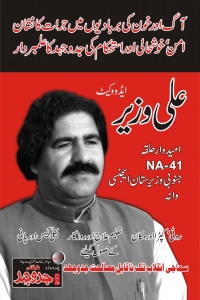
    Muhammad Ali Al-Maroof Ali Wazir (pictured in electoral poster) won again the elections in the electoral district 41 of the "Taliban" region of South Waziristan under the traditional slogan "bread, clothes and homes", as well as demanding schools and healthcare for all. He did also in 2008 but then as now, the real Pakistani state, the secret services known as ISI, have managed to force a repeat of the voting process. 

    I can only underline how ironical is that in the stronghold of Islamic Fascism a communist wins once and again the elections. In other parts of the South Asian country, communists have been effectively barred from running (ah, "democracy"!), but in South Waziristan, Ali Wazir managed to run on an independent ticket... and win. 

    Soon after his victory was announced, still at 86% of the vote count, the authorities declared that the election would have to be repeated.