Showing posts with label Capitalism. Show all posts

Wednesday, September 18, 2013

Greece: Nazis murder musician with full police complicity

Nazi terrorists murdered antifascist hip-hop musician Pavlos Fyssas (aka Killah P) in Piraeus. One of the criminals is Georgios Roupakias, 45, already arrested, but it was a well organized murder with many culprits, including the cops, who allowed it. 

According to the victim's father:
Pavlos’ friends made a remark against Golden Dawn inside a cafe where they were watching a football match. Somebody from a nearby table overheard them and made a phonecall to Golden Dawn members. Golden Dawn squads arrived almost simultaneously with DIAS motorbike police. Pavlos tried to help his friends evade the scene, but he was ambushed by another Golden Dawn squad and surrounded. Then another Golden Dawn associate drove with his car opposite in an one-way street, stopped and stabbed him to death, while the DIAS policemen did not intervene. One girl asked them to help but they didn’t. They only approached afterwards to arrest the man with the main suspect.

As reaction demonstrations have been called through the country for this evening. In some cities like Patras, morning protests of teachers (on strike) were joined by antifascists angry for the crime and its outrageous impunity. At least one Nazi see has been attacked.

Let's face it: Greece is already a Nazi state and Golden Dawn rules with the Samaras government being nothing but a transitional puppet, which does not want nor can oppose the Nazi terror, equally targeting immigrants, Roma, reds or the last honest judges. Police is completely in Nazi hands and that means that they control the state altogether. Democracy is not anymore for real at any meaningful sense but the situation is almost identical to Italy at the ascent of Mussolini: it popular self-defense is not urgently organized and exerted, the Nazis will soon march to Athens and take out the last pretense of freedom. 

This surely does not only apply to Greece but to much of Europe, as the fascists are growing everywhere in arrogance and boldness, usually with complicity of the bourgeois governments, police forces and secret services, as well as the upper bourgeois class, which sees in them the last line of defense of their privileges in societies that are quickly collapsing.

Source and more details: From the Greek Streets (link 1, link 2, link 3, link 4, link 5).

Tuesday, September 17, 2013

Basque Country: police forcibly enters worker-occupied industry

Police forces entered this morning with force in the factory of INCOESA in Bedia (Biscay) in order to allow the capitalist to retrieve the produce, raw materials and machinery. 

The workers had occupied the factory in order to prevent delocalization to Castile (Soria and Extremadura). 

Police not only employed violence but also charged seven workers for resistance.

The company is dedicated to the production of electrical transformers.


Real democracy means democratic control of the economy

This instance, like many others, highlights the importance of the democratic social control of the economy, not allowing the capitalists (if these exist at all) to dump the workers who have produced all the wealth at whim. 

It also highlights the importance of nation-peoples to effectively be able to decide independently of higher instances, be them old-school imperialist states like Spain or more complex modern entities like the EU. 

Real democracy means popular control of the economy and exerting that control at local and national levels. Nothing of this could happen under true democratic control by the people, because they would not allow such abuses (or do you think that Bedia would suicide by allowing such abuse to happen if these matters were subject to local democratic control?)

Sources: Naiz Info[es], BGD[eu].

Monday, September 16, 2013

Poland: massive protests going on for days

This photo was taken on Saturday in Warsaw, when the protests were already in their fourth day:


Surprisingly I had got no word of these massive demonstrations, affecting a major European country before today and I swear I have been watching the news in several channels, what says very little in favor of our so-called "free media" (corporate and state, extremely authoritarian and antidemocratic, and usually also boring, media).

The trigger has been the labor law reform, together with the already rampaging unemployment and underemployment. Another issue is the retirement age, moved to the age of 67. 

The protesters demand the resignation of PM Donald Tusk. 

Source: Webguerrillero[es].

Wednesday, September 11, 2013

Fukushima can't be fixed, let us be honest about it

There is an overly optimistic new blog in town about the Fukushima catastrophe. Fix Fukushima+ blog has the positive attitude of "hey, there is a problem, let's fix it". At the very least it does not try to hide the head in the sand as do the Japanese and North American authorities with the usual police state motto of "nothing to see here, move along". 

But it is totally unrealistic, sadly enough. The plan has several flaws but mostly just imagines that:
Since the US has battlefield atomic bombs in its inventory, it is likely that the defense department has developed radiation hardened battle robots.

Well, not quite. At least nobody ever heard of them and they seem most unlikely to exist, because robots like everything else fails against radioactivity. Radiation is not a mere poison, which only affects organic or certain materials and can be usually neutralized with an antidote: radiation is the destruction of matter itself. No material is radiation-proof, they may be more or less sensible but all them will collapse at some point, also the same as humans can't go around with thick lead armors to protect themselves from radiation (and only up to a point), the same happens to robots. It's mostly material density what acts as shield from radiation and that's why nuclear refuges are built deep underground (deep enough?) but neither humans nor robots can go around with such kind of massive weight, much less be able to work with it (they need joints, refrigeration, etc.)

Now, prove me wrong of course. I would be the first one happy about such a brutal catastrophe being able to be fixed. But being realistic that's not possible. It'd be easier, so to say, to use time-traveling technology and thwart nuclear energy development... but of course that's as much science fiction as radiation-proof robots able to act in extreme radiation environments. Nope. 

The reality is that Fukushima is impossible to fix. The only thing we can do is to be honest about it: evacuate North Honsu (at the very least the children) and probably other Pacific Ocean areas as soon as radiation levels become dangerous. That probably implies evacuating large metropolis like Tokyo (now), Los Angeles (soon quite reasonably), etc.

But they are not going to do that: there are too many business at stake and human life is meaningless to them in comparison to profit. Also within capitalist parameters, the huge amounts of resources needed to relocate so many people and reorganize their productive lives elsewhere are simply impossible to manage because there's no central planning authority, much less one which cares about the lives of children or people in general.

So they do the only thing conceivable to their mindset: extend and pretend until death catches them and the problem is transferred to someone else.

But that is simply not acceptable. It is not just not acceptable for the millions of Japanese who have already been declared expendable and told to smile in face of certain and painful death for themselves and their children, it is not acceptable for Humankind, very especially those who live around the North Pacific Ocean, whose waters are already being polluted with an endless flow of long-lived radioactive elements. 

But let's not forget that water is an open system: the waters of the Pacific are still not contained: they evaporate as mist and rain down who knows where, the fish captured over there goes to the tables all over the World without any effective radiation control system of any sort.

The reality is that Fukushima is here to stay, that it will keep polluting the World with an almost endless flow of radiation and that we can't do much about it other than, first of all acknowledge the extreme severity of the problem, and, then, evacuate the most damaged areas and stop treating human beings, notably the children, as expendable guinea pigs for the most macabre test ever!

Monday, September 9, 2013

Sápmi: roadblocks against Swedish mining plans

Roadblocks and other protests are going in the part of Sápmi (Lapland) under Swedish control, against the project by Beowulf Mining and the Swedish state to develop new mines in Sami land. At least six people have already been arrested.


They make a call for help because the police are employing themselves in full force with the goal of allowing the miner corporation to begin mining in five days.

They are also standing as human shields in the security perimeter so no explosives can be used (legally at least).

Reference in Swedish language: http://kolonierna.wordpress.com/

Source: Webguerrillero[es].


I don't know you but I can't help thinking in the movies of Pippi Langstrup and the two pathetic cops Kling and Klang. I just hope that reality for once gets close to fiction.

Sunday, September 8, 2013

Mexico: thousands march again against privatization of PEMEX

At least 30,000 people marched through D.F. in rejection of the project to privatize the state oil company PEMEX, one of the legacies of the Mexican Revolution, now a century old. 


Source: Webguerrillero[es].

Friday, September 6, 2013

Colombia: police murders four, including a child

Four more Colombian citizens were murdered by the police forces in the context of the farmer strike that shatters the South American country. Other 35 people were injured. 


The massacre took place in the village of Mojarras, in the department of Cauca, SE of the country. 

The exact number of victims is yet provisional but it is known that a boy aged six was killed by inhalation of tear gas. Among the injured there is a human rights activist: Deivid de Jesús Hurtado. 


The latest informations said that the victims were arriving to the hospital San José of Popayán (departmental capital), where there was a growing concentration of people, mostly students. 

Besides tear gas police forces used live fire and even explosive devices. Many of the victims were caused by these.

Source: Webguerrillero[es].

Mexico: thousands of teachers and students march again

The protests against the Education Law, which implies almost totalitarian cuts in worker rights, continued on Thursday in Mexico. Thousands marched through Distrito Federal and in many other cities through the North American country, along with other measures like blockade of roads, suspension of classes, etc. 

The government responded with massive police deployment, which is feared will be the main means that the contested President Peña Nieto will use to enforce his power, also as he attempts to privatize the oil company PEMEX, the backbone of the country's limited prosperity. 

Source: Webguerrillero[es].


Quebec: thousands march pot-banging against anti-social policies and lies

Thousands marched through the streets of Quebec banging pots in protest for the lies and betrayals of the government of Pauline Marois (Partí Québécois) which is applying almost exactly the same policies as their Liberal predecessors in spite of running with a social-democratic program. 


According to polls 70% of Québécoises are unhappy with their government after just one year in charge. As it seems to be the rule in the so-called "democracies" these days, politicians make promises that they systematically fail to fulfill, blindly obeying to the bankster oligarchy in all. 

That way the Marois government has continued cutting in education, healthcare and social services, much to the dismay of the citizens, who now demand their resignation.

Source: Webguerrillero[es].

Friday, August 30, 2013

Colombia: protests and clashes reach the capital Bogotá

The National Strike initiated by farmers and miners in Colombia has finally reached that islet of relative calm that is the capital Bogotá, as well as Cali and Medellín. 


Thousands marched through the streets peacefully yesterday... until hell broke loose. Clashes left many injured, police shot live fire.

The reaction of President Santos has been to militarize the city. Curfews are already active in several towns but this really looks like a Turkish uprising more and more, particularly as the government has very little legitimacy in a country shattered by decades of civil war and when it is clearly guilty of massacring protesters and not respecting the most basic human rights. 

The seriousness of the popular uprising can be gauged by the fact that Santos had to acknowledge for the first time that the farm sector has been abandoned.  

However he and his ministers appealed to the ghost of the guerrilla, whom they call "terrorists", in order to demonize and divide the protesters. 


But the real issue, the real terrorism is the brutal reality of Capitalist accumulation:
"My purchase power is zero, it's only enough to survive," said Orlando Pamo, 50, an indigenous father of six from central Tolima province who earns less than the minimum wage farming citrus and other fruits. "The government wants us off the land so it can be given to big business. We don't get the benefits companies get."


Sources: Reuters, NBC (photo gallery), Euronews (video), BBC, Webguerrillero[es] (photo gallery and video). 


Update: nice synthetic and musicalized video of the protests (comments in Spanish only but mostly images from the demos and some of the repression):

Wednesday, August 28, 2013

Argentina: anti-fracking protests in Neuquén

Thousands protested before the Neuquén Parliament against fracking concessions to Chevron. As usual police attacked the citizens in defense of capitalist interests. Several were injured. 


Source: Webguerrillero[es].

Japan: Governmente takes over Fukushima Daiichi disaster (mis-)management

As soon as they arrived they blamed "human errors" for the systemic problem of massive radioactive water seeping into the Pacific Ocean. It does not seem on first sight like they are going to do any better. 

The attitude of the Japanese Government so far has been disastrous, rejecting to evacuate the most contaminated areas (particularly most of Fukushima Prefecture, whose radiation levels are extremely hight, but in general all North Honsu) and campaigning in favor of absurd new myths like "radiation is good" and in general the attitude of pretend and extend. 

This may be just another step in their overall strategy of not facing the facts. Even in the best case they are already more than two years late.

Sources: Ex-SKF, Simply Info.

Tuesday, August 27, 2013

Honduras: three Tolupans murdered by miner mafias

Three persons of the Tolupa nation were murdered by hitmen at the service of illegal miners, foresters and constructors on August 25th at Locomapa (Yoro).

Ricardo Soto Fúnez, María Enriqueta Matute y Armando Fúnez Medina took part in a road blockade in defense of their ancestral territory.

Already in June the Tolupas denounced forester industrial Kenton Landa Úcles for the introduction of heavy machinery in the Tolupa forest.

In a similar incident, considering the total subservience of the state institutions to capitalist expoliation, soldiers murdered the member of the Lenca nation Tomas García on July 15th. 

Source: LINyM[es].


Spain: major retailer corporation El Corte Inglés lead again by a Fascist

El Corte Inglés is a very large and particularly infamous Spanish corporation that, shamelessly and with total impunity, practices extreme anti-worker policies and persecutes all kind of union activity among its employees. It was of course one of the companies who imported clothes from the Bangladesh factory that collapsed earlier this year. Pretty much like the local version of Wal Mart but even worse if that is possible. 

In order not to be singled out in the media, El Corte Inglés regularly contracts LOTS of publicity, making the media heavily dependent on this brand and effectively unwilling to criticize the mafioso corporation. 

Their sees are usually a central battle in all general strikes, as pickets attempt to force the corporation to guarantee their workers the right to strike, while police serves the interests of the capitalists.

It was founded under Fascism by a client of the Franco dictatorship, Isidoro Álvarez, and it seems it continues under openly fascist control. The new Director General of the all-powerful corporation, Dimas Rodrigo Gimeno Álvarez, has been in the lists of Falange (the classical Fascist party in Spain) in at least three occasions: 1996 and 2000 at state level and also in 1999 in Catalonia. 

While he denies to be affiliated to Falange, his father and brother are. His father, Miguel Ángel Gimeno married the daughter of the El Corte Inglés' magnate, being therefore grandson of Isidoro Álvarez. Álvarez was of course a prominent member of Falange in the dark age of Francoism. 

So essentially: El Corte Inglés = Fascism... today as yesterday. Boycott El Corte Inglés. 

Source: El Diario[es].

Monday, August 26, 2013

The ever-growing surplus value

I'm borrowing here a graph appeared at Naked Capitalism (data for the USA but it could be anywhere):

http://www.nakedcapitalism.com/wp-content/uploads/2013/08/Worker-Productivity-Annual-Wage-Compensation.png 

The implications are obvious: capitalists have been taking an ever growing share of the produced wealth since c. 1972. Previously, in what some have described as the period of "generous capitalism" (caused by the Cold War and fear of socialist revolutions) surplus value (the share of production appropriated by capitalists as manager class of the economy) was more or less stable, but since the 1970s it has grown steadily up to more than double, while real wages have remained stable. 

Wages are the share of production kept by producers, workers. But beware: salaries have remained stable but the share of wealth retained by producers has declined very sharply. 

This is how Capitalism works normally in fact. Marx explained it in Das Kapital with the example of the pin factory, in which vast improvements in technology and organization of production (~ productivity) led only to loss of jobs, not any improvement to the conditions of workers but exactly the opposite. 

Only radical and global class struggle caused a parenthesis in this natural tendency of Capitalism: the post-war decades of relatively shared affluence, which marked a generation that is now dying out.

But for all other generations of workers this is just the normal. And that is why Communism is extremely necessary and urgent.

Sunday, August 25, 2013

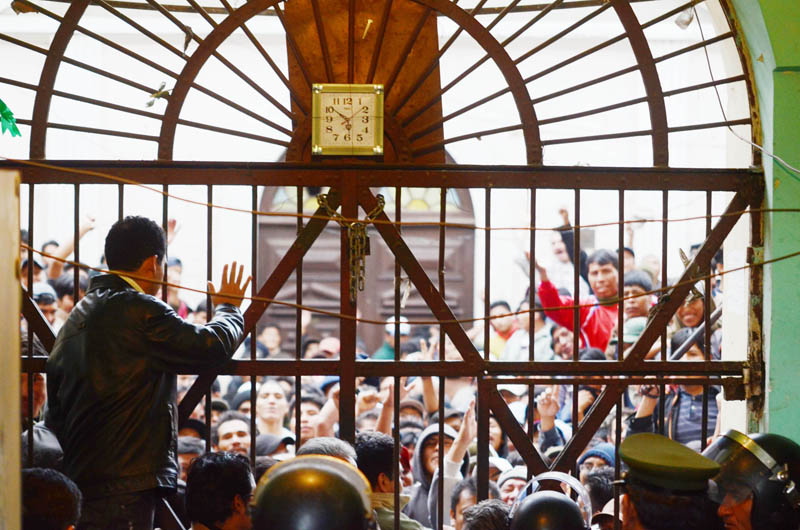
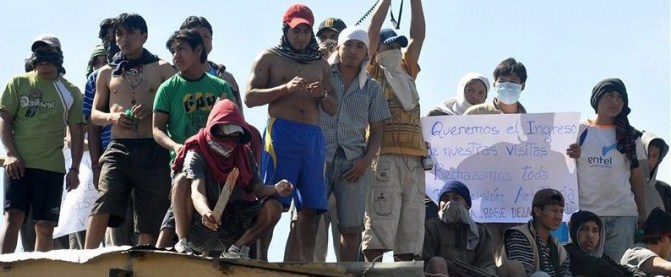
Bolivia: prisoners riot: "crime is not punished, poverty is"

In another example of the very limited progress achieved by the Bolivarian governments of Latin America, whose model is in essence developist socialdemocracy, Bolivian prisoners have risen up against a regime that punishes the poor and is getting worse by means of punishments that disperse the inmates the system wants to punish (not necessarily those deserving punishment). 


Bolivian prisons rise up


“When a prison riot starts, even those who accept the rules of society are roused by the noble temptation of freedom; when the ceilings of the prisons are pulled off by fire or rebels, we throw their hands off our shoulders and identify the enemy.”

Editor’s note: In their zeal, these words have no intention of victimizing the prisoners of the Bolivian State, but rather simply describing events that took place in the jails here. The echoes of our anarchist will reach those living confined in the State’s cold slave pens.

Mass riots in Bolivian jails began a year ago, calling for the resignation of Ramiro Llanos, the director of the penal system; demanding an end to delays of justice, “humane” treatment, and transportation to hearings. Foreign prisoners demanded to be sent to their countries of origin, and everyone demands an increase to the daily expenses that feed each individual [prediario]. Added to the protests is the unfulfilled agreement signed in February 2013 between the prisoners in San Pedro (La Paz) and the penal system, which brought a recess and a suspension of the riots, giving a period of three months for compliance with all of the agreed-upon points. Ramiro Llanos denied knowledge of this document, and to this day the prisoners’ demands have not been met.

The State plans to apply new rules on the penal system that fix harsher conditions for prisoners as well as visitors. They are ordering the systematic transfer of prisoners from San Pedro to other panopticon-style prisons far from the city of La Paz. They plan on not receiving new prisoners beginning on July 17th, and have announced the closure of this prison as a repressive measure against the constant protests that have arisen in the La Paz penitentiary. The riots are frequent, and the State intents to break them up through the transfer of prisoners to more distant jails. The transfer of the San Pedro inmates [that oftentimes live with their families on the inside] will cause more isolation due to the distance of the prisons where they are to be sent; this will mean that their families will have even more difficulty visiting them, since 80% of the prisoners and their families are poor.

Summary of the 2013 riots

On January 17th Llanos (director of the penal system) was taken hostage by the prisoners in San Pedro as a response to the constant threats to move them to other prisons if they mobilize or make demands. The repressive forces confronted the prisoners to rescue him. Llanos saved himself thanks to a few prisoner delegates, who prevented him from being strung up. Protests were unleashed as prisoners resisted the plan for 39 minors from the Calahuma Center for Youth Rehabilitation to be transferred to San Pedro in La Paz. After that day, Llanos no longer had the guts to reenter that combative prison. During the whole month, the prison was in a state of mutiny and riot, with all nine sections taking over all of the jail buildings. Flames were seen on the roofs and yards.

On this latest 10th of June, prisoners in the territory began new uprisings and protests, condemning the fact that only four of every hundred preliminary injunction hearings take place, while the rest are suspended. The principal slogan was a call for the resignation of Llanos. The State’s intention is to close the San Pedro prison, sending the convicts to the “Chonchoro” maximum security prison, and those less than 25 years of age to the Calahuma Center for Youth Rehabilitation, and the preventive prisoners to jails in Patacamaya and Sica Sica, hundreds of kilometers from the city of La Paz, as a reprisal and punishment for the fact that this prison has been in a state of emergency since 2012, demanding the director’s resignation.

Beginning on June 24th, simultaneous protests were initiated in the jails of El Abra in the city of Cochabamba and San Pedro in the city of Oruro. They demanded that their water and electrical services not be cut, as the State had not paid the bills.

On June 26th, the reaction in the Chonchocoro maximum security prison did not wait long after the announcement that prisoners from San Pedro would be transferred there.

On July 2nd, the Chonchocoro and Calahuma prisons protested and announced that they would be in a state of alert, facing the possible transfer of inmates from another prison, which would cause overcrowding in both facilities.
We hope for unity and solidarity among prisoners in Bolivian territory, and that they don’t let the State divide them by “sectional negotiations” (turning one group against the other), as it has frequently done to end riots.

Poverty is punished with prison 

“Crime is not punished, but poverty is.”(Words of an elder in the San Pedro prison)

In the prisons here, the majority of the population is poor. Nevertheless, the wealthier can live more comfortably, because cash rules. The poor have to survive miserable conditions, sickness, and destitution. For example, in the jail of San Pedro in La Paz the maintenance of cells, infrastructure, recreational space, the kitchen, cleaning materials, medications, and other goods are self-directed by the prisoners themselves. The State has knowledge of this context, but in its insensitivity and contempt toward the poor, it forces them to pay for their stint in prison with their own resources.

It is the poor who feel the harsh impact of prison society, both those in the hands of a judge who will determine whether or not they go to jail, and the preventive prisoners who must show that they have an established family, a home, personal guarantors, or an economic guarantee or job. All of these factors diminish one’s ability to move to house arrest. Thus, the question is: Are all prisoners in an economic position to benefit from this? The permanence of a poor majority in prisons is continually perpetuated, and for them the penal system is even harsher, with scarce opportunities to get out. The maximum period of preventive detention is 36 months. In Bolivian prisons, there are preventive detainees who have been in for more than three years without being sentenced (in some cases five or eight years). This cruel setting causes intentional overcrowding in prisons, and ensures that they are filled with the poor. The State is going to implement one more condition for release into house arrest: If a prisoner wants to get out, they must buy an anklet with a GPS chip at a cost of $4,000. This will only benefit those who have the ability to pay the cost. For those without means, there is only the hope that one day they will be able to get out. There are many older prisoners, and many with medical conditions, who request a move to house arrest; with the pardon law passed on December 24th, 2012, very few walked free. There is no adequate medical care or efficient method for medical leave, even in cases of emergency treatment. While bureaucratic paperwork slows everything down, the result of this inefficiency is that individuals’ health continues to deteriorate, and in many cases prisoners die from lack of medication or medical attention. Additionally, after being imprisoned it is difficult to find a job with a prior criminal record. This is all permitted by the State’s indifference.

In the maximum security prison of Chonchocoro, located in Viacha, there is no potable water; they have only one well to provide their water, which is still not potable.

Life in prisons in Bolivia is determined by one’s economic status. The majority have to work at whatever they can to survive and pay for their housing, bed, blanket, medication, and other goods. Among prisoners, food and clothing is bought and sold, and everything is a commodity. Prison makes visible the misery of an authoritarian society that chooses who to protect and who to leave in the dungeon.


The complicity of Press and Power

The role of yellow, sensationalist journalism is to adjust “information” to state versions, causing prisoners to be seen with disdain, and causing a broader “societal” rejection for them.

To this day, the penal establishment has diverted attention in other directions thanks to collaborationist coverage from the Press. As well, they have claimed that there was a supposed child rape in San Pedro, and that there is a drug lab inside the La Paz prison; these facts were made up by Llanos, but were refuted by the prisoners.

The State has succeeded in minimizing and smearing the prison riots through yellow journalists, as well as the frequent threats to send the prisoner representatives to other prisons, as they have them identified. The servile role of the disinformation media packages all of this to create an unfavorable situation for the prisoners. In San Pedro, they agreed voluntarily to the removal of children older than 11, and on July 8th they met again with state representatives and agreed to include all children older than 6 years of age.

Repudiation of rapists

In the Palma Sola jail, in the city of Santa Cruz de La Sierra, it came out that minors had been sexually abused. These deeds are detestable, and we repudiate them. Lamentably, this happens not only in Bolivian prisons where children live, but also in schools, churches, shelters, and orphanages, while these same spaces are also prisons by other names. Ramiro Llanos, director of the penal system, used these detestable acts to generalize about all prisoners, and take advantage of “public opinion.” Among the San Pedro prisoners, a collective agreement to prohibit the entrance of inmates who had committed rape emerged as another means of struggle. From the posters that remain on the walls and door of the prison, they do not simply call for Llanos to resign, but call for the prison population to reject rapists.

The State’s well known repressive strategy is the division, infiltration, intimidation, and punishment to make an example of individuals; thus the government is able to weaken, divide, and break up movements through negotiations per prison section. The increase in conditions of control and surveillance in the penal system are part of the maintenance of bourgeois society. It is thought that prison is the solution for “citizen security” or to reduce “delinquency.” Through this paradigm the State’s only real intention is to protect privileges and maintain the interests of the rich. This background undeniably shows us, for example, that some steal to eat, while others infringe on the law in order to avoid complicity with the impositions of this decadent society. Prisons in Bolivia, as in the world as a whole, reflect this society on a small scale; they are small cities wherein the imperfections of the system we live in are made visible: There are the privileged, the poor, those who serve as snitches for the police or administrators of “justice.” There are drugs and alcohol in prisons because the same administrators and police want these small worlds to rot with vice and sicknesses. Thus, as Power secures the privileges of the State/Capital, it shows its disdain for the poor and those who struggle against it.

Anarchist solidarity is extended to those who suffer punishment, those who do not bend to norms, those who survive in any way they can while the powerful exploit and destroy the earth. This is a humble call to struggle for a different world than the one that they have imposed on us.

Fight against the State with all your strength; the constant wait for a generalized mass revolt is a truly utopian desire that only perpetuates, strengthens, and assures the enemy’s continued existence. Move to the offensive, conspire, act; there is no reason to wait for the masses to rise, or for the appropriate conditions. While we are waiting, authority, repression, surveillance, and punishment are extended ever stronger against the poor and those who have decided to take the offensive. Attack loving that which you dream and feel inside, and hating society’s penury.

We do not forget our comrades who are locked up in the hateful enemy’s dungeons. Neither do we forget those who have decided to flee, showing their rejections of state persecution in a society that is falling apart and needs prisons to keep us scared and allow itself to continue. To our comrades: our sincerest greetings, laden with anarchist complicity.

Towards a community of free association and informal organization, without prisons, State, or Capital.

Fire to the prisons, fire to authority, solidarity with the prisoners in Bolivian territory!

Monday, August 19, 2013

Leaderless movements, late Capitalism and everything else

Yves Smith at Naked Capitalism hosts today a thoughtful meditation by Bill McKibben on the loss of the classical role of leadership, as the 50th anniversary of Martin Luther's King famous speech "I have a dream" approaches. 

Even if Smith has a "liberal" (progressive) approach, she is a very intelligent and thoughtful author and I often enjoy her analysis, even if I do not necessarily agree with all the details. The same can be said about McKibben's piece, which is focused on the ecologist facet. 

McKibben concludes that the paramount leader role has vanished and that instead a multi-headed kind of movement in which many smaller-scale leaders are actually doing the work in a cooperative networked manner is the only thing that can exist now. 

This, as he admits, is "old news" for those with experience in social and political movements. Indeed. In this sense, I include here my own commentary:

When you say that “I could cynically point out that this is also the Wall Street model, where “producers” enjoy more autonomy…” makes good sense because, after all, we exist in a socio-economic-cultural context. In “The Politics of Subversion”, Toni Negri claims that this loss of faith in leaders actually reflects the transition from highly hierarchical and disciplinary Fordism to the more decentralized Toyotism, both of which he relates to Marx’ forecasts in his posthumous manuscripts: the Formal and the Real subsumption of Work into Capital, which also have other implications, including the impossibility of the Stalinist system to survive without never-performed deep reforms. The central motif is anyhow the loss of respect for authority, and therefore the loss of power of authority itself: certain “anarchism” within the ultimate form of Capitalism (but also complete ideological success of Capitalism in many senses). This phase would have been going since c. 1968, a date he picks because of the “springs” of that time, which were full of anti-authority rebelliousness, expressing a radical change in the way we all think. Characters like Mussolini, Stalin, Hitler of De Gaulle (or even Gandhi, I guess) are now impossible because nobody really would take them seriously enough, unlike what happened before. This has pros and cons but is in any case the sign of the time. 

If we are to follow Deleuze and Guattari in “Anti-Oedipus”, a masterwork of the transition to this Toyotist era (already decades old in fact) we can understand that Capital is a corrupting force that decodifies without creating anything of its own in the social realm. In this senses it has two polarities: the schizoid decodifying vector and the paranoid recodifying reaction (drag), which is nevertheless always defeated because it only draws from the past, a past that is quickly erased and corrupted by Capitalism itself.
The real issue is how to go beyond this moral desert that Capital leaves at its wake. In many senses this is something positive because goes beyond what the most ambitious Maoist cultural revolution could imagine, but it also leaves Humankind naked and distructured. The only thing that survives is a naked Humankind in a totally transformed environment, so different from the Paleolithic reality we evolved for. 

In this sense I have been thinking that the novel ideas that are sometimes attributed to Capitalism such as human rights, democracy and such, are in fact not its product but the product of Naked Humankind, devoid of all the old Medieval values. If, as D&G say, Capitalism cannot create anything other than economic flows, then these must be creations of the thin red line, of the popular class struggle within Capitalism that exists since the time of the Sans Culottes. As D&G suggest, Capitalism incorporates ideas and structures from other realities, mostly from the Ancien Régime, which it rots until they fall dead… but it seems to me that also from the new antagonist forces conformed within it. 

If so these institutions (human rights, democracy, etc.) actually should prefigure to some extent the way out of this late Capitalist nightmare. But, of course, they are only part of the solution: in key things like private property, Capitalism can make no concessions or it would risk its own unlife.

Friday, August 16, 2013

Gladio: Nato's shadow state (III): against communism by any means necessary

The third article[es] of Daniele Ganser on the Gladio affair (French version) is most interesting for the present time, especially as communist forces like SYRIZA in Greece (or maybe others in the near future or at sub-state level, as may be the Basque case) aspire to reach to power by purely electoral means.

Some, very naively, expect the state apparatus to obey them as soon as they reach power but the reality is quite the opposite and the increased Nazi penetration in the Greek police forces is the proverbial tip of the iceberg that evidences that the deep state of the Balcanic country is getting ready to counter such an eventuality by all means. 

Gladio investigations established that NATO is not merely a defensive alliance but first and foremost an anti-communist organization of global reach. They also evidence that the real command is in Washington and not Brussels, with Europeans being relegated to a secondary role as auxiliary forces of the American Empire. Role that nevertheless many exert enthusiastically. 

A key organism is the hyper-secret Security Bureau, created in 1949 and whose declared mission is to coordinate, oversee and implement NATO's security policies. It's top officer is the Security Director, main councilor of NATO's Secretary General and President of the Security Committee of NATO. This committee gathers the chiefs of security services of NATO member states and discusses matters such as espionage, terrorism, subversion and other threats, including communism. 

In other words: it coordinates all NATO secret services. However some such services seem to have acted independently from their governments with full blessing by NATO. According to Portuguese newspaper Expresso (1990):
It seems evident that NATO applies a criterion of restricted trust. Under such doctrine some governments are not active enough in the struggle against communism, so it is not useful to inform them about the activities of the NATO's secret army. 

In a closed doors meeting, whose details were revealed by Portuguese media, Manfred Wörner, then NATO's Secretary General, explained that the Supreme Headquarters Allied Powers Europe (SHAPE) coordinates the activities of the Gladio network through the Allied Clandestine Committee (ACC), created in 1952. 

This network was first created in Italy as early as 1947 (the same year in which the CIA was organized) and then extended to the rest of Europe: France, Belgium, Great Britain, the Netherlands, Luxembourg, Denmark, Norway and Greece.

Former NATO Secretary General Joseph Luns declared to the press that he had no knowledge of the network. Luns implied that every secret operation was part of NATO, emphasizing that NATO is controlled by the USA and that the Commander General of the organization (SACEUR) is always a US-American appointed by Washington (the Deputy SACEUR has been mostly British but, since 1980, also occasionally German).

Thomas Polgar, retired CIA officer, acknowledged that there exists "a sort of group in charge of planning non-conventional war". He also emphasized US control of this department. 

According to the Belgian parliamentary committee, this organization was founded even before NATO itself with the name of Clandestine Committee of the Western Union (CCWU), which coordinated the allied secret services. This seems to be the same as the Security Bureau, as it's known nowadays, but was known for long as Clandestine Planning Committee (CPC). 

The first public evidence of the existence of secret anti-communist protocols was revealed in 1966, soon after De Gaulle retired France from the NATO structure (not the alliance itself) and expelled NATO headquarters from French soil. It was De Gaulle himself who denounced such protocols as a violation of national sovereignty.

According to US journalist Arthur Rowse (1994):
A secret clause of the original NATO treaty stipulated that every country candidate to adhesion must have established first a National Security authority in charge of directing the fight against Communism through clandestine citizen groups. 

Italian journalist Giuseppe de Lutiis found that in 1949, in the event of joining NATO, Italy had to sign a protocol establishing an unofficial organization in charge of guaranteeing the alignment of Italy's internal policies with those of the Western bloc by all means necessary, even in the event that the population would manifest a divergent inclination.

NATO officers have confirmed on condition of anonymity that such protocols explicitly protect far right members considered useful in the fight against communists. Even West Germany signed such protocols, in which it explicitly agreed to abstain from prosecuting notorious Nazi activists (Searchlight 1991).

The CPC was all the time directed by Washington, with a secondary role for London and Paris (before De Gaulle's walk out). In all CPC meetings there were CIA officers. A parallel structure is the Allied Clandestine Committee (ACC), created by order of the fourth SACEUR, Lauris Norstadt, in 1952. It's more relaxed and horizontal ambient allowed Gladio commanders to share their networks more effectively.

To this day NATO still denies the existence of either the CPC or the ACC. But even former CIA officers like Thomas Polgar have acknowledged them as very real. However no public debate has ever existed in the North American federation on these matters. Just a few journalists have attempted to inquire on these matters but had no or very limited success. 

Britain must also be mentioned. In 1991 the BBC reported that the role of Great Britain in the creation of these "stay behind" networks was central. This should surprise nobody considering that London was deeply implicated in the ascent of European fascisms in the 1920s and 1930s, including that of Hitler, naturally (just that he got off the leash by threatening to invade Russia single-handedly, which would have given Berlin too much power if successful). British democracy is a mere facade, serving as cover for terribly secret entities like the MI6, whose very existence was only revealed to the public in 1994.

Almost nothing of the British dirty war is known to this day. Nobody in Westminster seems concerned: the regime has 100% of the seats or almost.


Previous entries: I, II.

Tuesday, August 13, 2013

And an iron curtain descended on the USA

A quite interesting story on the person who served as contact for Edward Snowden before his complicated exile is available at the New York Times (needs cookies enabled).

But maybe the most interesting stuff is not when they talk about the spy who became a whistleblower but how Laura Poitras, a journalist, was, long before that, subject to a very extreme political persecution every time she traveled outside her country for reporting transparently on the invasion of Iraq, it seems.
Though she has written to members of Congress and has submitted Freedom of Information Act requests, Poitras has never received any explanation for why she was put on a watch list. “It’s infuriating that I have to speculate why,” she said. “When did that universe begin, that people are put on a list and are never told and are stopped for six years? I have no idea why they did it. It’s the complete suspension of due process.” She added: “I’ve been told nothing, I’ve been asked nothing, and I’ve done nothing. It’s like Kafka. Nobody ever tells you what the accusation is.”

And not just her:
William Binney, a former top N.S.A. official who publicly accused the agency of illegal surveillance, was at home one morning in 2007 when F.B.I. agents burst in and aimed their weapons at his wife, his son and himself. Binney was, at the moment the agent entered his bathroom and pointed a gun at his head, naked in the shower. His computers, disks and personal records were confiscated and have not yet been returned. Binney has not been charged with any crime. 

This kind of totalitarian police state is not at all the kind of idea US-Americans have or would like to have about their country. However it is very real: since the false-flag attacks of September 2001, the federation has been taken over by a perpetual state of emergency, renewed each year by the President, that allows police and spy corps to operate beyond any judicial supervision. This police state is justified with continuous allegations of "terrorist" threats, which in most cases, if not all seem extremely suspicious when looked at critically. 

The police state feeds the "terrorist" paranoia, probably even forging real attacks, some of which have been covered in detail in this blog, in order to justify itself. It's a total Gestapo coup whose main goals are clearly to hide the very police state from public scrutiny and to perpetuate its "need" by continuous threats and even some very real false-flag attacks. 

Another example:
Jacob Appelbaum, a privacy activist who was a volunteer with WikiLeaks, has also been filmed by Poitras. The government issued a secret order to Twitter for access to Appelbaum’s account data, which became public when Twitter fought the order. Though the company was forced to hand over the data, it was allowed to tell Appelbaum. Google and a small I.S.P. that Appelbaum used were also served with secret orders and fought to alert him. Like Binney, Appelbaum has not been charged with any crime. 

These are I guess the lucky ones. The police state, which is now legally authorized to murder anyone, has probably killed quite a bunch: suspicious deaths like the "suicide" of Aaron Swartz and many other people with lower profiles pile up. Why? The North American Gestapo trying to hide their tracks. 

So is the USA anymore the country of freedom it presumed of just a decade or two ago? Not at all. It is quickly decaying into a totalitarian police state. The forms are retained by the moment but any close scrutiny evidences an almost total lack of democracy: media concentrated in few hands, politicians that only serve the corporations, a judiciary that has been completely neutralized... and police eavesdropping even in your breakfast bowl. And it is worsening by the hour.

And, of course, what happens in the USA affects all the World.

Sunday, August 11, 2013

Greece: 10,000 workers to be fired; riot at immigrant concentration camp

Two different news from Greece, not as unrelated as they may seem: they are both serious symptoms of a failed capitalist state.


Samaras will fire 10,000 state workers

The 9,820 public servants mentioned by Eleftherotypia include teachers, cleaners, police agents (surely not the Nazis!), social assistants, airport workers, health personnel and archaeologists. Eleftheros Tipos makes the figure reach 10,092.

The pact with Satan, I mean: the Troika (EC, ECB, IMF), signed by Samaras implies 25,000 public workers to be fired only this year, 60,000 for 2015. The total of redundancies will then amount to 150,000 workers.

Naturally workers did not remain quiet: several thousands gathered before the Ministry of Finance and marched to Parliament.

They denounced that these measures imply closure of hospitals and other services because they cannot be attended with so few workers as they will remain. 


Source: Webguerrillero[es] (incl. video).


Riot in Amygdaleza concentration camp

Upon knowing that the detention term for illegal immigrants has been extended to 18 months, the prisoners at Amygdaleza (Athens) rioted at lunch time. 

According to police reports they attacked the guards with rocks and set fire to mattresses. The uprising was only suffocated after midnight. 10 police agents were injured but police has not reported the number of injured immigrants. 

Source: Webguerrillero[es].