Showing posts with label Basque politics. Show all posts

Tuesday, September 17, 2013

Basque Country: police forcibly enters worker-occupied industry

Police forces entered this morning with force in the factory of INCOESA in Bedia (Biscay) in order to allow the capitalist to retrieve the produce, raw materials and machinery. 

The workers had occupied the factory in order to prevent delocalization to Castile (Soria and Extremadura). 

Police not only employed violence but also charged seven workers for resistance.

The company is dedicated to the production of electrical transformers.


Real democracy means democratic control of the economy

This instance, like many others, highlights the importance of the democratic social control of the economy, not allowing the capitalists (if these exist at all) to dump the workers who have produced all the wealth at whim. 

It also highlights the importance of nation-peoples to effectively be able to decide independently of higher instances, be them old-school imperialist states like Spain or more complex modern entities like the EU. 

Real democracy means popular control of the economy and exerting that control at local and national levels. Nothing of this could happen under true democratic control by the people, because they would not allow such abuses (or do you think that Bedia would suicide by allowing such abuse to happen if these matters were subject to local democratic control?)

Sources: Naiz Info[es], BGD[eu].

Monday, September 2, 2013

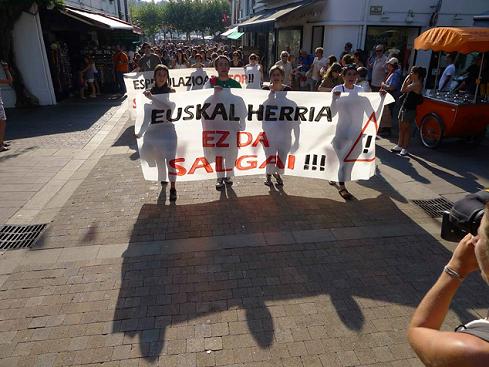
Basque Country: French police beats protesters against speculation

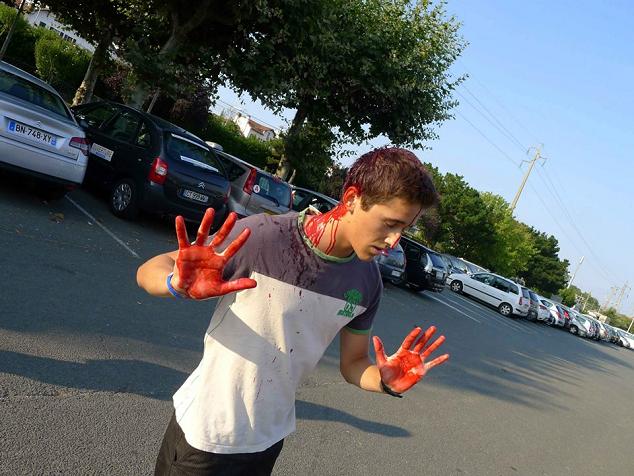
A peaceful protest at a real state company in Donibane-Lohitzune (St. Jean de Luz) was tainted by the blood of the Basque youth as the French military police (gendarmerie) violently beat the protesters.

Three peaceful protesters were injured and other two arrested.

The Basque Country is not for sale

And then they fill their dirty mouths with the word "democracy"!

Source: Boltxe Info[es].

See also: Altsasu occupied by military police in fiestas


Sunday, September 1, 2013

Basque Country: Altsasu occupied by military police in fiestas

Spanish military police (Guardia Civil) occupied on Friday the town of Altsasu (Sakana valley, Navarre) in the middle of its fiestas after fascist-like rampage by the Spanish-imposed provincial governor Carmen Alba. 

In 2011 the same fascist proconsul attempted to indict Mayor Garazi Urrestarazu on a festive parody of a royal discourse, now she charges again against the Ospa Eguna, which may be translated as Celebration Day (ospatu = celebrate) or as Go Away Day (ospa! = go away!, coll.) but hardly as Runaway Day, as the ignorant Alba said. 

Whatever the case she has unilaterally declared illegal the festive acts on the absolutely arbitrary grounds that such acts "have not been communicated to the state administration", as if we'd have to tell the occupants about every single local activity we organize in our towns and villages. The acts include a demonstration and the burning of a doll.

The military cops literally surrounded the town with controls and even entered the festive area threatening in Spanish to "clean it up of shit" (what "shit"? are you going to shoot yourselves dead?) 

In spite of all that the activities continued as intended, no matter that a helicopter roared threateningly above the fire of the doll. People showed a lot of bravery dancing and playing among the threatening police occupants.


Witnesses declared:
It was brutal, disproportionate! 

We suffered an incredible police deployment: the people were surrounded by automatic guns. 

For example, when some 200 people took part in the bertso* dinner, they were surrounded by almost the same number of armed cops. Forced identifications and verbal intimidation were common in the day. Town Hall representatives explained that:

It was to drive you crazy. We did not enter into the provocation and in a bertsolari* town as we live in, citizens went on improvising, and also sortzikoak, polkas, Basque dances and games they performed to impress the military policemen, as saying: "here we are and we will stay here". 

Repression no! Go away. Leave Altsasu in peace.

I must say that nothing of all this was in TV news yesterday, neither in the Spanish channels (of course) nor in the Basque ones.

Sources[eu]: Gara, Naiz Info.


* Bertsoak are a form of improvised song, usually in humorous duels, traditional among Basques. The singers are known as bertsolari(-ak).


Update (Sep 2): it has been known now that a young man was arrested, apparently for "answering back" to the verbal aggressions by the police forces → Topatu.info.

Sunday, August 25, 2013

Uruguay protests against the forgetfulness of Mujica

The authors of a massacre in 1994 against those supporting Basque exiles remain not just at large but with power to commit again any such massacre or worse. Hundreds demonstrated in Montevideo against such impunity, demanding justice and memory.


Roberto Facal and Fernando Morrone were the victims of a massacre executed by police in 1994 to break the resistance of some 4000 Uruguayans against the extradition of Basque exiles, who were in hunger strike at Hospital Filtro. At least 500 police officers took part in the attack, using nothing but live fire. 

Not just demonstrators were killed or injured but also nurses like Esteban Massa who was shot in the back while he aided another victim. 

The murderous repression continued mercilessly in union offices and through the neighboring streets. It was then when the two mortal victims were shot. 


It was a bourgeois elected government which assumed all responsibility with no shame nor remorse. Minister of Interior Gianola was backed by the government in full, nobody resigned, nobody was ever prosecuted. 

Every year in the anniversary of the massacre people march through Montevideo demanding justice and memory. The Frente Amplio ignores the issue and one of its leaders even said it was a massacre "to forget". 

Forget? Never! Forgive? Never! The culprits must pay or something of the like will happen again. 

Source: Borroka Garaia Da![es]

Tuesday, August 20, 2013

Basque Country: 200 years of "Liberal" Spanish imposition

Today 200 years ago the Parliament ("Cortes") of Navarre was dissolved in the name of the new post-Napoleonic "Liberal" regime of Cádiz. 

You may not know it, but in all the Kingdom of Spain, it were the Basque provinces the only ones who remained indifferent towards Napoleonic occupation. There was no guerrilla (except for some late offshoots triggered by the abuses of occupation) and the French Army had absolutely no problem in holding in our little country. Why? Obviously there was no sympathy for Spain and their Nationalist ideas and soon also it became obvious that the new "Liberal" ideology sought to impose the notion of a single nation-state against the wish of our people and its long-held liberties. 

The liberties of Spain became the yoke of the Basque Nation. 

For centuries, the Basque provinces had retained their unique (and quite "Liberal") institutions in the context of the Feudal system that dominated the Kingdom of Castile (later Spain). Our provinces were ruled by elected bodies since at least 1200, date of the Castilian annexation of the Western Basque Country, rooted in the Navarrese Law, very distinct from the Latin one. 

Residual Navarre had however evolved its "Cortes" into an more feudal-like body, similar to other European Parliaments of the time, in which the different estates (castes) were represented in less-democratic form. It was still better than what Castile/Spain had: absolute monarchy, with its intrinsic tendency to corruption and decadence.

With the Spanish War of Independence against the illustrated Napoleonic protectorate, a new and short-lived Spanish Liberal Monarchy arose from the Cortes of Cádiz, under Machiavellian British support. This new state suppressed the Navarrese Cortes altogether exactly 200 years, and also forced the Western Provinces' Juntas (Parliaments) to swear the new constitution, which incidentally suppressed them altogether. 

Ironically the return to Absolutism restored the Basque liberties, what set the stage for a whole century of Taliban-like support by the Basque institutions and people of the most reactionary camp in Spanish politics. Two Carlist wars, almost only manned by Basques, were the product of that imposition. Eventually it became obvious that the Spanish reactionaries were not either our friends and that the Basque society was much more liberal than its forced affiliation may have suggested and a more modern Basque Nationalism emerged, first with the Navarrese Republican Party, then the Basque Nationalist Party and finally with Basque Nationalist Action and its more recent offshoots: ETA and the Basque National Liberation Movement, with its various tactical names.

Partial source: El Blog de Fernando Mikelarena[es].

Sunday, August 18, 2013

Basque Country: strange fiestas under fascist Spanish imposition

Bilboko Aste Nagusia, the Great Week of Bilbao, began yesterday in a very strange mood, after the fascist Spanish proconsul ("delegate of the government") in the Western Basque Country, J.M. Urquijo, managed to use some of their fascist laws and fascist tribunals to impede that this year's Txupinera, Jone Artola, could exert as such. 

The txupin or ritual shot of a noisy firework is how fiestas begin, not just the first day but every day. Since the popular organization Coordination of Konpartsak (festive groups) took over the Bilbao Fiestas in 1978, after decades of fascist boredom, giving them new life, the role of the Txupinera (always a woman, as the Pregonero used to be a man back in those days) has rotated among each of the konpartsak, which in turn elect a woman among their ranks. 

This year 2013, it was the turn of Txori Barrote (= "bar bird"), whose logo represents a woodpecker breaking prison bars. Like many (but not all) other konpartsak, there is a socio-political organization behind it, in this case the veteran and highly popular Committees pro-Amnesty, which is now illegal but has brought year after year, week after week, for many decades, the plight of Basque prisoners, dispersed to remote prisons and often tortured and abused at all levels, to the streets of this country that fights and dances between the mountains and the sea. 

For the Spanish Nationalists, including Mr. Urquijo, there is no new period, no peace process or anything, just yet another phase in their endless conquest of our little country. In this sense he has been persecuting any expression of solidarity with Basque prisoners with unprecedented zeal. Even after tribunals acknowledged that display of prisoners' photos was no crime, they have been repressing such expressions of solidarity and love, up to the point that one year Txori Barrote and Kaskagorri konpartsak were declared illegal themselves, although for short time, with the result that the whole city was full of prisoners' photos. More than ever before, as an act of solidarity by all other konpartsak. 

This year the crusader zeal of the Spanish Imperialists had of course to leave a bitter taste in our fiestas (they are ours, not yours!) and the txupinera Jone Artola, who has the bad luck of being the sister of a long time political prisoner and, therefore, has acted often as speaker of the solidarity movement, was declared illegal herself, not her life but her right to be Txupinera.

If we would have a half-decent municipal government, they would have declared disobedience. But it's a pathetic bourgeois one and they only wanted to obey the law, no matter it is foreign imposed law. 

So, after long negotiations a coral txupin was agreed. The rocket was fired by the President of the Fiestas Comission, a local councilor, and, as the Txupinera could not legally wear the uniform, the Pregonera Iraia Iturregi (captain of the local women football team) took her own off as soon as her speech was over, embracing Jone, who wore proudly her 27 years' old Txori Barrote shirt. 

Iturregi and Artola embraced

Iturriaga's speech was full of references to the inquisitorial abuse:

I am really tired of those who do not seem to understand which is the essence of Aste Nagusia. Stop! We want to enjoy each second of the fiesta independent of gender, race and political ideologies! We want to enjoy the fiestas all together as the persons we are.

She ended with a cry of Gora gu ta gutarrak! (Up with us and our people!)

Which was cheered by the crowd with cries of Go Txupinera! and Mr. Governor: you are dumb!

The two women dressed in their uniforms again to enjoy of the fiestas in the streets, where they were homaged by the konpartsak, which are the soul of it.


Monday, July 29, 2013

Basque Country: Nazi alert in Bilbao

This armed (and truly dangerous) man who looks so much like Sylvester Stallone is a well known Nazi from Valladolid (Castile), plays the guitar in the Nazi music band "Más que palabras" ("More than just words") and is suspect of several violent aggressions in his hometown and in Santander. He's known as "Albertito" and I could not find his full name online (although it's probably known).

On May 23, he attacked a Cantabrian independentist in the city of Santander, to whom they followed from Bilbao in the bus. When the victim reported to police, these sarcastically asked him: "why do you think he attacked you and not me?"

Stupid question proper of a stupid man who should (but will not) be suspended on his functions as police agent. 

It is believed that the Nazi cell that Albertito is organizing in Bilbao already attacked an immigrant worker in the subway in 2010 (Bilbao subway has extreme security measures, yet they got away).

The Nazi thug and potential assassin has apparently organized a small cell of Nazis in Bilbao who organized a "protest" in "solidarity" with the murderer of Clément Méric in Paris two months ago. These are their faces:

Albertito leading his horde (click to expand)

What can be said and what can be done?

Zero tolerance against Fascism and get that scum out of our streets quickly. Cancers are much easier to deal with when they are small, else we may well end up with a serious problem.

Sources[es]: Sare Antifaxista, La Haine.

Wednesday, July 24, 2013

Political repression of Basque youths continues unabated

Two more young Basques have seen confirmed their ideological punishment of six years in prison for the "crime" of illegal association, i.e. for being members of a political organization arbitrarily banned by the Spanish imperialist authorities.

This very same Spanish Supreme Court just the day before dramatically reduced a sentence against Spanish corrupt ringleader Jaume Matas (ex-President of Balears, PP) from six years to a mere nine months (so he won't go to prison).

The sentence reduction, by means of declaring the politician innocent of most charges, was issued by a tribunal which is controlled by the ultra-catholic greedy power-mongering cult Opus Dei and on whose likely deep corruption as institution there are already appearing detailed articles and even a Facebook group. 

Back to incorruptible Basque revolutionaries, it is expected that, in the next weeks, other trials for political activity will be reactivated in the Spanish Supreme Court. 

A campaign of civil disobedience, the popular wall already organized in similar cases in order to highlight the dramatic ideological repression that Spain continues exerting against the youth of this oppressed country, is being readied for these cases. 

However what is desirable and democratic is that repression ends at once and that Castile-Spain pulls back its occupation forces behind the 1199 international border.

Note: all links direct to Spanish language articles.

Tuesday, July 16, 2013

Basque Country: political arrests in Navarre

Three Five arrested, see updates below.

Artzai Santesteban has been arrested tonight in Antsoain by Spanish police forces under unclear accusations of taking part in "an incident" during these San Fermin fiestas. It is speculated that it may be the placing of the gigantic Basque flag but no details have surfaced yet. 

He seems to be a scapegoat because he has been previously persecuted once and again: he was arrested in Italy under the political accusation of being member of Segi (Basque Left-Nationalist youth movement) and then deported to Spain, where he was in prison for more than a year. 

He was also accused of burning several cash machines, without evidence, the case being archived.

Last year he also became scapegoat of an inconsequential fight which took place within the riau-riau between Basque and Spanish nationalist individuals. Only Basque Nationalists were arrested. 

Just months ago he was declared not guilty for an attack against a police van. As in the other occasions, there was absolutely no evidence, excepted declarations obtained under torture. 

He still awaits trial for being member of Segi.

Source: Ateak Ireki[es].


Update: not one but three people have been arrested, according to Naiz Info[es].

Besides the already mentioned Artzai Santesteban, Endika Garai and Jon Karmelo Lizarazu are the other two victims of this instance of political repression.

It seems that the accusations are not related to the hanging of a Basque flag before the City Hall but to the clashes that, triggered by police violence, took place in Txapitela St. when a march attempted to access the City Hall Square with another large ikurriña:


Video by Ateak Ireki

In those incidents Navarrese MP Txelui Moreno was injured by police batons on the head. Allegedly a municipal policeman was also injured by a bottle, although this is not apparent in the video. 


Update: two more have been arrested so far: Ekaitz Esteban Baruke and Eneko Pérez → Ateak Ireki[es].


Update (Jul 18): the five have been released but another person, Monika Mendiberri was arrested tonight in the Old Quarter of Iruñea-Pamplona accused of "destruction" (arson?, vandalism?) → Ateak Ireki[es].

The victims of political persecution denounced the ruling party UPN to have done that in order to hide their own misery. One denounced beatings while under arrest. → Ateak Ireki[es] (incl. press conference video).

Friday, July 12, 2013

Basque Country: how the gigantic national flag was placed before the City Hall (video)

You may not know it but the word bizarre comes from Basque bizardun (bearded), via Spanish bizarro (brave, dashing, manly). You may consider, or not, this a little bizarre but it is certainly fully bearded. 

Bizardun productions presents: The making of the 2013 ikurriña:


This direct nonviolent action put the Basque national icon in the forefront of San Fermin fiestas again. The authorities decided then to delay the beginning of the fiestas nothing less than 20 minutes, something absolutely unprecedented. 

Source: Ateak Ireki[es].


Update (Jul 24): Tasio at Gara imagined the unpopular UPN authorities planning the 2014 txupin in order to absolutely impede the Basque flag to be present:


Translation:
THE INTERIOR COMMITTEE OF PAMPLONA CITY HALL PLANNING THE TXUPIN OF THE YEAR 2014

Councilor A: Here in Santo Domingo we deploy the 5th infantry battalion, clearing the area for the sapper company of the Legion...

Councilor B: In the roofs we place the sharpshooter company just arrived from Afghanistan.

Councilor C: The [armored division] Brunete we put in Mercaderes St. The tanks in white and red to dissimulate a bit... the guns covered with sashes.

Cop A: I bet a thousand that next year's ikurriña is even larger. 

Cop B: That's not fair: you are playing safe.

Luckily for all 2014 will be their last year in power... unless the sky falls over our heads, so to say. 

Monday, July 8, 2013

Basque Country: San Fermin parade march under the demand of the People to oust the government

The San Fermin institutional parade that every day officially opens the fiestas has found itself drowned by the massive popular demand for the extremely corrupt and illegitimate government to resign. While the authorities marched under heavy police protection, the crowds chanted: "UPN kanpora!" (UPN out!). 

The Navarrese People's Union (UPN) is a "regionalist" party tightly allied with the Spanish Nationalist Right (PP) and is not just extremely opposed to the recovery of the Basque identity, language and culture of Navarre, never mind joining the other Southern Basque regions politically, but also has demonstrated in the last years to be one of the worst institutional looters of Europe, being so extremely and blatantly corrupt that they will no doubt lose the government for the first time in decades as soon as there are free elections. 

Video of the parade:


Source: Ateak Ireki[es].


Txupin for prisoners get harassed by police

A group of Navarrese citizens also wanted to make the fiestas reach, even if just symbolically, to the prison. Therefore they launched their own alternative txupin (sound firework) near the prison (photo) and organized a lunch.

A van of the Spanish National Police showed up, forcing the identification of the activists with very aggressive attitude, while from prison it could be heard the protests against the cops: "assassins", "antiterrorist law for them", "son of a bitch"...

When the activists were already leaving, some police agents used their batons against them. 

Source: Ateak Ireki[es].

Saturday, July 6, 2013

Basque Country: San Fermin fiestas begin with unprecedented delay

The highly unpopular, and therefore illegitimate, Navarrese and Pamplonese authorities have made once again all in their hand again to impede the popular demands from being present in the txupin (firework shooting, official beginning of the fiestas), notably Basque flags.


Their Spanish nationalist zeal was such that they delayed for the first time in history the txupin in order to allow police forces to remove a Basque flag that had been hang above the plaza by a group of people wearing berets and fake beards.

The march that carried a large Basque flag to the City Hall Plaza was blocked by police forces, with some use of violence. Only after they folded it they were allowed to continue. Smaller flags were allowed in however.


In the incident, people chanted in favor of prisoners to come back home and for police forces to go away instead. They also demanded that ruling Spanish Nationalist party UPN to resign.

Sources: Naiz Info[es], video from Ateak Ireki.

Friday, June 28, 2013

San Fermin Fiestas: corruption and looting cope popular banners

It is traditional that the renowned San Fermin fiestas, to begin on July 7th in Iruñea-Pamplona, include banners of political satire made by the popular peñas. This year they are almost monothematic: corruption and looting in Navarre. Example (La Única):

Never so few stole so much!!
500 years stealing
Other themes are the demand of public housing and stop to home evictions, the demand of return of Basque prisoners and exiles, the dangers of private hospital "cuisine", rejection to social cuts and overwhelming police repression.

Source: Ateak Ireki[es] → gallery of all banners[eu/es].

Tuesday, June 25, 2013

Basque Country: homophobic mayor warned by the authorities

The notoriously homophobic mayor of Arrangoitze (Northern Basque Country), Jean-Michel Colo (UPM), was warned by the French authorities of dire consequences if he did not abide by the law marrying a local gay couple, as he must (or alternatively a lieutenant-mayor can as well). 

While the meeting of the mayor with the sub-prefect of Baiona took place, opposing groups of demonstrators concentrated nearby, almost clashing. Police intervened arresting one of the equal rights demonstrators (as usual the fascists have impunity).

After the meeting finished the fascist mayor declared his intention to continue with his unilateral homophobic attitude. He has a week to comply.

Source: Sare Antifaxista[es].


The arrested victim of police caprice is Arrangoitze neighbor and antifascist militant Joel Sistiaga:

Arrest of Sistiaga
Free Joel Sistiaga!! IPEK ANTIFAXISTA
 Source: SA[es].

Saturday, June 22, 2013

Navarre: massive demonstration against the corrupt government

Some 10,000 Navarrese citizens marched this Saturday through Iruñea-Pamplona to demand the resignation of the beleaguered corrupt President Yolanda Barcina (UPN, unionist right) so she can be tried in Navarre (and not in Spain). 

Barcina resists in her role of President of the Chartered Government thanks to the "passive" support of the other large unionist party PSOE. Polls predict that the twin-party system that has ruled the Old Kingdom for decades will completely lose control of the Navarrese Parliament, and therefore the Government, as soon as elections are held, but these are not scheduled to happen until 2015 (however they can be called in advance, something the Navarrese People clearly demands).

People at the march chanted slogans like "Thieves out of our institutions", "UPN out", "There is solution: Barcina resignation and bankers to jail", "Out Enrique Maya" (mayor of Pamplona), "One, two, three, four, let them give back what they stole" and also "this is Ali Baba's cave", while in front of the UPN see. 

Source: Gara[es].

Wednesday, June 19, 2013

Revolutionary Nationalism

I translate here an article[es] by Josemari Lorenzo Espinosa recently published at the Cultural Society Pepe Rei, which I believe has great interest in the debate on national liberation and socialist revolution:

Josemari Lorenzo Espinosa. Revolutionary Nationalism.


Federico Krutwig Sagredo
Historian Josemari Lorenzo Espinosa rescues an article by Federico Krutwig, published at Branka magazine in April 1966, in which the author dissected the revolutionary vision of nationalism. For Krutwig, the nationalist prism gives the revolution of a content that non-nationalist communism lacks. For Krutwig, the national and revolutionary components within Revolutionary Nationalism are impossible to separate. 

Soon it will be the 50th anniversary of the birth of Branka magazine, published in the 1960s in Belgium by Basque exiles. Among the collaborations of its first issue, one by F. Krutwig (1) had a notable influence in that time. Under the title "Revolutionary Nationalism" (2), "a new way of struggle of man for his freedom and, very especially, of the working classes for their national liberation" was applied to the Basque case. The author established differences between this "revolutionary nationalism" and communism, although he assured that its roots were in Lenin and Bakunin. He said that Lenin introduced a new vision of nationalism, compared with that of the founders of Marxism, which implied an essential change. Lenin considered that the "national liberation struggle of every people is an integral part of the struggle of liberation of the oppressed in general". According to Krutwig, the development of that theory would have produced revolutionary nationalism, which "is the form of struggle (...) adopted by the peoples submitted to imperialism". In the author's opinion, and in spite of the Leninist contributions to Marxism, "the peoples not submitted to foreign occupation (...) are not able to understand the great revolutionary and progressive force that the struggles of the oppressed against colonialism do contain". Therefore, with the birth of revolutionary nationalism, communists would be finally ready to understand the just national claims of workers and these to participate in their own revolutionary movements. According to Krutwig, "in revolutionary nationalism, national and revolutionary components form a chemical compound. They are inseparable". For this author, revolutionary nationalism was a dialectic jump in the revolutionary struggle of workers. A new reality and, even though partly similar to bourgeois nationalism, its essence and praxis were different. 

This revolutionary nationalism, which was being experimented in Latin America, in Asia or in Africa, applied to the Basque case had a major impact. Krutwig charged, in his article, against the Spanish and French communist parties. This last one criticized also for its attitude towards Algeria, accusing them of "bringing a new imperialism to the Basque Country, this time under proletarian command". Simultaneously he opened the door for the participation of the Basque petty bourgeoisie, something, that he admitted as unthinkable without the foreign occupation. That is, the possibility of bourgeois-proletarian collaboration (what was then called National Front) existed only because of the existence of shared national interests. Krutwig saw a revolutionary fraternity beyond the undeniable class confrontation, because "the Spanish revolutionary fights against a foe within his own people, while in the struggle of the Basque People, the enemy is first and foremost defined by its character as foreign looter". On the other hand, in this struggle, "if Spanish proletarians side with the oppressor state, they will become our enemies".

Among the enemies of the Basque People, Krutwig mentioned notably those "Basque by surname": "Esteban Bilbao, Areilza, Lequerica, Careaga and so many agents of imperialism", saying that the fatherland of these people is Spain. Also to the North he pointed them: the Ibarnegaray, Ibarrondo, Elizabide, etc., who held ranks in French parties. "From all this that the Basque national liberation struggle must to be carried on against all that means the chimera Spain..." For Krutwig the historical moment must be interpreted and to each case the specific revolutionary solution applied. And, even if he cites Lenin, Mao and others, he wants to avoid mimicry and to demand the application of the socialism most adequate for each particular case. For that purpose, he rejects the experience and contributions of the Spanish and French communist parties, who ignore Leninist texts in favor of self-determination and do not seem able to interpret the specific needs of the oppressed peoples of these states, and resorts instead to the liberation examples of the communist parties of China, Vietnam, Cuba or Korea, concluding that national liberation cannot be achieved without social emancipation. 

The author does not ignore the problems of a national front with the bourgeoisie. "Basque nationalist bourgeoisie", he claims, "tends to collaborate with the Spanish bourgeoisie" and also: "the jelkide* is by nature bourgeois". However for Krutwig, in revolutionary nationalism "the primary condition is to be nationalist". In this aspect, Krutwig dedicated ample room to quotes from Mao. Among them he brought forward a cue: "In a nation which struggles against a foreign enemy, the class struggle takes the shape of national struggle and, under this form, unity manifests". Not forgetting ever that the main contradiction is which confronts the exploiter class (bourgeoisie) and the working class, Krutwig says that many examples of colonial liberation show that there is variance to it. And then the problem of the "pure leftist" ones is that they become "reactionary imperialists". For Krutwig this demonstrates a complete ignorance of the specific conditions of revolutionary struggle in Vasconia. These people, sometimes, for rejecting the bourgeois nature of the Basque Nationalist Party, what they did was to throw the baby with the dirty water down the sink. In support of this thesis he cites again Mao: "In the event of a war of aggression (...) the different classes can join forces provisionally to carry on a national war against imperialism". Doubtlessly the situation is much less dramatic today in the Basque case, where the occupation is not always as crude as in the Chinese, Vietnamese, Algerian and other cases, or even in the Basque Country of 1936. But for this Mao also had an advise: "When imperialism does not resort to war, it can use other means: political, economical and cultural ones as more moderate forms of oppression". Then "the dominant class of the semicolonial country can capitulate to imperialism: an oppressor alliance is then formed against the popular masses". 

Krutwig does not forget either the fundamental role that the native language acquires in the processes of national liberation. He dedicates many paragraphs and offers ideas against cultural or linguistic oppression. And he did propose, based on the thesis of the Vietnamese Troung Chinh, the creation of the well known fronts (which later ETA would try to adopt) among which the cultural one would deal with the promotion of the Basque language and to create contradictions with bourgeois nationalism, which, in addition to being bourgeois is also promoting the Spanish language. This and other writings by Krutwig on revolutionary nationalism, or also on Basque history, enlightened and marked the thought of a whole generation in a period of unprecedented cultural repression. But they have not lost all their relevance. For whoever has this article at hand, we recommend its re-reading. In any case, we leave floating the possible actuality of these, then revolutionary theories, that are now almost 50 years old, and which in some aspects may require mending but in others retain their original lucidity.
_____________________________________________________

(1) Federico Krutwig (1921-1998): Basque scholar and militant. One of the most influential members of ETA in the period of the V Assembly. 
(2) "Nacionalismo Revolucionario" Branka, nº1 - April 1966. Ediciones vascas (1979).

Translation note:
* Jelkide: member of the bourgeois Basque Nationalist Party. The term means "follower" or "supporter of the JEL", which is the acronym of the barely reformed Carlist principles, after removal of allegiance to the King: "God and the Old Law" (Jainkoa Eta Legizarra).


***


Addendum by Maju:

As Lorenzo Espinosa says in the last paragraph, some of the details and emphasis of Krutwig's Revolutionary Nationalism require mending or revision. I personally find a bit annoying his insistence on inter-classist alliance with the petty bourgeoisie, which in the mid term is not too productive and appears to lead to an incomplete revolution. However he is right that in the event of national oppression, as in any other form of oppression, every ally is valuable and we should not disdain them. 

My opinion on the matter is that the petty bourgeoisie is generally weak and cowardly, however many of them are also borderline proletarians, so harsh is the Capitalist exploitation, especially in times of crisis like the one we suffer today, that they are also pushed against the ropes and their objective interest converges with that of the working class: dignified life vs the Capitalist offer of slavish survival.

In the mid twentieth century probably the petty bourgeoisie was perceived as a stronger and more dynamic sub-class, however nowadays they lack even personality of their own, as the "middle classes", as they call them, are being wiped out altogether with very few exceptions, to make room for the insatiable greed of the grand bourgeoisie. 

This is in any case not a major problem for the proletarian camp, because 90% and 99% are not that different. It is however a serious problem for the capitalist one, because 10% and 1% have almost no comparison. The door is always open for whoever in the petty bourgeoisie wants to join us but this time we, the 90%, the working class, shall set the terms: terms of dignity, terms of freedom, terms of equality but without concessions to private property privileges of any kind. They must choose between a worthy human life and their coveted but extremely eroded property privileges: it is not us who are in the middle of the most colossal struggle ever: we are one side, the one who has the big numbers and the productive skills, so we really do not need their help. If they are welcome is only because our camp is the camp of Humankind, so every person who chooses this camp deserves praise and support, but there is no other reason. 

The reality of Revolutionary Nationalism today has more to do with the fact of ethnic identity being a real social agglutinative force, something that Krutwig also grasps. Nearly all people, not just the bourgeois, but actually even more intensely the workers, feel this kind of, maybe subtle but very real, social organization which is the ethnicity or nationality. Fighting against it is futile and counter-productive, and doing so in the case of oppressed peoples is plainly unfair, a treason to the principles of Humanism that we have as our standard. If all peoples are equal, all peoples have the same right to self-rule and should not be submitted by others.

Blending together these two vectors of liberation can only add up and become enriched fuel for World revolution from the local communitarian level. Reality confirms it: nationalist or otherwise ethnic-based revolutionary forces are almost invariably much stronger and persistent in the long run than similar ones in the context of imperialist nations, precisely because they blend two (or more) legitimate demands of emancipation, making a much more stable platform for popular struggle.

But the petty bourgeoisie is totally unnecessary as ally: they are nearing extinction and add nothing of value to the power of the Working Class.


Update: the original text (in Spanish, with occasional quotes in French) by Krutwig (signed with his pen name F. Sarrailh de Ihartza) is available online in PDF (thanks to Petriko Barreno for the info). Some translated key fragments:

Lenin demands from the socialists that they must support without reservations the national liberation struggles of the oppressed peoples. This demand he proclaims very especially for very proletarian class of the oppressor nation. He imposes to the communist parties the duty of making the workers of the oppressor nations understand the just rights of the oppressed peoples. And he sees in this preaching of the right of self-determination of the oppressed peoples, preaching that must be realized by the worker parties of oppressor nations among their members, the ultimate proof of true proletarian internationalism. Without such support of the right of self-determination (and for greater clarity Lenin declares that for right of self-determination we must understand the right of the oppressed people to separate themselves from the oppressor people and to create their own state), Lenin proclaims that there is no proletarian internationalism.

He then mentions other examples of strong criticism by Russian revolutionaries of the Jacobin-chauvinist stand of Spanish and French communist parties on the national issue. Koltsow, Pravda journalist in the time of Stalin, and Trotsky alike made such sharp criticisms, condemning the chauvinist stand of these as anti-Leninist (Koltsow) and debilitating of the class struggle (Trotsky).

While Lorenzo seems to prefer the, somewhat inter-classist, quotes of Mao, he ignores, for some reason, the ones by Lenin, which are much more rotund, unequivocally proletarian, and more directly applicable to the European reality, for example:

The Working Class of the oppressor nations cannot limit itself to generic and stereotyped sentences repeated by any pacifist bourgeois against the annexations and in favor of equality among nations in abstract. The Working Class cannot remain silent in front of the question, particularly "upsetting" for the imperialist bourgeoisie of the state borders based on national oppression. The Working Class cannot stop fighting against the violent retention of oppressed nations within the borders of any given state, and that means fighting for the right of self-determination. The Working Class must demand the freedom of political separation of colonies and nations oppressed by "their" nation. Otherwise proletarian internationalism will become a hollow and merely verbal concept; class trust and solidarity will become impossible between the workers of the nations oppressed by "their own" nation and held captive by the violence of "their own" state. 
Lenin again with particularly fiery verb:
If Finland, Poland or Ukraine separate themselves from Russia there is nothing wrong with it. What could be wrong? Whoever claims that is a chauvinist!

Basque Country: workers evicted from their company

In a case that evidences the extreme injustice and irrationality of the bourgeois legal system, the workers of Troquenor (Sondika, near Bilbao) were yesterday evicted from the grounds of their manufacture, which was a perfectly viable company, producing metallurgic products in high demand. 

The legal pretext is that Troquenor owes € 250,000 to the owner of the industrial pavilion, who in turn owes millions to the public treasury in terms of taxes (€ 10.6 million) and social security (€ 7 million) but nobody is prosecuting him. 

The workers, who have not even yet formally laid out, have so far no right to even unemployment benefits. 

Therefore they have been entrenched for weeks in their workplace in demand of a solution that allows Troquenor to continue producing and generating salaries. 

However yesterday the court executed the embargo order with heavy presence of police forces, as well as one of the owners of the pavilion, Jatsu Giménez Bretón.

Source: Gara[es].

Friday, June 14, 2013

Basque official report on the victims during the guerrilla war

Fascist mercenaries at the Montejurra massacre
The semi-autonomous Western Basque Government has issued a report[es] that attempts to quantify the numbers and typology of the victims in the period of the guerrilla war from 1960 to 2013. 

Actually ETA was only active in armed form from 1968 and officially declared the end to armed struggle in 2011. Guerrilla war and state repression should be quantified, in my understanding since 1936, when the fascist coup ignited the fire of popular armed resistance, which existed since then in many forms (grouped in the catch-all term maquis, inherited from the French Resistance), some of them with clear independentist undertones. 

The report also seems somewhat biased in favor of certain kind of victims, not counting, for example, deaths in prison or those killed or mutilated in car accidents when traveling to far away prisons to visit their relatives or friends. People in prison for political reasons, with or without sentence, should be accounted and in most cases are not. The report mentions once and again the various associations of "victims of terrorism" but never any association against torture, for the rights of prisoners, etc. Those killed in police operations against armed groups, such as the Pasaia Massacre, don't seem to be accounted for either. It is not clear if the reports of police violence include those by French agents (surely not).

Fascist PM Carrero Blanco was killed by ETA(m)
In any case, the report accounts for the following figures for the 1960-1978 period:
  • 136 killed by ETA, Autonomous Anti-Capitalist Commandos (CCAA) and other anti-system groups. In detail:
    • ETA (prior to schism): 18
    • ETA (militar): 89
    • ETA (political-militar): 9 (2 in kidnappings)
    • CCAA: 4
    • Iberian Directorate for Liberation (DRIL): 1
    • Others: 2
    • Not sufficiently clear: 13 (2 in kidnappings).
  • 87 killed by the Spanish police (74), death squads (13) or death penalty. In detail:
    • Police abuses, confusion and other causes: 23
    • Police violence in demonstrations: 22
    • In road controls: 19
    • In police custody: 5
    • By out-of-service agents: 5
    • By the Basque-Spanish Battalion (BVE): 3
    • By the Apostolic Anti-Communist Alliance (Triple A): 2
    • By fascist violence against demonstrators: 3
    • By execution after military trial: 2 (the famous Txiki and Otaegi, 10 others were sentenced to death but never actually killed).
  • Other anti-system violence:
    • 236 seriously injured in attacks (230 by ETA in its various forms).
    • 14 people kidnapped and later released (3 after being shot to the knee).
    • 8 attacks against media.
    • An undetermined number of police agents injured in demonstrations.
    • Some 3600 major attacks (by organized groups) in this and the following period.
    • Some 4500 minor attacks (in the so called "street fight") in this and the following period.
  • Other state violence:
    • 422 injured by police violence in demonstrations. 
    • 355 death squad arson attacks and death threats.
    • 238 subject to military trials.
    • 103 terror attacks by death squads (not including kidnappings).
    • 32 journalist brought to trial or otherwise jailed.
    • 22 injured in road controls.
    • 22 death squad attacks against demonstrations.
    • 13 hospitalized after arrest.
    • 11 death squad attacks against media.
    • 9 kidnappings with violence and torture by death squads.
    • 6 injured by out-of-service police agents.
    • An undetermined number of arbitrary arrests, preventive prison, etc.
    • An undetermined number of media closures, censorship and prohibitions.
    • Not researched but mentioned: abuses and torture against prisoners.
  • Unclear: 4 people missing.

Not accounted for? (Pasaia 1984)
In the 1979-2013 period:
  • 703 killed by anti-system groups:
    • In attacks by ETA(m): 644 
    • In attacks by the CCAA: 38
    • In attacks by ETA(pm): 12
    • In attacks by Iparretarrak (IK): 3
    • In attacks by Iraultza: 1 (but a member of Iraultza, which never targeted people).
    • In kidnappings by ETA(m): 8
    • In kidnappings by ETA(pm): 2
    • In kidnappings by the CCAA: 2
    • In kidnappings by ETA-VIII: 1
    • In "street fight" actions: 3
    • Itsasondo man who got tired of police persecution and killed two with a hunting rifle (later run away and joined ETA): 2. 
    • Not clarified: 314 (figure by FVT, highly suspect, not added to total).
  • Some 126 killed by the state and satellite groups:
    • In attacks by the Anti-Terrorist Liberation Groups (GAL): 24
    • By police (abuse, confusion or other causes): 18
    • In attacks by the Basque-Spanish Battalion (BVE): 14
    • In police custody: 12
    • By out-of-service police agents: 12
    • In road controls: 11
    • By police violence in demonstrations: 10
    • In attacks by the Spanish Anti-Terrorist Groups (GAE): 7
    • In attacks by the Triple A: 3
    • By death squad attacks against demonstrations: 3
    • In prison: 2 (only?)
    • Women raped and killed by the BVE: 2
    • Other death squad kidnappings with murder: 2
    • Missing people whose corpses were found: 2
    • In attacks by "Antiterrorismo ETA" (ATE): 1
    • Deaths by death squads never clarified: at least 3. Most cases were never investigated properly anyhow.
  • Other anti-system violence:
    • Injured in attacks: figures vary: from 2068 to 16,000.
    • Kidnapped and released: 
      • ETA(pm): 24 (11 after being shot to the knee)
      • ETA(m): 17
      • ETA-VIII: 5
      • ETA (prior to schism): 3
      • CCAA: 3
      • ETA-VII: 1
      • Not clarified: 8 (these may be mafia violence in fact)
    • Attacks against media: 32
    • Major arson attacks (by armed groups): some 3600 (both periods)
    • Minor arson attacks (by the so-called "street violence"): some 4500 (both periods)
  • Other state violence:
    • Torture: maybe as many as 10,000 victims, some 5500 public denounces.
      • Hospitalized after police arrest: 124
      • Only 62 agents (who tortured 31 victims) were declared guilty of tortures, 27 of them were later pardoned by the government.
    • Injured in road controls: 30
    • Injured by police (confusion, abuses and other causes): 39
    • Injured by out-of-service police agents: 13
    • Injured by police in demonstrations: 222 (only?)
    • Undue closure of media: 2 (Egin newspaper and radio, Egunkaria)
    • Violations of human rights in prison: not researched (lots!)
    • Injured in death squad attacks: 232
    • Injured by death squads in demonstrations: 10
    • Women raped by death squads: 13
    • Kidnappings with intimidation and torture: 49
    • Arson attacks and death threats by death squads: 633 (10 against media)
  • Not clarified: 2 missing people and another unspecified case.

While I do not necessarily subscribe the data produced in this report (too many blanks and question marks), it is clear that it serves as partial reference for historians and political debate.

Monday, June 3, 2013

Basque Country: metal commerce workers protests

Metal commerce workers, who are on strike for their collective agreement, occupied the European Center for Innovation of Navarre (CEIN), a public-owned think tank for corporate innovation, where one of the capitalist negotiators works (how ironic that a capitalist leader works for a public company!)

They were then evicted by Spanish military police (Guardia Civil), so they then organized a sit-in before the Irigaray hardware store.


Source: Ateak Ireki[es].

Basque Country: march against the military use of Bardeak (video)

Yet another year hundreds took part in the march against the military polygon of Bardeak (also known as Las Bárdenas or Bárdenas Reales in Spanish), in the heart of a natural protected area of Southern Navarre. 


Source: Ateak Ireki.