Showing posts with label Autonomism. Show all posts

Sunday, September 1, 2013

Greece: direct action against repressive governor

A group of people self described as "Solidarians" attacked on Saturday the luxury resort of the Governor of Epirus in retaliation for the eviction of squats, damaging elements of the property and the cars of his posh guests. 

In their own words:
Yesterday night, 30/8, we visited uninvited the private resort that the family of Epirus regional governor, Alekos Kachrimanis, maintains at the city of Ioannina. There occurred a feast for the celebration of his name day. We couldn’t have missed the chance to be there to wish happy name day to him warmly! The specific guy, along with other local rulers and the administrator of the Chatzikosta general hospital, Fotis Vavvas, had participated last April at a conference on the topic of finding a definite solution for putting an end to the months-long occupation of premises at the former Chatzikosta hospital. We hold the aforementioned gentleman co-responsible for the eviction of Antiviosi squat, and we remind him that buildings like this one are spaces that have already been reclaimed, and constitute cores of social resistance and struggle. Really, that’s the reason why they are being targeted by the repression of state power and all of its sidekicks.

For all these reasons, we got ourselves at the yard of the resort yesterday, where the banquet was underway, with a purpose to cause disruption and put an end to it, and as an act of solidarity with Antiviosi squat. We painted “Antiviosi squat will stay” at the wall of the yard, while we shouted slogans such as: “10, 100, 1000 squats against a world of organized sepsis”, and “Antiviosi squat will stay; the flame we lit cannot be put out by anyone.” Also, we smashed the windows and mirrors of two super luxury cars that belonged to guests of the regional governor.

IDEAS CAN NEITHER BE EVICTED, NOR SILENCED SOLIDARITY WITH THE SQUATS
 
solidarians

Source: Contra Info.

Saturday, August 24, 2013

Marx as "Anarchist"

Or almost. Maybe more like modern Autonomists.

The Commune publishes today a very interesting article by David Adams questioning in depth the notion of Marxism, or more precisely Marx' own thought, as authoritarian and statist, being in fact quite different from the Leninist model (as well as from the Socialdemocratic or Bersteinian one).

A key excerpt on the dictatorship of Proletariat as being nothing but radical grassroots democracy:
A little-known text by Marx, his 1874 “Notes on Bakunin’s Book Statehood and Anarchy,” explains the concept of proletarian dictatorship more clearly than any other. In his book Bakunin ridicules Marx’s concept of the transitional state power of the proletarian dictatorship, and Marx critically responds in his “Notes.”  Bakunin writes, “If there is a state, then there is domination and consequent slavery. A state without slavery, open or camouflaged, is inconceivable-that is why we are enemies of the state. What does it mean, ‘the proletariat raised to a governing class?’”26 Marx responds, “It means that the proletariat, instead of fighting in individual instances against the economically privileged classes, has gained sufficient strength and organisation to use general means of coercion in its struggle against them; but it can only make use of such economic means as abolish its own character as wage labourer and hence as a class; when its victory is complete, its rule too is therefore at an end, since its class character will have disappeared.”27 The claim that through revolution the proletariat will be “raised to a governing class” thus has nothing to do with creating a dictatorship of a political sect, but is rather a claim that the proletariat will use “general means of coercion” to undercut the bourgeoisie’s power (by abolishing the private ownership of the means of production, disbanding the standing army, and so forth). It is the entire proletariat that is to exercise this power.  Bakunin asks, “Will all 40 million [German workers] be members of the government?”28 Marx responds, “Certainly! For the system starts with the self-government of the communities.”29

Can there be a more Anarchist statement? Or rather we may want to describe it as genuine Communism. 

Another excerpt: Leninism as Blanquism:

Blanqui, for example, advocated an educative dictatorship of a small group of revolutionaries. Marx’s use of the word “dictatorship” in the phrase “dictatorship of the proletariat,” however, is original and deliberately distinct from Blanqui’s usage. Engels emphasizes this point in a passage on Blanqui: “From the fact that Blanqui conceives of every revolution as the coup de main of a small revolutionary minority, what follows of itself is the necessity of dictatorship after it’s success-the dictatorship, please note, not of the entire revolutionary class, the proletariat, but of the small number of those who made the coup de main and who themselves are organized beforehand under the dictatorship of one person or a few. One can see that Blanqui is a revolutionary of the previous generation.”37 It is clear that the Leninist model of a particular sect or political party exercising political power is much closer to the Blanquist conception of “dictatorship” than to Marx’s (...)

Much of the divergence between Anarchists and Marx seems merely semantic: the use of the word "state" (polity):
For Marx, this form of power can be a “state” from the perspective of its political, coercive function of uprooting the foundations of the rule of capital. It cannot be a “state” in the sense of a “parasitic excrescence” usurping power from the mass of workers.50

Again much closer to Kropotkin or Durruti than to Lenin, never mind Stalin.
Marx saw the mandated and revocable delegates of the Commune as an example of working class state power in action.

Mandated and revocable delegates? Isn't that precisely what Anarchists propose?

So what do Marx and Engels mean by "state" and "class dictatorship"? In the words of Richard N. Hunt:
The full-time army as parasite disappeared, but the part-time National Guard remained as the coercive instrument of the workers’ state. Here in sharpest focus one can perceive Marx and Engels’ double usage: the parasite state is to be smashed immediately; the state as instrument of class coercion is to remain until the need for it fades away.

A people's militia under popular command, it seems.

The criticism of bourgeois "democracy" and state is persistent and merciless, and Engels charged against the USA as archetype of this separation between society and state by means of ritual and pointless elections:
Nowhere do “politicians” form a more separate and powerful section of the nation than precisely in North America. . . . It is precisely in America that we see best how there takes place this process of the state power making itself independent in relation to society, whose mere instrument it was originally intended to be. Here there exists no dynasty, no nobility, no standing army, beyond the few men keeping watch on the Indians, no bureaucracy with permanent posts or the right to pensions. And nevertheless we find here two great gangs of political speculators, who alternately take possession of the state power and exploit it by the most corrupt means and for the most corrupt ends-and the nation is powerless against these two great cartels of politicians, who are ostensibly its servants, but in reality dominate and plunder it.

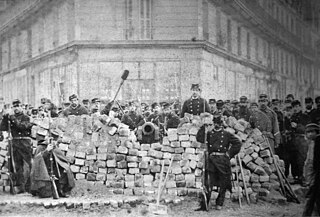
Naturally, although many have forgotten, the term Communism itself derives from commune (municipality or local government in French and other languages) and very specifically from the 1871 Paris Commune.

In this pioneering communist "state", not just the army became part of the people in full but the whole state did by suppressing the bureaucracy and getting managers to be paid common workers' salaries and be under the command of the People directly. Totally different to what happened in the Soviet Union.

Marx did not live to see the Russian Revolution but he witnessed the beginnings of the rise of what is now the Socialdemocracy, especially in France and Germany. It was then when he famously declared "I am not a Marxist myself". He was very critical of Lassalle and his socialdemocratic or proto-Keynesian ideas of building socialism from above by means of state loans and other nonsense. 

One of the key issues is democratic centralism, centralization or central planning. In this certainly Marx and Bakunin were very much at odds:
While Bakunin was a sworn enemy of all political and economic centralization, Marx had a very different perspective, but one that was in no way more “authoritarian”: “National centralization of the means of production will become the natural basis of a society composed of associations of free and equal producers, carrying on the social business on a common and rational plan.”70 Marx thought that both centralism (a common plan) and democratic control from below were necessary for building socialism.

Read the original article, "Karl Marx and the State", at The Commune.

Tuesday, June 25, 2013

Britain: The People's Assembly gathers


the people’s assembly: the fight-back begins?

24 06 2013
 
The gathering of over 4,000 people at the People’s Assembly Against Austerity in London on Saturday 22nd June was truly inspirational. To be together with so many who regard profit as a dirty word & who want a world based upon more humane values, such as equality, solidarity & dignity, it’s hard not to believe that there will be a fight-back. But as useful as it is to raise spirits, John Keeley attempts a more objective analysis of what the People’s Assembly potentially offers.


Will the People’s Assembly stop austerity? To do this it would need to bring down the Con-Dem coalition & reclaim the Labour Party as a party fighting for the class interest of the workers. The first part is relatively easy compared to the second. Indeed, the fact that Labour haven’t stood up for the workers is the main reason why the coalition has had a relatively easy time of it to date. Although there are still many good people in Labour, the leadership & the vast majority of MP’s care first & foremost about their careers. They want power & from their rationale this means not upsetting corporate interests. Hence on the same day as the People’s Assembly, Miliband gives a speech saying he won’t reverse the cuts. How much more evidence do you need of the pro-business nature of the Labour Party?

Labour is lost in history. Just as capitalism faces potential collapse & the case for socialism needs to be made more than ever, Labour are found missing. Labour only offer a vision of revitalised capitalism providing tax revenue for public-private initiatives financing public-private provided services. The promise of better healthcare & education funded by a buoyant capitalism that somehow produces ‘social entrepreneurs’ who have a social conscious, once of course they have made their millions. It’s the ideology of liberals who want to be remembered as ‘good individuals’. Blair, Brown, Miliband, they are all the same.

So can Labour be reclaimed? An optimistic scenario would have the People’s Assembly amassing support from a large section of the population & scoring victories over the coalition so that it falls & the new Labour government, in their gratitude to the unions, giving them a bit of say & launching a Keynesian fiscal stimulus – more investment, more jobs, more union members. A new boom then boosts the coffers in the Treasury enabling a confident, more self-assured Labour to renationalise the railways & the public utilities, as well as investing in the NHS & a fully state-controlled comprehensive education system. A return to the hope of 1945 & the parliamentary road to socialism.
Rather than optimistic, this is delusional. Only those who have no understanding of the nature of capitalism today can entertain such a possibility. Unfortunately, that’s the vast majority in the unions & the Labour Party. The problem is the confusion between the vast wealth created by capitalism & the fact that capitalism only produces for a profit. On top of that is the nature of debt & how it artificially supports profit rates. These are not easy subjects. This is why it is essential for those of us who have studied capitalism & the nature of its crises to engage with the leaders of the People’s Assembly to show them that social democracy – capitalism with a strong welfare state – is not a realistic possibility.

There is no Keynesian solution. Capitalism cannot be reformed. For there to be true democracy where the people are both legislature & executive, requires not just the common, social ownership of the means of production, but a whole new approach to politics. It requires embracing participatory forms of organising – something that is happening increasingly. Political parties & parliament are not democracy. New institutions, such as local Peoples’ Assemblies, are required to enable equality in decision-making. An alternative to austerity necessitates an alternative system. A new mode of production & a new form of politics. Can the People’s Assembly rise to this historical challenge?


For a more skeptic and a bit cynic criticism of the PA from the Left, see Random Pottins: 'Why I skipped Assembly'.

Thursday, June 20, 2013

Britain: the People's Assembly


what can the people’s assembly do for the people?

20 06 2013
 
This Saturday more than 3,000 people are expected to attend the People’s Assembly Against Austerity in London. John Keeley examines what it offers the people.

People's AssemblyLaunched in February 2013 with a letter to The Guardian signed by Tony Benn, President of the Coalition of Resistance (CoR), & many trade union leaders, it stated its aim as being to “bring together campaigns against cuts and privatisation with trade unionists in a movement for social justice”.

The CoR is largely a Counterfire (John Ress, Lindsey German, Chris Nineham) initiative. As such it conforms to the united-front tactic of enabling revolutionaries to engage & shape things working alongside non-revolutionary workers. By bringing together those who are essentially social democrats, wanting to defend the welfare state but not challenge capitalism, with trade unionists who have the power to lead strike action, & those who are already clear that capitalism is the problem, there is the possibility of reforms that benefit the working class leading to demands for more reforms & the eventual overthrow of capitalism.

Obviously, the success or otherwise of such a strategy largely depends upon the material conditions. As I’ve mentioned many times before, I believe that capitalism is in real trouble, & what we are now seeing is the politics catching up with the economics. In otherwords, the workers have been suffering, there’s little prospect this will end, indeed it’s more likely to increase, & hence consciousness is now changing & more & more people want to do something about it.

Finally, this is resulting in the left starting to work together, realising that petty arguments over the nature of the Russian Revolution are not vitally important, even that ‘democratic-centralism’ has been largely undemocratic & totally unappealing to today’s generation.

The word that is catching on more & more is ‘participation’. People want involvement. They want to be involved in decision-making. They are sick of the elites; whether professional politicians, bankers & other corporate fat-cats, even professional revolutionaries & trade union leaders who have constantly sold out their members. So we will have to see how much power the union leaders have & whether they are brave enough to lead the fight or become a hindrance.

The draft statement that the People’s Assembly is being asked to endorse talks about defending education, health & welfare provision. It aims to unite the anti-cuts movement & states its goal as being to “make the government abandon its austerity programme”. All limited but quite sensible. It then goes on to say it intends to “develop rapidly key policies and an alternative programme for a new anti-austerity government”. What does this mean? For many, no doubt, it will be to get the Labour party elected. The ‘One-Nation’ Labour party of Ed Miliband & Ed Balls who have no intention of reversing many of the cuts already made or proposed by the Tories in their vain attempt to convince the City, & big business in general, that they are no threat to capitalism – which they clearly are not. The Labour party are now very openly a pro-business party & therefore cannot be a party for the workers. This will be a battle to be fought by all involved in the People’s Assembly.

There are positives though. Through the building of local people’s assemblies based upon participatory decision-making, there’s a real chance that a movement based upon real people power can take on its own momentum. The union leaders & professional politicians may well find that the people do not follow them in the direction they want to go – social democracy, for many – but get a real taste of their power & ability to shape things. One of the first tests will be the proposed national day of civil disobedience on Guy Fawkes Day – 5th November. Will the more radical elements end up being disowned by the union leaders or will there be a ground-swell of support for a General Strike? As protests spread throughout the world & an economy on a knife’s-edge, where things go is quite hard to predict.

The People’s Assembly, just like Left Unity, it’s an initiative that allows revolutionaries to reach a larger number of people who are being increasingly radicalised by the current crisis. As such I think it’s a vehicle that should not be ignored. For too long now revolutionaries have held ideologically pure positions where, in their own minds at least, they are right & everyone else is wrong. Here’s an opportunity to engage with others, & although many will not agree, increasing numbers will. The world is going to change, don’t let it pass you by.

Wednesday, June 19, 2013

Revolutionary Nationalism

I translate here an article[es] by Josemari Lorenzo Espinosa recently published at the Cultural Society Pepe Rei, which I believe has great interest in the debate on national liberation and socialist revolution:

Josemari Lorenzo Espinosa. Revolutionary Nationalism.


Federico Krutwig Sagredo
Historian Josemari Lorenzo Espinosa rescues an article by Federico Krutwig, published at Branka magazine in April 1966, in which the author dissected the revolutionary vision of nationalism. For Krutwig, the nationalist prism gives the revolution of a content that non-nationalist communism lacks. For Krutwig, the national and revolutionary components within Revolutionary Nationalism are impossible to separate. 

Soon it will be the 50th anniversary of the birth of Branka magazine, published in the 1960s in Belgium by Basque exiles. Among the collaborations of its first issue, one by F. Krutwig (1) had a notable influence in that time. Under the title "Revolutionary Nationalism" (2), "a new way of struggle of man for his freedom and, very especially, of the working classes for their national liberation" was applied to the Basque case. The author established differences between this "revolutionary nationalism" and communism, although he assured that its roots were in Lenin and Bakunin. He said that Lenin introduced a new vision of nationalism, compared with that of the founders of Marxism, which implied an essential change. Lenin considered that the "national liberation struggle of every people is an integral part of the struggle of liberation of the oppressed in general". According to Krutwig, the development of that theory would have produced revolutionary nationalism, which "is the form of struggle (...) adopted by the peoples submitted to imperialism". In the author's opinion, and in spite of the Leninist contributions to Marxism, "the peoples not submitted to foreign occupation (...) are not able to understand the great revolutionary and progressive force that the struggles of the oppressed against colonialism do contain". Therefore, with the birth of revolutionary nationalism, communists would be finally ready to understand the just national claims of workers and these to participate in their own revolutionary movements. According to Krutwig, "in revolutionary nationalism, national and revolutionary components form a chemical compound. They are inseparable". For this author, revolutionary nationalism was a dialectic jump in the revolutionary struggle of workers. A new reality and, even though partly similar to bourgeois nationalism, its essence and praxis were different. 

This revolutionary nationalism, which was being experimented in Latin America, in Asia or in Africa, applied to the Basque case had a major impact. Krutwig charged, in his article, against the Spanish and French communist parties. This last one criticized also for its attitude towards Algeria, accusing them of "bringing a new imperialism to the Basque Country, this time under proletarian command". Simultaneously he opened the door for the participation of the Basque petty bourgeoisie, something, that he admitted as unthinkable without the foreign occupation. That is, the possibility of bourgeois-proletarian collaboration (what was then called National Front) existed only because of the existence of shared national interests. Krutwig saw a revolutionary fraternity beyond the undeniable class confrontation, because "the Spanish revolutionary fights against a foe within his own people, while in the struggle of the Basque People, the enemy is first and foremost defined by its character as foreign looter". On the other hand, in this struggle, "if Spanish proletarians side with the oppressor state, they will become our enemies".

Among the enemies of the Basque People, Krutwig mentioned notably those "Basque by surname": "Esteban Bilbao, Areilza, Lequerica, Careaga and so many agents of imperialism", saying that the fatherland of these people is Spain. Also to the North he pointed them: the Ibarnegaray, Ibarrondo, Elizabide, etc., who held ranks in French parties. "From all this that the Basque national liberation struggle must to be carried on against all that means the chimera Spain..." For Krutwig the historical moment must be interpreted and to each case the specific revolutionary solution applied. And, even if he cites Lenin, Mao and others, he wants to avoid mimicry and to demand the application of the socialism most adequate for each particular case. For that purpose, he rejects the experience and contributions of the Spanish and French communist parties, who ignore Leninist texts in favor of self-determination and do not seem able to interpret the specific needs of the oppressed peoples of these states, and resorts instead to the liberation examples of the communist parties of China, Vietnam, Cuba or Korea, concluding that national liberation cannot be achieved without social emancipation. 

The author does not ignore the problems of a national front with the bourgeoisie. "Basque nationalist bourgeoisie", he claims, "tends to collaborate with the Spanish bourgeoisie" and also: "the jelkide* is by nature bourgeois". However for Krutwig, in revolutionary nationalism "the primary condition is to be nationalist". In this aspect, Krutwig dedicated ample room to quotes from Mao. Among them he brought forward a cue: "In a nation which struggles against a foreign enemy, the class struggle takes the shape of national struggle and, under this form, unity manifests". Not forgetting ever that the main contradiction is which confronts the exploiter class (bourgeoisie) and the working class, Krutwig says that many examples of colonial liberation show that there is variance to it. And then the problem of the "pure leftist" ones is that they become "reactionary imperialists". For Krutwig this demonstrates a complete ignorance of the specific conditions of revolutionary struggle in Vasconia. These people, sometimes, for rejecting the bourgeois nature of the Basque Nationalist Party, what they did was to throw the baby with the dirty water down the sink. In support of this thesis he cites again Mao: "In the event of a war of aggression (...) the different classes can join forces provisionally to carry on a national war against imperialism". Doubtlessly the situation is much less dramatic today in the Basque case, where the occupation is not always as crude as in the Chinese, Vietnamese, Algerian and other cases, or even in the Basque Country of 1936. But for this Mao also had an advise: "When imperialism does not resort to war, it can use other means: political, economical and cultural ones as more moderate forms of oppression". Then "the dominant class of the semicolonial country can capitulate to imperialism: an oppressor alliance is then formed against the popular masses". 

Krutwig does not forget either the fundamental role that the native language acquires in the processes of national liberation. He dedicates many paragraphs and offers ideas against cultural or linguistic oppression. And he did propose, based on the thesis of the Vietnamese Troung Chinh, the creation of the well known fronts (which later ETA would try to adopt) among which the cultural one would deal with the promotion of the Basque language and to create contradictions with bourgeois nationalism, which, in addition to being bourgeois is also promoting the Spanish language. This and other writings by Krutwig on revolutionary nationalism, or also on Basque history, enlightened and marked the thought of a whole generation in a period of unprecedented cultural repression. But they have not lost all their relevance. For whoever has this article at hand, we recommend its re-reading. In any case, we leave floating the possible actuality of these, then revolutionary theories, that are now almost 50 years old, and which in some aspects may require mending but in others retain their original lucidity.
_____________________________________________________

(1) Federico Krutwig (1921-1998): Basque scholar and militant. One of the most influential members of ETA in the period of the V Assembly. 
(2) "Nacionalismo Revolucionario" Branka, nº1 - April 1966. Ediciones vascas (1979).

Translation note:
* Jelkide: member of the bourgeois Basque Nationalist Party. The term means "follower" or "supporter of the JEL", which is the acronym of the barely reformed Carlist principles, after removal of allegiance to the King: "God and the Old Law" (Jainkoa Eta Legizarra).


***


Addendum by Maju:

As Lorenzo Espinosa says in the last paragraph, some of the details and emphasis of Krutwig's Revolutionary Nationalism require mending or revision. I personally find a bit annoying his insistence on inter-classist alliance with the petty bourgeoisie, which in the mid term is not too productive and appears to lead to an incomplete revolution. However he is right that in the event of national oppression, as in any other form of oppression, every ally is valuable and we should not disdain them. 

My opinion on the matter is that the petty bourgeoisie is generally weak and cowardly, however many of them are also borderline proletarians, so harsh is the Capitalist exploitation, especially in times of crisis like the one we suffer today, that they are also pushed against the ropes and their objective interest converges with that of the working class: dignified life vs the Capitalist offer of slavish survival.

In the mid twentieth century probably the petty bourgeoisie was perceived as a stronger and more dynamic sub-class, however nowadays they lack even personality of their own, as the "middle classes", as they call them, are being wiped out altogether with very few exceptions, to make room for the insatiable greed of the grand bourgeoisie. 

This is in any case not a major problem for the proletarian camp, because 90% and 99% are not that different. It is however a serious problem for the capitalist one, because 10% and 1% have almost no comparison. The door is always open for whoever in the petty bourgeoisie wants to join us but this time we, the 90%, the working class, shall set the terms: terms of dignity, terms of freedom, terms of equality but without concessions to private property privileges of any kind. They must choose between a worthy human life and their coveted but extremely eroded property privileges: it is not us who are in the middle of the most colossal struggle ever: we are one side, the one who has the big numbers and the productive skills, so we really do not need their help. If they are welcome is only because our camp is the camp of Humankind, so every person who chooses this camp deserves praise and support, but there is no other reason. 

The reality of Revolutionary Nationalism today has more to do with the fact of ethnic identity being a real social agglutinative force, something that Krutwig also grasps. Nearly all people, not just the bourgeois, but actually even more intensely the workers, feel this kind of, maybe subtle but very real, social organization which is the ethnicity or nationality. Fighting against it is futile and counter-productive, and doing so in the case of oppressed peoples is plainly unfair, a treason to the principles of Humanism that we have as our standard. If all peoples are equal, all peoples have the same right to self-rule and should not be submitted by others.

Blending together these two vectors of liberation can only add up and become enriched fuel for World revolution from the local communitarian level. Reality confirms it: nationalist or otherwise ethnic-based revolutionary forces are almost invariably much stronger and persistent in the long run than similar ones in the context of imperialist nations, precisely because they blend two (or more) legitimate demands of emancipation, making a much more stable platform for popular struggle.

But the petty bourgeoisie is totally unnecessary as ally: they are nearing extinction and add nothing of value to the power of the Working Class.


Update: the original text (in Spanish, with occasional quotes in French) by Krutwig (signed with his pen name F. Sarrailh de Ihartza) is available online in PDF (thanks to Petriko Barreno for the info). Some translated key fragments:

Lenin demands from the socialists that they must support without reservations the national liberation struggles of the oppressed peoples. This demand he proclaims very especially for very proletarian class of the oppressor nation. He imposes to the communist parties the duty of making the workers of the oppressor nations understand the just rights of the oppressed peoples. And he sees in this preaching of the right of self-determination of the oppressed peoples, preaching that must be realized by the worker parties of oppressor nations among their members, the ultimate proof of true proletarian internationalism. Without such support of the right of self-determination (and for greater clarity Lenin declares that for right of self-determination we must understand the right of the oppressed people to separate themselves from the oppressor people and to create their own state), Lenin proclaims that there is no proletarian internationalism.

He then mentions other examples of strong criticism by Russian revolutionaries of the Jacobin-chauvinist stand of Spanish and French communist parties on the national issue. Koltsow, Pravda journalist in the time of Stalin, and Trotsky alike made such sharp criticisms, condemning the chauvinist stand of these as anti-Leninist (Koltsow) and debilitating of the class struggle (Trotsky).

While Lorenzo seems to prefer the, somewhat inter-classist, quotes of Mao, he ignores, for some reason, the ones by Lenin, which are much more rotund, unequivocally proletarian, and more directly applicable to the European reality, for example:

The Working Class of the oppressor nations cannot limit itself to generic and stereotyped sentences repeated by any pacifist bourgeois against the annexations and in favor of equality among nations in abstract. The Working Class cannot remain silent in front of the question, particularly "upsetting" for the imperialist bourgeoisie of the state borders based on national oppression. The Working Class cannot stop fighting against the violent retention of oppressed nations within the borders of any given state, and that means fighting for the right of self-determination. The Working Class must demand the freedom of political separation of colonies and nations oppressed by "their" nation. Otherwise proletarian internationalism will become a hollow and merely verbal concept; class trust and solidarity will become impossible between the workers of the nations oppressed by "their own" nation and held captive by the violence of "their own" state. 
Lenin again with particularly fiery verb:
If Finland, Poland or Ukraine separate themselves from Russia there is nothing wrong with it. What could be wrong? Whoever claims that is a chauvinist!

Friday, June 14, 2013

Basque official report on the victims during the guerrilla war

Fascist mercenaries at the Montejurra massacre
The semi-autonomous Western Basque Government has issued a report[es] that attempts to quantify the numbers and typology of the victims in the period of the guerrilla war from 1960 to 2013. 

Actually ETA was only active in armed form from 1968 and officially declared the end to armed struggle in 2011. Guerrilla war and state repression should be quantified, in my understanding since 1936, when the fascist coup ignited the fire of popular armed resistance, which existed since then in many forms (grouped in the catch-all term maquis, inherited from the French Resistance), some of them with clear independentist undertones. 

The report also seems somewhat biased in favor of certain kind of victims, not counting, for example, deaths in prison or those killed or mutilated in car accidents when traveling to far away prisons to visit their relatives or friends. People in prison for political reasons, with or without sentence, should be accounted and in most cases are not. The report mentions once and again the various associations of "victims of terrorism" but never any association against torture, for the rights of prisoners, etc. Those killed in police operations against armed groups, such as the Pasaia Massacre, don't seem to be accounted for either. It is not clear if the reports of police violence include those by French agents (surely not).

Fascist PM Carrero Blanco was killed by ETA(m)
In any case, the report accounts for the following figures for the 1960-1978 period:
  • 136 killed by ETA, Autonomous Anti-Capitalist Commandos (CCAA) and other anti-system groups. In detail:
    • ETA (prior to schism): 18
    • ETA (militar): 89
    • ETA (political-militar): 9 (2 in kidnappings)
    • CCAA: 4
    • Iberian Directorate for Liberation (DRIL): 1
    • Others: 2
    • Not sufficiently clear: 13 (2 in kidnappings).
  • 87 killed by the Spanish police (74), death squads (13) or death penalty. In detail:
    • Police abuses, confusion and other causes: 23
    • Police violence in demonstrations: 22
    • In road controls: 19
    • In police custody: 5
    • By out-of-service agents: 5
    • By the Basque-Spanish Battalion (BVE): 3
    • By the Apostolic Anti-Communist Alliance (Triple A): 2
    • By fascist violence against demonstrators: 3
    • By execution after military trial: 2 (the famous Txiki and Otaegi, 10 others were sentenced to death but never actually killed).
  • Other anti-system violence:
    • 236 seriously injured in attacks (230 by ETA in its various forms).
    • 14 people kidnapped and later released (3 after being shot to the knee).
    • 8 attacks against media.
    • An undetermined number of police agents injured in demonstrations.
    • Some 3600 major attacks (by organized groups) in this and the following period.
    • Some 4500 minor attacks (in the so called "street fight") in this and the following period.
  • Other state violence:
    • 422 injured by police violence in demonstrations. 
    • 355 death squad arson attacks and death threats.
    • 238 subject to military trials.
    • 103 terror attacks by death squads (not including kidnappings).
    • 32 journalist brought to trial or otherwise jailed.
    • 22 injured in road controls.
    • 22 death squad attacks against demonstrations.
    • 13 hospitalized after arrest.
    • 11 death squad attacks against media.
    • 9 kidnappings with violence and torture by death squads.
    • 6 injured by out-of-service police agents.
    • An undetermined number of arbitrary arrests, preventive prison, etc.
    • An undetermined number of media closures, censorship and prohibitions.
    • Not researched but mentioned: abuses and torture against prisoners.
  • Unclear: 4 people missing.

Not accounted for? (Pasaia 1984)
In the 1979-2013 period:
  • 703 killed by anti-system groups:
    • In attacks by ETA(m): 644 
    • In attacks by the CCAA: 38
    • In attacks by ETA(pm): 12
    • In attacks by Iparretarrak (IK): 3
    • In attacks by Iraultza: 1 (but a member of Iraultza, which never targeted people).
    • In kidnappings by ETA(m): 8
    • In kidnappings by ETA(pm): 2
    • In kidnappings by the CCAA: 2
    • In kidnappings by ETA-VIII: 1
    • In "street fight" actions: 3
    • Itsasondo man who got tired of police persecution and killed two with a hunting rifle (later run away and joined ETA): 2. 
    • Not clarified: 314 (figure by FVT, highly suspect, not added to total).
  • Some 126 killed by the state and satellite groups:
    • In attacks by the Anti-Terrorist Liberation Groups (GAL): 24
    • By police (abuse, confusion or other causes): 18
    • In attacks by the Basque-Spanish Battalion (BVE): 14
    • In police custody: 12
    • By out-of-service police agents: 12
    • In road controls: 11
    • By police violence in demonstrations: 10
    • In attacks by the Spanish Anti-Terrorist Groups (GAE): 7
    • In attacks by the Triple A: 3
    • By death squad attacks against demonstrations: 3
    • In prison: 2 (only?)
    • Women raped and killed by the BVE: 2
    • Other death squad kidnappings with murder: 2
    • Missing people whose corpses were found: 2
    • In attacks by "Antiterrorismo ETA" (ATE): 1
    • Deaths by death squads never clarified: at least 3. Most cases were never investigated properly anyhow.
  • Other anti-system violence:
    • Injured in attacks: figures vary: from 2068 to 16,000.
    • Kidnapped and released: 
      • ETA(pm): 24 (11 after being shot to the knee)
      • ETA(m): 17
      • ETA-VIII: 5
      • ETA (prior to schism): 3
      • CCAA: 3
      • ETA-VII: 1
      • Not clarified: 8 (these may be mafia violence in fact)
    • Attacks against media: 32
    • Major arson attacks (by armed groups): some 3600 (both periods)
    • Minor arson attacks (by the so-called "street violence"): some 4500 (both periods)
  • Other state violence:
    • Torture: maybe as many as 10,000 victims, some 5500 public denounces.
      • Hospitalized after police arrest: 124
      • Only 62 agents (who tortured 31 victims) were declared guilty of tortures, 27 of them were later pardoned by the government.
    • Injured in road controls: 30
    • Injured by police (confusion, abuses and other causes): 39
    • Injured by out-of-service police agents: 13
    • Injured by police in demonstrations: 222 (only?)
    • Undue closure of media: 2 (Egin newspaper and radio, Egunkaria)
    • Violations of human rights in prison: not researched (lots!)
    • Injured in death squad attacks: 232
    • Injured by death squads in demonstrations: 10
    • Women raped by death squads: 13
    • Kidnappings with intimidation and torture: 49
    • Arson attacks and death threats by death squads: 633 (10 against media)
  • Not clarified: 2 missing people and another unspecified case.

While I do not necessarily subscribe the data produced in this report (too many blanks and question marks), it is clear that it serves as partial reference for historians and political debate.

Monday, May 27, 2013

Belgium: political raids against anti-authoritarians

On May 22nd Belgian police forces raided the library Acrata and three homes inhabited by people of Anarchist and Autonomist ideas. Every single person present in the raids were arrested. 

The initial charges are major: membership in a terrorist organization, conspiracy and arson. However, after (failed) interrogation all them were set free without even going through court.

In the raids police confiscated all kind of documents, personal belongings, computers, mobile phones, etc. 

The political operation is led by Judge Isabelle Panou. 

Source: Contra Info.