Showing posts with label prison. Show all posts

Friday, September 6, 2013

California prisoners suspend hunger strike after almost two months

Yesterday Pelican Bay State Prison inmates announced that they have suspended their hunger strike, lasting for nine weeks. They warn however that the struggle is far from over. 

Greetings of Solidarity and Respect!

The PBSP-SHU, Short Corridor Collective Representatives hereby serve notice upon all concerned parties of interest that after nine weeks we have collectively decided to suspend our third hunger strike action on September 5, 2013.
To be clear, our Peaceful Protest of Resistance to our continuous subjection to decades of systemic state sanctioned torture via the system’s solitary confinement units is far from over. Our decision to suspend our third hunger strike in two years does not come lightly. This decision is especially difficult considering that most of our demands have not been met (despite nearly universal agreement that they are reasonable). The core group of prisoners has been, and remains 100% committed to seeing this protracted struggle for real reform through to a complete victory, even if it requires us to make the ultimate sacrifice.  With that said, we clarify this point by stating prisoner deaths are not the objective, we recognize such sacrifice is at times the only means to an end of fascist oppression.
Our goal remains: force the powers that be to end their torture policies and practices in which serious physical and psychological harm is inflicted on tens of thousands of prisoners as well as our loved ones outside.  We also call for ending the related practices of using prisoners to promote the agenda of the police state by seeking to greatly expand the numbers of the working class poor warehoused in prisons, and particularly those of us held in solitary, based on psychological/social manipulation, and divisive tactics keeping prisoners fighting amongst each other. Those in power promote mass warehousing to justify more guards, more tax dollars for “security”, and spend mere pennies for rehabilitation — all of which demonstrates a failed penal system, high recidivism, and ultimately compromising public safety.  The State of California’s $9.1 billion annual CDCR budget is the epitome of a failed and fraudulent state agency that diabolically and systemically deprives thousands of their human rights and dignity. Allowing this agency to act with impunity has to stop! And it will.
With that said, and in response to much sincere urging of loved ones, supporters, our attorneys and current and former state legislators, Tom Ammiano, Loni Hancock, and Tom Hayden, for whom we have the upmost respect, we decided to suspend our hunger strike.  We are especially grateful to Senator Hancock and Assembly Member Ammiano for their courageous decision to challenge Governor Brown and the CDCR for their policies of prolonged solitary confinement and inhumane conditions. We are certain that they will continue their fight for our cause, including holding legislative hearings and the drafting legislation responsive to our demands on prison conditions and sentencing laws. We are also proceeding with our class action civil suit against the CDCR.
The fact is that Governor Brown and CDCR Secretary Beard have responded to our third peaceful action with typical denials and falsehoods, claiming solitary confinement does not exist and justifying the continuation of their indefinite torture regime by vilifying the peaceful protest representatives. They also obtained the support of the medical receiver (Kelso) and Prison Law Office attorney (Spector—who is supposed to represent prisoners interests, and instead has become an agent for the state) to perpetuate their lie to the public and to the federal court — that prisoners participating in the hunger strike have been coerced — in order to obtain the August 19, 2013 force feeding order.
We have deemed it to be in the best interest of our cause to suspend our hunger strike action until further notice.
We urge people to remember that we began our present resistance with our unprecedented collective and peaceful actions (in tandem with the legislative process) back in early 2010, when we created and distributed a “Formal Complaint” for the purpose of educating the public and bringing widespread attention to our torturous conditions.
After much dialogue and consideration, this led us to our first and second hunger strike actions in 2011, during which a combined number of 6,500 and 12,000 prisoners participated. We succeeded in gaining worldwide attention and support resulting in some minor changes by the CDCR concerning SHU programming and privileges. They also claimed to make major changes to policies regarding gang validation and indefinite SHU confinement by creating the STG/SDP Pilot Program. They released a few hundred prisoners from SHU/AD SEG to general population in the prison.  But in truth, this is all part of a sham to claim the pilot program works and was a weak attempt to have our class action dismissed. It didn’t work.
In response we respectfully made clear that CDCR’s STG-SDP was not responsive to our demand for the end to long term isolation and solitary confinement and thus unacceptable.  (See: AGREEMENT TO END HOSTILITIES)
Our supporting points fell on deaf ears, leading to our January 2013 notice of intent to resume our hunger strike on July 8, 2013 if our demands were not met.  We also included Forty Supplemental Demands.
In early July, CDCR produced several memos notifying prisoners of an increase in privileges and property items, which are notably responsive to a few of our demands, while the majority of our demands were unresolved, leading to our third hunger strike, in which 30,000 prisoners participated and resulted in greater worldwide exposure, support and condemnation of the CDCR!
From our perspective, we’ve gained a lot of positive ground towards achieving our goals.  However, there’s still much to be done.  Our resistance will continue to build and grow until we have won our human rights.
Respectfully,
For the Prisoner Class Human Rights Movement
Todd Ashker, C58191, D1-119
Arturo Castellanos, C17275, D1-121
Sitawa Nantambu Jamaa (Dewberry), C35671, D1-117
Antonio Guillen, P81948, D2-106
And the Representatives Body:
Danny Troxell, B76578, D1-120
George Franco, D46556, D4-217
Ronnie Yandell, V27927, D4-215
Paul Redd, B72683, D2-117
James Baridi Williamson, D-34288. D4-107
Alfred Sandoval, D61000, D4-214
Louis Powell, B59864, D1-104
Alex Yrigollen, H32421, D2-204
Gabriel Huerta, C80766, D3-222
Frank Clement, D07919, D3-116
Raymond Chavo Perez, K12922, D1-219
James Mario Perez, B48186, D3-124

Source: Prisoner Hunger Strike Solidarity (see also Electronic Intifada, which compares the inhumane situation in Palestine's prisons with that of California).

Sunday, August 25, 2013

Bolivia: prisoners riot: "crime is not punished, poverty is"

In another example of the very limited progress achieved by the Bolivarian governments of Latin America, whose model is in essence developist socialdemocracy, Bolivian prisoners have risen up against a regime that punishes the poor and is getting worse by means of punishments that disperse the inmates the system wants to punish (not necessarily those deserving punishment). 


Bolivian prisons rise up


“When a prison riot starts, even those who accept the rules of society are roused by the noble temptation of freedom; when the ceilings of the prisons are pulled off by fire or rebels, we throw their hands off our shoulders and identify the enemy.”

Editor’s note: In their zeal, these words have no intention of victimizing the prisoners of the Bolivian State, but rather simply describing events that took place in the jails here. The echoes of our anarchist will reach those living confined in the State’s cold slave pens.

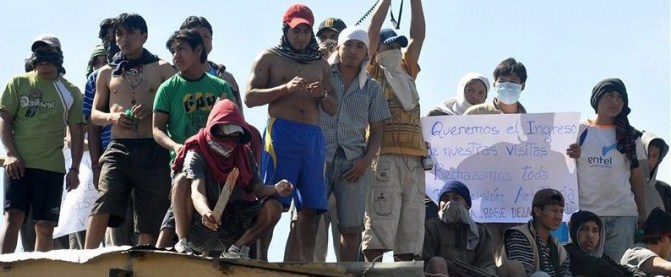
Mass riots in Bolivian jails began a year ago, calling for the resignation of Ramiro Llanos, the director of the penal system; demanding an end to delays of justice, “humane” treatment, and transportation to hearings. Foreign prisoners demanded to be sent to their countries of origin, and everyone demands an increase to the daily expenses that feed each individual [prediario]. Added to the protests is the unfulfilled agreement signed in February 2013 between the prisoners in San Pedro (La Paz) and the penal system, which brought a recess and a suspension of the riots, giving a period of three months for compliance with all of the agreed-upon points. Ramiro Llanos denied knowledge of this document, and to this day the prisoners’ demands have not been met.

The State plans to apply new rules on the penal system that fix harsher conditions for prisoners as well as visitors. They are ordering the systematic transfer of prisoners from San Pedro to other panopticon-style prisons far from the city of La Paz. They plan on not receiving new prisoners beginning on July 17th, and have announced the closure of this prison as a repressive measure against the constant protests that have arisen in the La Paz penitentiary. The riots are frequent, and the State intents to break them up through the transfer of prisoners to more distant jails. The transfer of the San Pedro inmates [that oftentimes live with their families on the inside] will cause more isolation due to the distance of the prisons where they are to be sent; this will mean that their families will have even more difficulty visiting them, since 80% of the prisoners and their families are poor.

Summary of the 2013 riots

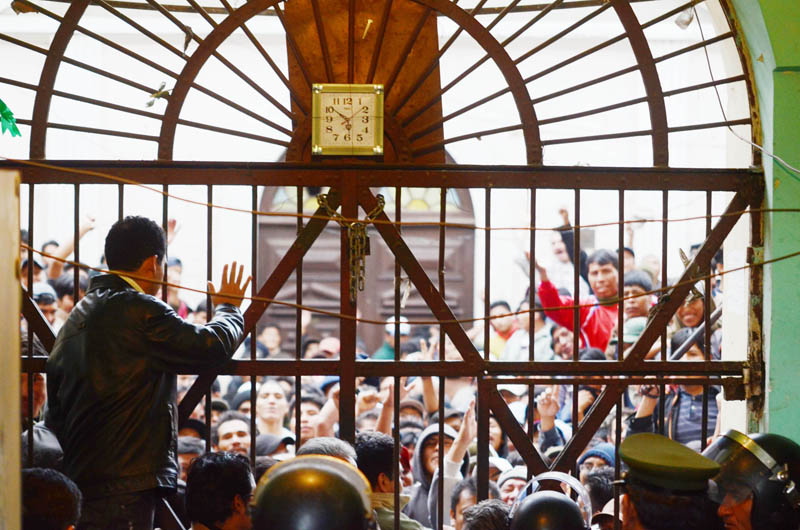
On January 17th Llanos (director of the penal system) was taken hostage by the prisoners in San Pedro as a response to the constant threats to move them to other prisons if they mobilize or make demands. The repressive forces confronted the prisoners to rescue him. Llanos saved himself thanks to a few prisoner delegates, who prevented him from being strung up. Protests were unleashed as prisoners resisted the plan for 39 minors from the Calahuma Center for Youth Rehabilitation to be transferred to San Pedro in La Paz. After that day, Llanos no longer had the guts to reenter that combative prison. During the whole month, the prison was in a state of mutiny and riot, with all nine sections taking over all of the jail buildings. Flames were seen on the roofs and yards.

On this latest 10th of June, prisoners in the territory began new uprisings and protests, condemning the fact that only four of every hundred preliminary injunction hearings take place, while the rest are suspended. The principal slogan was a call for the resignation of Llanos. The State’s intention is to close the San Pedro prison, sending the convicts to the “Chonchoro” maximum security prison, and those less than 25 years of age to the Calahuma Center for Youth Rehabilitation, and the preventive prisoners to jails in Patacamaya and Sica Sica, hundreds of kilometers from the city of La Paz, as a reprisal and punishment for the fact that this prison has been in a state of emergency since 2012, demanding the director’s resignation.

Beginning on June 24th, simultaneous protests were initiated in the jails of El Abra in the city of Cochabamba and San Pedro in the city of Oruro. They demanded that their water and electrical services not be cut, as the State had not paid the bills.

On June 26th, the reaction in the Chonchocoro maximum security prison did not wait long after the announcement that prisoners from San Pedro would be transferred there.

On July 2nd, the Chonchocoro and Calahuma prisons protested and announced that they would be in a state of alert, facing the possible transfer of inmates from another prison, which would cause overcrowding in both facilities.
We hope for unity and solidarity among prisoners in Bolivian territory, and that they don’t let the State divide them by “sectional negotiations” (turning one group against the other), as it has frequently done to end riots.

Poverty is punished with prison 

“Crime is not punished, but poverty is.”(Words of an elder in the San Pedro prison)

In the prisons here, the majority of the population is poor. Nevertheless, the wealthier can live more comfortably, because cash rules. The poor have to survive miserable conditions, sickness, and destitution. For example, in the jail of San Pedro in La Paz the maintenance of cells, infrastructure, recreational space, the kitchen, cleaning materials, medications, and other goods are self-directed by the prisoners themselves. The State has knowledge of this context, but in its insensitivity and contempt toward the poor, it forces them to pay for their stint in prison with their own resources.

It is the poor who feel the harsh impact of prison society, both those in the hands of a judge who will determine whether or not they go to jail, and the preventive prisoners who must show that they have an established family, a home, personal guarantors, or an economic guarantee or job. All of these factors diminish one’s ability to move to house arrest. Thus, the question is: Are all prisoners in an economic position to benefit from this? The permanence of a poor majority in prisons is continually perpetuated, and for them the penal system is even harsher, with scarce opportunities to get out. The maximum period of preventive detention is 36 months. In Bolivian prisons, there are preventive detainees who have been in for more than three years without being sentenced (in some cases five or eight years). This cruel setting causes intentional overcrowding in prisons, and ensures that they are filled with the poor. The State is going to implement one more condition for release into house arrest: If a prisoner wants to get out, they must buy an anklet with a GPS chip at a cost of $4,000. This will only benefit those who have the ability to pay the cost. For those without means, there is only the hope that one day they will be able to get out. There are many older prisoners, and many with medical conditions, who request a move to house arrest; with the pardon law passed on December 24th, 2012, very few walked free. There is no adequate medical care or efficient method for medical leave, even in cases of emergency treatment. While bureaucratic paperwork slows everything down, the result of this inefficiency is that individuals’ health continues to deteriorate, and in many cases prisoners die from lack of medication or medical attention. Additionally, after being imprisoned it is difficult to find a job with a prior criminal record. This is all permitted by the State’s indifference.

In the maximum security prison of Chonchocoro, located in Viacha, there is no potable water; they have only one well to provide their water, which is still not potable.

Life in prisons in Bolivia is determined by one’s economic status. The majority have to work at whatever they can to survive and pay for their housing, bed, blanket, medication, and other goods. Among prisoners, food and clothing is bought and sold, and everything is a commodity. Prison makes visible the misery of an authoritarian society that chooses who to protect and who to leave in the dungeon.


The complicity of Press and Power

The role of yellow, sensationalist journalism is to adjust “information” to state versions, causing prisoners to be seen with disdain, and causing a broader “societal” rejection for them.

To this day, the penal establishment has diverted attention in other directions thanks to collaborationist coverage from the Press. As well, they have claimed that there was a supposed child rape in San Pedro, and that there is a drug lab inside the La Paz prison; these facts were made up by Llanos, but were refuted by the prisoners.

The State has succeeded in minimizing and smearing the prison riots through yellow journalists, as well as the frequent threats to send the prisoner representatives to other prisons, as they have them identified. The servile role of the disinformation media packages all of this to create an unfavorable situation for the prisoners. In San Pedro, they agreed voluntarily to the removal of children older than 11, and on July 8th they met again with state representatives and agreed to include all children older than 6 years of age.

Repudiation of rapists

In the Palma Sola jail, in the city of Santa Cruz de La Sierra, it came out that minors had been sexually abused. These deeds are detestable, and we repudiate them. Lamentably, this happens not only in Bolivian prisons where children live, but also in schools, churches, shelters, and orphanages, while these same spaces are also prisons by other names. Ramiro Llanos, director of the penal system, used these detestable acts to generalize about all prisoners, and take advantage of “public opinion.” Among the San Pedro prisoners, a collective agreement to prohibit the entrance of inmates who had committed rape emerged as another means of struggle. From the posters that remain on the walls and door of the prison, they do not simply call for Llanos to resign, but call for the prison population to reject rapists.

The State’s well known repressive strategy is the division, infiltration, intimidation, and punishment to make an example of individuals; thus the government is able to weaken, divide, and break up movements through negotiations per prison section. The increase in conditions of control and surveillance in the penal system are part of the maintenance of bourgeois society. It is thought that prison is the solution for “citizen security” or to reduce “delinquency.” Through this paradigm the State’s only real intention is to protect privileges and maintain the interests of the rich. This background undeniably shows us, for example, that some steal to eat, while others infringe on the law in order to avoid complicity with the impositions of this decadent society. Prisons in Bolivia, as in the world as a whole, reflect this society on a small scale; they are small cities wherein the imperfections of the system we live in are made visible: There are the privileged, the poor, those who serve as snitches for the police or administrators of “justice.” There are drugs and alcohol in prisons because the same administrators and police want these small worlds to rot with vice and sicknesses. Thus, as Power secures the privileges of the State/Capital, it shows its disdain for the poor and those who struggle against it.

Anarchist solidarity is extended to those who suffer punishment, those who do not bend to norms, those who survive in any way they can while the powerful exploit and destroy the earth. This is a humble call to struggle for a different world than the one that they have imposed on us.

Fight against the State with all your strength; the constant wait for a generalized mass revolt is a truly utopian desire that only perpetuates, strengthens, and assures the enemy’s continued existence. Move to the offensive, conspire, act; there is no reason to wait for the masses to rise, or for the appropriate conditions. While we are waiting, authority, repression, surveillance, and punishment are extended ever stronger against the poor and those who have decided to take the offensive. Attack loving that which you dream and feel inside, and hating society’s penury.

We do not forget our comrades who are locked up in the hateful enemy’s dungeons. Neither do we forget those who have decided to flee, showing their rejections of state persecution in a society that is falling apart and needs prisons to keep us scared and allow itself to continue. To our comrades: our sincerest greetings, laden with anarchist complicity.

Towards a community of free association and informal organization, without prisons, State, or Capital.

Fire to the prisons, fire to authority, solidarity with the prisoners in Bolivian territory!

Sunday, August 11, 2013

Greece: 10,000 workers to be fired; riot at immigrant concentration camp

Two different news from Greece, not as unrelated as they may seem: they are both serious symptoms of a failed capitalist state.


Samaras will fire 10,000 state workers

The 9,820 public servants mentioned by Eleftherotypia include teachers, cleaners, police agents (surely not the Nazis!), social assistants, airport workers, health personnel and archaeologists. Eleftheros Tipos makes the figure reach 10,092.

The pact with Satan, I mean: the Troika (EC, ECB, IMF), signed by Samaras implies 25,000 public workers to be fired only this year, 60,000 for 2015. The total of redundancies will then amount to 150,000 workers.

Naturally workers did not remain quiet: several thousands gathered before the Ministry of Finance and marched to Parliament.

They denounced that these measures imply closure of hospitals and other services because they cannot be attended with so few workers as they will remain. 


Source: Webguerrillero[es] (incl. video).


Riot in Amygdaleza concentration camp

Upon knowing that the detention term for illegal immigrants has been extended to 18 months, the prisoners at Amygdaleza (Athens) rioted at lunch time. 

According to police reports they attacked the guards with rocks and set fire to mattresses. The uprising was only suffocated after midnight. 10 police agents were injured but police has not reported the number of injured immigrants. 

Source: Webguerrillero[es].

Monday, August 5, 2013

USA: first California hunger strike prisoner died on July 22nd

Billy 'Guero' Sell, 32, was found dead on July 22nd at his cell in Corcoran State Prison, California. According to other prisoners, he had been asking for medical attention since mid-July.

Officials of the California prison system initially claimed "suicide" but it does not seem to be the case at all, being instead the first casualty of the hunger strike against the arbitrary and fascist "snitch or rot in the hole" regime.

Source and more details: Uruknet.

Monday, July 29, 2013

Greece: immigrant dies after being neglected in concentration camp

The unbearable shame of concentration camps for immigrants in Europe has become even worse with a death caused by criminal neglect. 


Migrant from Afghanistan dies in Athens hospital after long-term neglect in the hands of the police

Mohammad Hassan, a migrant from Afghanistan, had been detained in the concentration camp of Corinth since September 2012. Despite the fact that he repeatedly complained about the pain he was suffering, his pleas were completely ignored and he received no medical help. Only on July 2, Mohammad was finally transferred to the Sismanogleio hospital in Athens. He died at the hospital on July 27. 

The doctors had diagnosed him with a respiratory infection, which would point at pneumonia or another similar infection.

Wednesday, July 10, 2013

USA: 30,000 prisoners join hunger strike in California!!!

This may be the more massive hunger strike ever. Some 30,000 inmates from  22 of the 33 California prisons have joined a hunger strike for their most basic rights.


The strike was initiated by the Pelican Bay prisoners, who suffer the worst conditions maybe in the whole North American federation. Of some 80,000 prisoners under isolation regime in the USA, at least 1000 are in that jail. In all California maybe 4500 inmates are being kept in the hole, often for many years, even decades! Some people in SHU (security housing units) regime have not seen sunlight in 20 years.

Other 6000 suffer some other variants of the isolation regime.

Most of the isolated inmates are being held hostage of arbitrary and inhumane prison rules:
By far the largest number of SHU inmates are accused of belonging to gangs, and can only be released from solitary by accusing other inmates of gang affiliation – a process that is euphemistically called “debriefing” – thus turning everyone into a potential snitch against everyone else.

Belonging to a gang can be "determined" by the simple fact of greeting someone else, believed to be a gang member. In other words: you cannot have normal relationships with the other prisoners, make friends or whatever on penalty of being thrown into the hole for years.

Only snitches and such scum are allowed some sort of normal life and possibility of parole.

Their core demands are:
  1. Eliminate Group Punishments
  2. Abolish the Debriefing Policy and Modify ‘Active/Inactive’ Gang Status Criteria
  3. Comply with Recommendations of U.S. Commission on Safety and Abuse in America’s Prisons (from 2006)
  4. Provide Adequate Food
  5. Provide Constructive Programs and Privileges for Indefinite SHU Inmates.


See also: yesterday's entry USA: prisoners in California begin hunger strike against "super-max isolation" regime and their PDF single issue newspaper with demands and all kind of explanations: Strike the Prisons.

Monday, July 8, 2013

USA: prisoners in California begin hunger strike against "super-max isolation" regime

Prisoners in California have begun today a hunger strike in protest against the extreme isolation regime to which they are subject, which amounts to torture.

They have published a single-issue newspaper named STRIKE THE PRISONS to make their situation and demands known, as well as relating their struggle to the many other popular fights that shatter the World these days.

Their demands:
  1. Eliminate Group Punishments
  2. Abolish the Debriefing Policy and Modify ‘Active/Inactive’ Gang Status Criteria
  3. Comply with Recommendations of U.S. Commission on Safety and Abuse in America’s Prisons (from 2006)
  4. Provide Adequate Food
  5. Provide Constructive Programs and Privileges for Indefinite SHU Inmates.


Opening article:

CALIFORNIA’S SOLITARY CONFINEMENT POLICY IS A ‘HUMAN RIGHTS DISASTER’

In 2011, thousands of California state prisoners engaged in a hunger strike to end long term solitary confinement and to demand changes to the way that prisoners are assigned to these torturous units, known as SHUs (security housing units). The corrections department (CDCR) agreed to make changes, which it rolled out in November, 2012. CDCR’s public relations strategy is to persuade lawmakers, judges and the general public that its new program is a vast improvement. However, the new program keeps most of the objectionable elements of the old program and adds some new elements which make it even worse.

The Step Down Program: Under the old rules, the only way to get out of the SHU was to “parole, snitch or die”, or be found “inactive” as a gang member or associate (a rare finding). The new policy offers a new way out: the Step Down Program, a 4 step program which takes a minimum of three or four years. The first 2-3 years are spent in solitary confinement, with no education or other programming. The prisoner is required to demonstrate “progress” by, among other things, filling out workbooks showing changed attitudes. The one workbook we have seen is condescending and judgmental. Lifetime solitary confinement remains possible.

Coerced secret evidence: The hated “debriefing” program remains live and well. SHU prisoners can get out of the SHU by confessing his/her own gang involvement and identifying other prisoners’ gang involvement. This information is used to place other prisoners in the SHU or retain them there. Targeted prisoners are not entitled to know who has named them, or the specifics of the accusation. It is almost impossible to defend oneself against secret charges.

Guilt by association: Under the old policies, prisoners were assigned a six year SHU term for simply being affiliated (as a member or associate) with a prison gang. The prisoner did not have to break any prison rule. Prisoners were validated for possessing art work or political readings, signing a greeting card, exercising with other prisoners or saying hello to another prisoner. Under the new rules, this same evidence can be used to prove a prisoner is a member, and membership alone justifies a SHU term.

New disciplinary program: Under the old rules, possessing certain artwork or literature was used as evidence of gang association. Prisoners and advocates objected, saying that SHU placement should only be for gang behavior. CDCR’s responded in its new program by labeling such evidence as gang “behavior” in its new rules. Guards can now cite prisoners for rules violations for possessing these items and punishment can be imposed.

Widening the net: Under the old policies, a prisoner could be placed in the SHU for affiliation with any of seven prison gangs. Under the new rules, any grouping of three or more prisoners can be added to the list as a “security threat group”, membership in which can result in a SHU term. The expansion of the SHU-eligible population is of grave concern.

Rubber-stamping: Although CDCR has inserted a new stage of review for SHU placements, this review is still within the confines of the prison system, where the dominant culture is to rubber-stamp the gang unit’s decisions. CDCR has not changed its culture. Independent oversight is necessary to curtail CDCR’s excesses.

Re-evaluations of current SHU prisoners: As part of the resolution of the 2011 hunger strikes, CDCR agreed to re-evaluate the SHU placement of current SHU prisoners, using its new criteria. CDCR is reviewing associates first and reports that over half of its initial reviews are resulting in assignments to general population. This reclassification is a huge victory and is proof of the unfairness of the old SHU policies, but is no proof of fairness of the new policies.

stoptortureca.org


Source: Kasama.

Basque Country: San Fermin parade march under the demand of the People to oust the government

The San Fermin institutional parade that every day officially opens the fiestas has found itself drowned by the massive popular demand for the extremely corrupt and illegitimate government to resign. While the authorities marched under heavy police protection, the crowds chanted: "UPN kanpora!" (UPN out!). 

The Navarrese People's Union (UPN) is a "regionalist" party tightly allied with the Spanish Nationalist Right (PP) and is not just extremely opposed to the recovery of the Basque identity, language and culture of Navarre, never mind joining the other Southern Basque regions politically, but also has demonstrated in the last years to be one of the worst institutional looters of Europe, being so extremely and blatantly corrupt that they will no doubt lose the government for the first time in decades as soon as there are free elections. 

Video of the parade:


Source: Ateak Ireki[es].


Txupin for prisoners get harassed by police

A group of Navarrese citizens also wanted to make the fiestas reach, even if just symbolically, to the prison. Therefore they launched their own alternative txupin (sound firework) near the prison (photo) and organized a lunch.

A van of the Spanish National Police showed up, forcing the identification of the activists with very aggressive attitude, while from prison it could be heard the protests against the cops: "assassins", "antiterrorist law for them", "son of a bitch"...

When the activists were already leaving, some police agents used their batons against them. 

Source: Ateak Ireki[es].

Sunday, June 2, 2013

Guantanamo: hunger strike continues, prisoners threatened

Some 103 (the vast majority) of prisoners in US-controlled Guantanamo concentration camp continue on hunger strike in demand of their human rights (what essentially means their immediate release or fair trial). Nothing has changed since Obama made a brief empty speech on the matter last week, rejecting to make use of his presidential super-powers to order the immediate closure of the infamous prison.

If anything for the worse. 36 strikers are being force-fed, while intimidation happens daily in an attempt to curtail access to attorneys (the only lifeline these people have with the World). 

Source: Webguerrillero[es] (link 1, link 2).


Thursday, May 30, 2013

Greece: persistent unrest in prisons: mutinies, escapes, hunger strikes

A recent communication synthesizes the situation of chaos at Greek prisons. Just in the last few months all the following happened:

February 9th 2013: prisoners of the Detention Centre in Orestiada break out in revolt

February 20th: attempt of revolt in Koridallos prison

February 24th: escape attempt with helicopter by a prisoner in Trikala prison

March 5th: hunger strike in Rhodes jail

March 5th: revolt in Nafplio prison

March 6th: mutiny of prisoners in Patra prison

March 7th: mutiny in Grevena prison

March 11th: seven prisoners escape from the jail of Feres, Evros

March 17th: five prison guards held hostages in Malandrinos prison

March 19th: escape from Agrinio prison

March 22nd: escape from Trikala prison

March 24th: mutiny in Larisa and Patra prisons

March 30th: mutiny of the prisoners of the first ward in Koridallos prison

April 3rd: mutiny in Koridallos female prisons

[No date] Letter of Anarchist Prisoners’ Initiative about the EKAM raids in cells

April 22nd: prisoners’ abstention from mess [meal] in Larisa prison

April 29th: 580 prisoners on hunger strike in Larisa prison

Source and full communication: From the Greek Streets.

Wednesday, May 29, 2013

Basque political prisoners on hunger strike after abuses from French guards

Basque political prisoners Itziar Moreno (Bilbao) and Ohiana Garmendia (Santurzti), imprisoned at Muret Seysses prison (Dijon), began a hunger strike two days ago (May 27) to denounce the abuses suffered at the hands of French prison guards, one of which pushed and threw Moreno to the ground arbitrarily and later punished her with punishment cell (isolation). 

Yesterday she was denied toilet paper and, upon her protest, sent again to isolation. These kinds of abuses seem to be increasing in the Burgundian jail. 

Solidarity protest today in Bilbao
Source: Bilboko Branka[eu].

Monday, May 27, 2013

Netherlands: immigrants in hunger and thirst strike


Since May 1st, 2013 more than a hundred prisoners in migrant detention centers throughout the Netherlands have gone on hunger and thirst strike. Some have already been broken by intimidation and isolation, but some, such as Nessar, who is on hunger and thirst strike in Rotterdam, are still on strike at the time of writing (the 13th of May). Since he is a spokesperson for the strikers, he was placed in isolation a few days ago. They are waking him up every hour, refusing to allow independent doctors visits, and since his kidneys are failing, he was brought yesterday, against his will, to the penitentiary hospital.

Solidarity with the migrants in hunger strike

These strikes have only become known due to the solidarity demo’s that took place in several migrant prisons on the 5th of May. The recent hunger strikes deserve our full solidarity, as a desperate call for dignity and freedom. In the Netherlands thousands of people are locked up simply for being ‘illegal’. The ones who decide to take these ‘measures’, the ones who make laws to which everyone must bend, are the ones profiting from control and repression.

Wednesday, May 8, 2013

USA: 100,000 people in solitary confinement every single day - new prisoner hunger strike in California

The USA is not only the state with more people in prison but also the one with more people submitted to cruel and unusual punishments like solitary confinement. Don't tell me about gulags anymore please...


The total U.S. prison inmate population held in solitary confinement on any given day exceeds 100,000 – “the equivalent of locking up every man, woman and child in Charleston, South Carolina, in their own little 8 by 12 foot box – for an eternity.” Prisoners in solitary at California’s Pelican Bay may once again go on hunger strike, July 8. They need support from the outside.

Another prison hunger strike is looming in California, where more than 200 inmates at the Pelican Bay supermax have been in solitary confinement for between five and ten years and nearly 100 have been shut off from most human contact for 20 years or more. Across the nation, on any given day, more than 100,000 inmates suffer in solitary – about 25,000 in the federal system and another 80,000 or so in state facilities. That’s the equivalent of locking up every man, woman and child in Charleston, South Carolina, in their own little 8 by 12 foot box – for an eternity. Nothing like this American form of mass human torment has ever existed on the face of the earth: systematic, industrial strength torture, multiplied 100,000 times per day. Solitary confinement as a form of routine, mass punishment is beyond barbarity. Nowhere in human history do we find barbarians who tortured hundreds of thousands of people every day for decades at a time. Only in America.

Solitary confinement, by its very nature, is designed to ensure that no one but the torturers hears the cries of the tormented. However, knowledge of such monstrous evil compels decent men and women to action, in solidarity with those who have been wronged. The prisoners of Pelican Bay, who went on hunger strike in 2011, have sent word that they will do so again, on July 8, if the state of California does not meet their core demands. One demand is fundamental: that inmates not be confined to solitary unless they have been charged, “and found guilty of, committing a serious offense… a felony!”

... continue reading at BAR.