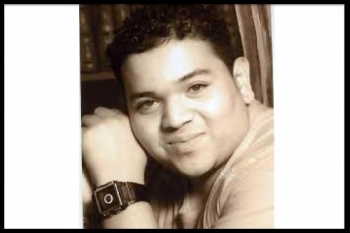
Showing posts with label torture. Show all posts

Monday, September 9, 2013

Basque prisoner in hunger strike against deportation to Spain, where he may face torture

Basque prisoner Ibai Sueskun (pictured) is in hunger strike since September 1st against his forced deportation to Spain, where he fears he could be arbitrarily arrested and tortured, even after having completed his 10-year sentence for membership in ETA. 

Sueskun is natural of Larraga (Navarre) but resident in Donibane (Northern Basque Country, under French administration) and is now at the Prison of Tarascon.

Source: Ateak Ireki[es].

Wednesday, July 31, 2013

Chile: torturer physicians' list is made public

A list with the names of 36 physicians who tortured political prisoners under Pinochet's Fascist-Thatcherist regime has come to light. Many of them still exert their profession freely. 

The full list is available in Spanish language at WPChile and Webguerrillero.

Wednesday, July 24, 2013

Greece: police raid in Patras in support of the Nazis - trotures reported while under arrest

From From the Greek Streets:

Patras: anti-fascists clash with the fascists of Golden Dawn; police detain 25 anti-fascists in retaliation

On the evening of July 24, local Golden Dawn members had called for and attempted to hold a gathering at the square outside stadium of Panahaiki (a local football team). Just prior to the gathering, approximately 50 anti-fascists were pushed back by the riot police guarding the square on behalf of the Golden Dawn nazis.

Later on, at approximately 11pm, car with GD members drove past Olgas square, a popular anarchist/anti-fascist hang-out. It was swiftly attacked by the anti-fascists and members of the police’s DELTA squad attacked them in retaliation. 

Approximately 25 anti-fascists were detained by the police and some were subsequently tortured at the police HQ. At least two anti-fascists who had been seriously injured had request to see a doctor rejected for hours.

At approximately 02:40, all 25 anti-fascists were finally released.

Monday, July 8, 2013

USA: prisoners in California begin hunger strike against "super-max isolation" regime

Prisoners in California have begun today a hunger strike in protest against the extreme isolation regime to which they are subject, which amounts to torture.

They have published a single-issue newspaper named STRIKE THE PRISONS to make their situation and demands known, as well as relating their struggle to the many other popular fights that shatter the World these days.

Their demands:
  1. Eliminate Group Punishments
  2. Abolish the Debriefing Policy and Modify ‘Active/Inactive’ Gang Status Criteria
  3. Comply with Recommendations of U.S. Commission on Safety and Abuse in America’s Prisons (from 2006)
  4. Provide Adequate Food
  5. Provide Constructive Programs and Privileges for Indefinite SHU Inmates.


Opening article:

CALIFORNIA’S SOLITARY CONFINEMENT POLICY IS A ‘HUMAN RIGHTS DISASTER’

In 2011, thousands of California state prisoners engaged in a hunger strike to end long term solitary confinement and to demand changes to the way that prisoners are assigned to these torturous units, known as SHUs (security housing units). The corrections department (CDCR) agreed to make changes, which it rolled out in November, 2012. CDCR’s public relations strategy is to persuade lawmakers, judges and the general public that its new program is a vast improvement. However, the new program keeps most of the objectionable elements of the old program and adds some new elements which make it even worse.

The Step Down Program: Under the old rules, the only way to get out of the SHU was to “parole, snitch or die”, or be found “inactive” as a gang member or associate (a rare finding). The new policy offers a new way out: the Step Down Program, a 4 step program which takes a minimum of three or four years. The first 2-3 years are spent in solitary confinement, with no education or other programming. The prisoner is required to demonstrate “progress” by, among other things, filling out workbooks showing changed attitudes. The one workbook we have seen is condescending and judgmental. Lifetime solitary confinement remains possible.

Coerced secret evidence: The hated “debriefing” program remains live and well. SHU prisoners can get out of the SHU by confessing his/her own gang involvement and identifying other prisoners’ gang involvement. This information is used to place other prisoners in the SHU or retain them there. Targeted prisoners are not entitled to know who has named them, or the specifics of the accusation. It is almost impossible to defend oneself against secret charges.

Guilt by association: Under the old policies, prisoners were assigned a six year SHU term for simply being affiliated (as a member or associate) with a prison gang. The prisoner did not have to break any prison rule. Prisoners were validated for possessing art work or political readings, signing a greeting card, exercising with other prisoners or saying hello to another prisoner. Under the new rules, this same evidence can be used to prove a prisoner is a member, and membership alone justifies a SHU term.

New disciplinary program: Under the old rules, possessing certain artwork or literature was used as evidence of gang association. Prisoners and advocates objected, saying that SHU placement should only be for gang behavior. CDCR’s responded in its new program by labeling such evidence as gang “behavior” in its new rules. Guards can now cite prisoners for rules violations for possessing these items and punishment can be imposed.

Widening the net: Under the old policies, a prisoner could be placed in the SHU for affiliation with any of seven prison gangs. Under the new rules, any grouping of three or more prisoners can be added to the list as a “security threat group”, membership in which can result in a SHU term. The expansion of the SHU-eligible population is of grave concern.

Rubber-stamping: Although CDCR has inserted a new stage of review for SHU placements, this review is still within the confines of the prison system, where the dominant culture is to rubber-stamp the gang unit’s decisions. CDCR has not changed its culture. Independent oversight is necessary to curtail CDCR’s excesses.

Re-evaluations of current SHU prisoners: As part of the resolution of the 2011 hunger strikes, CDCR agreed to re-evaluate the SHU placement of current SHU prisoners, using its new criteria. CDCR is reviewing associates first and reports that over half of its initial reviews are resulting in assignments to general population. This reclassification is a huge victory and is proof of the unfairness of the old SHU policies, but is no proof of fairness of the new policies.

stoptortureca.org


Source: Kasama.

Saturday, July 6, 2013

Torture in the Basque Country

From Borroka Garaia Da! (English and Spanish original, videos subtitled in English):

Torturas. Torture in the Basque Country


10.000 basques  has been tortured in the Spanish state for the past 50 years. 40.000 politically-related arrested Basques over 53 years an more than 30.000 were not later charged.

That in a country of barely three million people some ten thousand cases of torture have been documented is an indicator of the brutality that has characterized the state in their repression of the Basque independence movement, and the fact that the cases have maintained throughout time an example that the this repression hasn’t changed with regimes or governments. Torture has always been understood by Madrid as one more tool in their policy towards this people.

An example that torture has been a strategy of the state against the Basque Country is to realize that there have only been 19 convictions condemning torture. Altogether, no more than 62 agents of the state’s security forces have been condemned for torturing Basque citizens. And what is even more shameful, more than half of those condemned, a total of 36 have been pardoned by the governments of the PP or the PSOE.

—————


http://www.youtube.com/watch?v=kOlrOwf_O5g


http://www.youtube.com/watch?v=r_iaxiJ_QAM


http://www.youtube.com/watch?v=KGLi0ii9Jfs


http://www.youtube.com/watch?v=-3Ra9UAGzC8

Spanish High Court judge Baltasar Garzón complied with the protocol regarding the people held under arrest after the police operation executed in Biscay in July 2008, and, in theory, the Guardia Civil (a Spanish police force) adopted several due procedures concerning those under arrest; meanwhile, the Guardia Civil video-recorded the arrest. During the oral trial some images taken in the cells were shown: the arrested people along with the policemen can be seen to and fro the corridors of the jail — Arkaitz Goikoetxea, Iñigo Gutierrez, Maialen Zuazo and Anabel Prieto-

The documentary gathers together the statements made by those tortured under police arrest by the police, the assessments of lawyers and experts, and the images shown in the trial. The work is made in Spanish with Basque, French and English subtitles.

——–

120 hours. Torture against the Basque Country


http://www.youtube.com/watch?v=l0dk3vvILUc#at=2104

English subtitles

Eguzki bideoak

“120 horas, la tortura contra Euskal Herria”; un documental que trata de explicar los recobecos de la tortura y su uso en la actualidad. Este método con el que sonsacar información o con el que forzar a admitir una información que puede o no ser cierta, ha sido aplicada de manera sistemática a muchas de las personas detenidas que participaban en el movimiento social de euskal herria.
A través de entrevistas a personas que han sufrido esta práctica ruin y otras que han analizado con detenimiento esta realidad, como abogadas, médicas y activistas especializadas conoceremos por qué todavía es posible que la tortura se aplique, considerando que nos encontramos en un supuesto sistema democrático donde se preservan los derechos civiles y humanos, y cuáles podrían ser los mecanismos para erradicar esta realidad que los vulnera de manera radical.

————

TORTURE AGAINST THE BASQUES


———–.


————

Saturday, June 22, 2013

Spanish actor Willy Toledo moves to Cuba and speaks out again

Guillermo "Willy" Toledo has won several prizes but he is best known maybe for his compromise with popular struggles in Spain and abroad alike, as well as his blunt honesty. Recently he announced he is moving to Cuba because he feels the need to be in direct contact with the lively dynamics of Latin America. Digital Newspaper Webguerrillero reproduces today an interview[es] with him, of which I translate some small fragments:

They have always told me: "if you like Cuba so much, why don't you move there". Well, I am already in Cuba... I imagine now the chief editors and the lackeys of their masters in the newspapers' redactions squeezing their brains to see how they could discredit me and all they could muster was that one: to publish a photo of a mansion with butlers, chaffeur and swimming pool... and all the fantasized privileges that the Cuban state gives those who defend it... well, it is radical and absolutely false. 

...

I am aware that I have been vetoed [in Spain, because of his compromise with Cuba] for various jobs in TV and cinema. What dimension does this have? I can't say because, excepting all these cases that I know for sure, I will never get to know if they said: "don't give this job to Willy Toledo". I am persuaded that this happens, exactly the same that there are dozens or even hundreds of political prisoners in my country just for expressing their opinions, just for being activists of the Left, of the Revolutionary Left especially, be it in the Basque Country, in Madrid, in Andalusia, in Catalonia wherever... Recently some Catalan Anarchists were arrested just for expressing their opinions in Facebook; that is the democratic state we live in. I am, I have always been very conscious of the consequences that being active in the Left, or the "extreme left" as they say, may carry.

... I keep an eye in Spain and when they need me I will be back there. When everything explodes, because it will explode, there will be a social uprising and there will be a true frontal opposition in the streets against the criminal government ruling in the Spanish state, I will be the first one to join. 

... would not I be a well-known actor I would probably be in jail right now, in prison in Spain; that is the sensation I have, they have tried it a couple of times but I think they calculated that having me in prison is not in their interest... by the moment, because there are many young men and women in jail who never had the media repercussion that there was the two times I was arrested.

Note: he was arrested once at a protest in the Spanish Congress in solidarity against the Moroccan massacre of the Peace and Dignity Camp of Gdeim Izik, West Sahara. Then he was also arrested when participating in a General Strike picket, suffering, as many others, false accusations. 

In the case of the General Strike many comrades who were arrested that very same night were kept prisoners for months in the jails of the Spanish state where - according to the European Union, the United Nations, Amnesty International, Human Rights Watch and local anti-torture groups - still today, in the year 2013, prisoners are brutally tortured in police stations and prisons, something that never happened in Cuba. 

Friday, June 14, 2013

Basque official report on the victims during the guerrilla war

Fascist mercenaries at the Montejurra massacre
The semi-autonomous Western Basque Government has issued a report[es] that attempts to quantify the numbers and typology of the victims in the period of the guerrilla war from 1960 to 2013. 

Actually ETA was only active in armed form from 1968 and officially declared the end to armed struggle in 2011. Guerrilla war and state repression should be quantified, in my understanding since 1936, when the fascist coup ignited the fire of popular armed resistance, which existed since then in many forms (grouped in the catch-all term maquis, inherited from the French Resistance), some of them with clear independentist undertones. 

The report also seems somewhat biased in favor of certain kind of victims, not counting, for example, deaths in prison or those killed or mutilated in car accidents when traveling to far away prisons to visit their relatives or friends. People in prison for political reasons, with or without sentence, should be accounted and in most cases are not. The report mentions once and again the various associations of "victims of terrorism" but never any association against torture, for the rights of prisoners, etc. Those killed in police operations against armed groups, such as the Pasaia Massacre, don't seem to be accounted for either. It is not clear if the reports of police violence include those by French agents (surely not).

Fascist PM Carrero Blanco was killed by ETA(m)
In any case, the report accounts for the following figures for the 1960-1978 period:
  • 136 killed by ETA, Autonomous Anti-Capitalist Commandos (CCAA) and other anti-system groups. In detail:
    • ETA (prior to schism): 18
    • ETA (militar): 89
    • ETA (political-militar): 9 (2 in kidnappings)
    • CCAA: 4
    • Iberian Directorate for Liberation (DRIL): 1
    • Others: 2
    • Not sufficiently clear: 13 (2 in kidnappings).
  • 87 killed by the Spanish police (74), death squads (13) or death penalty. In detail:
    • Police abuses, confusion and other causes: 23
    • Police violence in demonstrations: 22
    • In road controls: 19
    • In police custody: 5
    • By out-of-service agents: 5
    • By the Basque-Spanish Battalion (BVE): 3
    • By the Apostolic Anti-Communist Alliance (Triple A): 2
    • By fascist violence against demonstrators: 3
    • By execution after military trial: 2 (the famous Txiki and Otaegi, 10 others were sentenced to death but never actually killed).
  • Other anti-system violence:
    • 236 seriously injured in attacks (230 by ETA in its various forms).
    • 14 people kidnapped and later released (3 after being shot to the knee).
    • 8 attacks against media.
    • An undetermined number of police agents injured in demonstrations.
    • Some 3600 major attacks (by organized groups) in this and the following period.
    • Some 4500 minor attacks (in the so called "street fight") in this and the following period.
  • Other state violence:
    • 422 injured by police violence in demonstrations. 
    • 355 death squad arson attacks and death threats.
    • 238 subject to military trials.
    • 103 terror attacks by death squads (not including kidnappings).
    • 32 journalist brought to trial or otherwise jailed.
    • 22 injured in road controls.
    • 22 death squad attacks against demonstrations.
    • 13 hospitalized after arrest.
    • 11 death squad attacks against media.
    • 9 kidnappings with violence and torture by death squads.
    • 6 injured by out-of-service police agents.
    • An undetermined number of arbitrary arrests, preventive prison, etc.
    • An undetermined number of media closures, censorship and prohibitions.
    • Not researched but mentioned: abuses and torture against prisoners.
  • Unclear: 4 people missing.

Not accounted for? (Pasaia 1984)
In the 1979-2013 period:
  • 703 killed by anti-system groups:
    • In attacks by ETA(m): 644 
    • In attacks by the CCAA: 38
    • In attacks by ETA(pm): 12
    • In attacks by Iparretarrak (IK): 3
    • In attacks by Iraultza: 1 (but a member of Iraultza, which never targeted people).
    • In kidnappings by ETA(m): 8
    • In kidnappings by ETA(pm): 2
    • In kidnappings by the CCAA: 2
    • In kidnappings by ETA-VIII: 1
    • In "street fight" actions: 3
    • Itsasondo man who got tired of police persecution and killed two with a hunting rifle (later run away and joined ETA): 2. 
    • Not clarified: 314 (figure by FVT, highly suspect, not added to total).
  • Some 126 killed by the state and satellite groups:
    • In attacks by the Anti-Terrorist Liberation Groups (GAL): 24
    • By police (abuse, confusion or other causes): 18
    • In attacks by the Basque-Spanish Battalion (BVE): 14
    • In police custody: 12
    • By out-of-service police agents: 12
    • In road controls: 11
    • By police violence in demonstrations: 10
    • In attacks by the Spanish Anti-Terrorist Groups (GAE): 7
    • In attacks by the Triple A: 3
    • By death squad attacks against demonstrations: 3
    • In prison: 2 (only?)
    • Women raped and killed by the BVE: 2
    • Other death squad kidnappings with murder: 2
    • Missing people whose corpses were found: 2
    • In attacks by "Antiterrorismo ETA" (ATE): 1
    • Deaths by death squads never clarified: at least 3. Most cases were never investigated properly anyhow.
  • Other anti-system violence:
    • Injured in attacks: figures vary: from 2068 to 16,000.
    • Kidnapped and released: 
      • ETA(pm): 24 (11 after being shot to the knee)
      • ETA(m): 17
      • ETA-VIII: 5
      • ETA (prior to schism): 3
      • CCAA: 3
      • ETA-VII: 1
      • Not clarified: 8 (these may be mafia violence in fact)
    • Attacks against media: 32
    • Major arson attacks (by armed groups): some 3600 (both periods)
    • Minor arson attacks (by the so-called "street violence"): some 4500 (both periods)
  • Other state violence:
    • Torture: maybe as many as 10,000 victims, some 5500 public denounces.
      • Hospitalized after police arrest: 124
      • Only 62 agents (who tortured 31 victims) were declared guilty of tortures, 27 of them were later pardoned by the government.
    • Injured in road controls: 30
    • Injured by police (confusion, abuses and other causes): 39
    • Injured by out-of-service police agents: 13
    • Injured by police in demonstrations: 222 (only?)
    • Undue closure of media: 2 (Egin newspaper and radio, Egunkaria)
    • Violations of human rights in prison: not researched (lots!)
    • Injured in death squad attacks: 232
    • Injured by death squads in demonstrations: 10
    • Women raped by death squads: 13
    • Kidnappings with intimidation and torture: 49
    • Arson attacks and death threats by death squads: 633 (10 against media)
  • Not clarified: 2 missing people and another unspecified case.

While I do not necessarily subscribe the data produced in this report (too many blanks and question marks), it is clear that it serves as partial reference for historians and political debate.

Saturday, June 8, 2013

Bahrain: tortured prisoner sent to isolation instead of hospital

It would seem that the current "fashion" of extra-judiciary killings has become now to make people die in prison.

From BCHR:
The Bahrain Center for Human Rights (BHRC) is gravely concerned for the health and wellbeing of Ali Abdullah Al-Singace, who is still subjected to torture, denied access to adequate medical care, and has been in solitary confinement for the last ten days.

Ali Al-Singace is a 20 year-old Bahraini who was initially sentenced to death by a military court during the imposed State of National Emergency in 2011; his conviction for allegedly running over a policeman on 16 MAR 2011 was later reduced to a life sentence. Ali was not given a fair trial, and his conviction remained in place despite the fact that the lawyers had presented evidence that Ali had a broken leg during the time of his alleged crime. For more background information on the case, please refer to: http://bahrainrights.hopto.org/en/node/3983.

Since the day of his arrest on the 23rd of March 2011 until now, Ali has been subjected to different kinds of physical, sexual and sociological torture. He was stripped of his clothes and brutally beaten with sharp weapons, metal rods and wooden sticks on different parts of his body, causing him to suffer from sever back and heart pains. He was also threatened with rape and death, and has lost some of his teeth after he was beaten in the face. 

Tuesday, June 4, 2013

Turkey: 72 hrs general strike called beginning today, clashes continue

Police shoots gas bombs into a home
The three major unions, Türk-Is, Hak-Is y DISK, have got together and called for a general strike of three days, beginning today. While the formal pretext is solidarity with TEKEL (a major public company in process of privatization) nobody ignore that the real reasons are much wider and that the core of the struggle is political: to remove Erdogan from office and end with repression and reactionary neo-islamization.

The clashes have continued with epicenter in the Ankaran district of Beksitas, where the government headquarters are located, but also in popular neighborhoods. Repression has been brutal again.

This man lost his eye when hit by a rubber bullet


Video (RT): street battles in Ankara

Communist banners in a protest
One of the main focus of institutional repression has been the Communist Party (TPK), whose offices were assaulted by police with no contempt. 

In one of the street battles, citizens found an old AK-47 rifle inside one of the police cars, raising speculations that they may have been planning yet another false flag attack (typical of Turkish "deep state"). 

The injured by institutional repression are so many that camp hospitals have been placed in many cities and towns. Hospitals cannot just cope anymore. The number of arrested is also immense and there are serious fears that they are being tortured in police stations.

The struggle continues, Erdogan will fall.

Source: Webguerrillero[es] (link1, link 2, link 3, link 4, link 5, link 6).

See also: What is happening in Istanbul (an open letter to the World by blogger Sumandef Hakkında).

Wednesday, May 8, 2013

USA: 100,000 people in solitary confinement every single day - new prisoner hunger strike in California

The USA is not only the state with more people in prison but also the one with more people submitted to cruel and unusual punishments like solitary confinement. Don't tell me about gulags anymore please...


The total U.S. prison inmate population held in solitary confinement on any given day exceeds 100,000 – “the equivalent of locking up every man, woman and child in Charleston, South Carolina, in their own little 8 by 12 foot box – for an eternity.” Prisoners in solitary at California’s Pelican Bay may once again go on hunger strike, July 8. They need support from the outside.

Another prison hunger strike is looming in California, where more than 200 inmates at the Pelican Bay supermax have been in solitary confinement for between five and ten years and nearly 100 have been shut off from most human contact for 20 years or more. Across the nation, on any given day, more than 100,000 inmates suffer in solitary – about 25,000 in the federal system and another 80,000 or so in state facilities. That’s the equivalent of locking up every man, woman and child in Charleston, South Carolina, in their own little 8 by 12 foot box – for an eternity. Nothing like this American form of mass human torment has ever existed on the face of the earth: systematic, industrial strength torture, multiplied 100,000 times per day. Solitary confinement as a form of routine, mass punishment is beyond barbarity. Nowhere in human history do we find barbarians who tortured hundreds of thousands of people every day for decades at a time. Only in America.

Solitary confinement, by its very nature, is designed to ensure that no one but the torturers hears the cries of the tormented. However, knowledge of such monstrous evil compels decent men and women to action, in solidarity with those who have been wronged. The prisoners of Pelican Bay, who went on hunger strike in 2011, have sent word that they will do so again, on July 8, if the state of California does not meet their core demands. One demand is fundamental: that inmates not be confined to solitary unless they have been charged, “and found guilty of, committing a serious offense… a felony!”

... continue reading at BAR.

Monday, May 6, 2013

Hunger strike to death in Guantanamo concentration and torture camp continues unabated

From The Independent:

Emaciated and frail, more than 100 men lie on concrete floors of freezing, solitary cells in Guantánamo, silently starving themselves to death.


Stripped of all possessions, even basics such as a sleeping mat or soap, they lie listlessly as guards periodically bang on the steel doors and shout at them to move an arm or leg to prove they are still conscious.

The notorious detention centre is in crisis, suffering a rebellion of unprecedented scale, with most of the camp on lockdown and around two-thirds of the 166 detainees on hunger strike.

This week 40 American military nurses were drafted in to try to stem a mass suicide. The last Brit inside, Shaker Aamer, has said he is prepared to strike to his death.

The US administration does its best to keep prying eyes from the unfolding tragedy but the The Independent has obtained first-hand reports.

Twice a day, the 23 most weak are taken into a room. Their wrists, arms, stomach, legs and head are strapped to a chair and repeated attempts are made to force a tube down their noses into their stomachs. It is an ugly procedure as they gag and wretch, blood dripping from their nostrils. “They won’t let us live in peace and now they won’t let us die in peace,” said detainee, Fayiz Al-Kandari, a Kuwaiti held for 11 years without charge.

Four are so ill that they lie in shackles in the hospital wing and insiders predict it is only a matter of time before one perishes.

“It is possible that I may die in here,” said Mr Aamer, 44, through his lawyer, Clive Stafford Smith, recently. “I hope not, but if I do die, please tell my children that I loved them above all else, but that I had to stand up for the principle that they cannot just keep holding people without a trial, especially when they have been cleared for release,” said the father of four, who remains in Camp 5 despite being approved for release more than five years ago. “Sad to say, torture and abuse continue in Guantánamo Bay and the US is throwing away yet more of its dwindling moral authority,” added Mr Stafford Smith.

The protest, which began on 6 February, has now spread through Camp 6 and Camp 5 with an estimated 100 to 130 taking part. These are not the high value detainees kept in Camp 7, the handful charged with terror offences. The hunger strikers are those who have waited a decade or more without trial, including 86 cleared for release but remain trapped because of restrictions imposed by Congress.

... continue reading at The Independent.